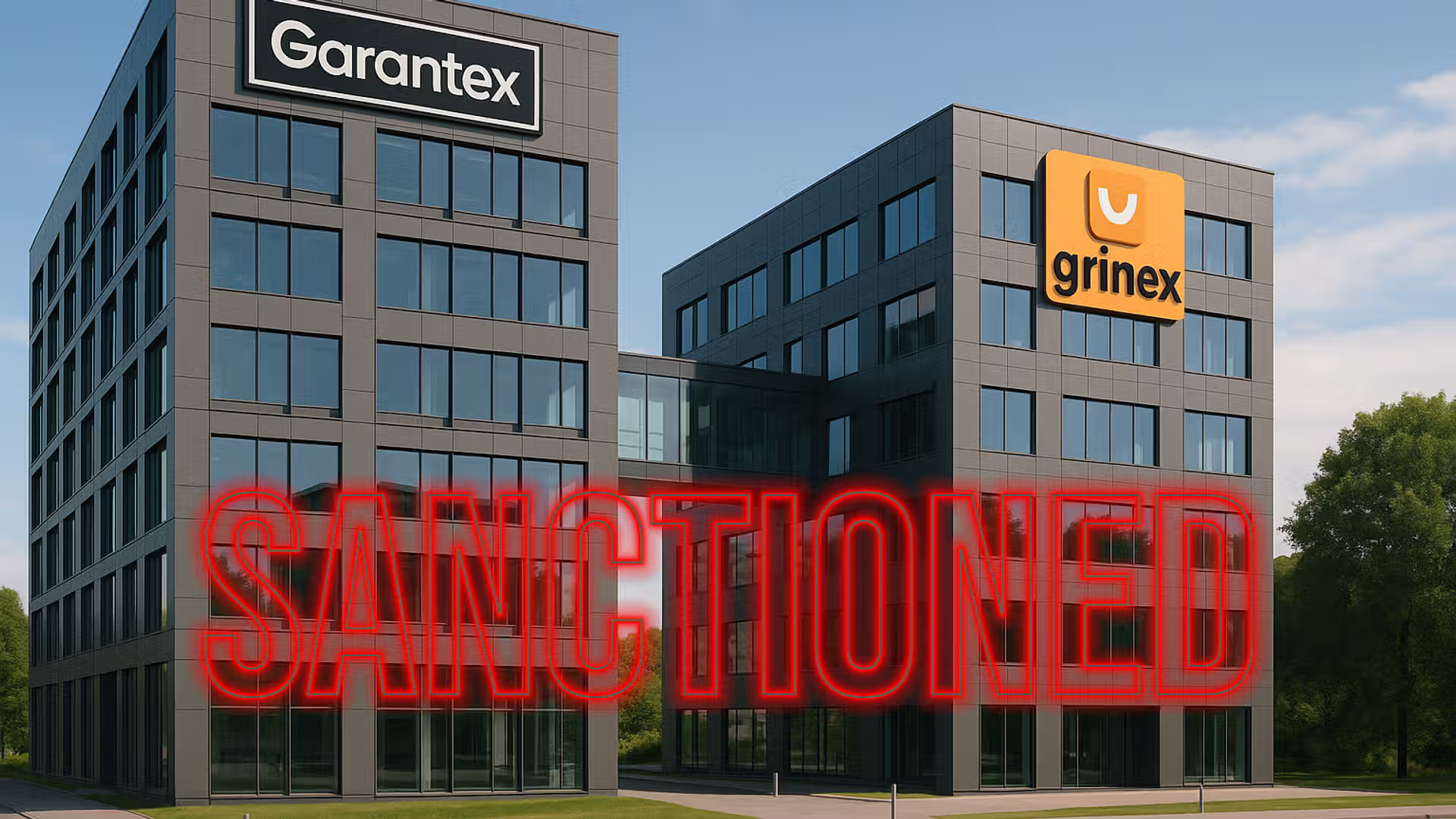
The escalation of sanctions against cryptocurrency exchanges Garantex and Grinex has become a defining case in how financial crime enforcement adapts to the digital asset era. The coordinated measures reveal how sanctions authorities, law enforcement, and cross-border partners are applying targeted strategies to disrupt cybercriminal networks that exploit virtual asset service providers for money laundering and sanctions evasion. This case also underscores the ongoing battle to preserve trust in legitimate cryptocurrency markets while shutting down exchanges that knowingly facilitate illicit transactions.
Table of Contents


Garantex Sanctions Illustrate The Focus On Cryptocurrency Crime
Garantex, originally launched in late 2019, built its operations around a customer base heavily concentrated in Russia, operating largely from Moscow and Saint Petersburg. While registered in Estonia at the outset, it quickly became known within investigative circles as a hub for illicit funds, including ransomware proceeds, darknet market sales, and other forms of cybercrime revenue.
Investigations have linked over $100 million in Garantex transactions directly to illicit actors. Among these, significant amounts were traced to ransomware groups such as Conti, Black Basta, LockBit, NetWalker, and Phoenix Cryptolocker. The exchange also reportedly provided account and exchange services to individuals tied to the Ryuk ransomware operation.
In early 2022, Estonian regulators revoked its license to operate as a virtual asset service provider after uncovering severe anti-money laundering and counter-terrorist financing compliance gaps. These deficiencies included weak customer due diligence, ineffective transaction monitoring, and links to cryptocurrency wallets already flagged for criminal activity. Despite losing its license, Garantex continued its operations from Russia, evolving methods to avoid detection.
The U.S. applied sanctions under cyber-related executive authorities, targeting the exchange for materially supporting malicious cyber-enabled activities that threaten national security. These sanctions freeze assets within U.S. jurisdiction, restrict access to the global financial system, and prohibit U.S. persons from engaging in transactions with the designated entities or individuals. This approach mirrors previous actions against other high-risk exchanges that have served as payment channels for cybercrime.
Creation Of Grinex To Evade Enforcement
Rather than ceasing operations after enforcement measures in March 2025, Garantex executives established Grinex to continue servicing their client base. This successor exchange was positioned as a workaround to sanctions and infrastructure seizures, allowing existing Garantex customers to recover funds and continue transacting.
Funds were reportedly moved to Grinex through a combination of direct asset transfers and the use of a ruble-backed token called A7A5. The token, issued by Kyrgyzstani company Old Vector, was part of a broader sanctions-evasion infrastructure designed in collaboration with sanctioned Russian and Moldovan entities. The A7A5 token was used to settle cross-border transactions and re-credit accounts of customers who lost funds during enforcement disruptions.
By creating Grinex, Garantex effectively preserved its operational network, client list, and transaction flow while attempting to mask ownership and control links. This tactic, while not unique in the cryptocurrency sector, demonstrates the agility of illicit service providers when faced with regulatory shutdowns. It also highlights the necessity for sanctions programs to target not only primary entities but also successor companies, associated intermediaries, and enabling technologies.
Network Of Individuals And Companies Enabling Evasion
The case against Garantex and Grinex extends beyond the exchanges themselves to a network of individuals and companies providing direct support. Senior executives were directly involved in securing infrastructure, developing promotional materials, and integrating services with other platforms that facilitate sanctions evasion.
Entities such as Independent Decentralized Finance Smartbank (InDeFi Bank) and the payment platform Exved, both co-founded by a Garantex executive, have been implicated in enabling cryptocurrency-based trade outside regulated financial channels. These platforms are alleged to have assisted in transferring funds between Russia and international partners, bypassing traditional banking restrictions and sanctions compliance checks.
Ownership structures of associated companies reveal links to sanctioned financial institutions and politically exposed individuals. This network model, where an exchange relies on third-party service providers, affiliated companies, and informal settlement systems, complicates enforcement actions. Authorities have responded by extending sanctions to these enablers, effectively cutting off peripheral support systems that sustain illicit exchange operations.
Broader Implications For Sanctions Compliance And AML Enforcement
The Garantex and Grinex designations highlight several strategic considerations for financial institutions, compliance officers, and regulators worldwide. First, the case reinforces the reality that illicit actors will adapt quickly, creating successor entities or shifting to alternative platforms to maintain operations. Compliance programs must account for these shifts through continuous monitoring of beneficial ownership, transaction patterns, and network relationships.
Second, this case demonstrates the necessity of international cooperation. Actions against Garantex involved coordination between U.S., European, and Asian enforcement bodies, including domain seizures, arrests, and asset freezes. Without cross-border collaboration, the network’s migration to a new brand could have gone undetected long enough to entrench its market presence.
Third, the role of tokens like A7A5 shows how emerging digital assets can be structured specifically to circumvent sanctions. While many tokens serve legitimate purposes, the issuance of assets tied to sanctioned jurisdictions presents a regulatory blind spot. Authorities may need to adopt new frameworks to assess the risks associated with fiat-backed tokens, stablecoins, and other digital instruments used in cross-border settlements.
For AML practitioners, the case serves as a reminder that due diligence on virtual asset service providers must go beyond basic registration checks. Evaluating the jurisdiction of operation, the integrity of leadership, and the quality of AML/CFT controls is critical. Exchanges that have lost licenses in one jurisdiction but continue operations elsewhere should be treated as high-risk until proven otherwise.
Lessons For The Fight Against Crypto-Enabled Financial Crime
The sanctions against Garantex and Grinex represent more than a single enforcement event—they are part of a broader strategy to target cryptocurrency exchanges that have become central nodes in the illicit finance ecosystem. By freezing assets, seizing infrastructure, and designating both primary and successor entities, enforcement agencies send a clear signal that sanctions evasion via rebranding or relocation will not succeed.
Financial crime networks thrive on speed, anonymity, and global reach. The ability of regulators and law enforcement to disrupt these networks hinges on rapid intelligence sharing, advanced blockchain analytics, and robust sanctions screening. The case also illustrates the importance of monitoring emerging threats in the cryptocurrency sector, including the misuse of fiat-backed tokens and decentralized finance platforms.
Ultimately, the goal of these actions is to protect the integrity of the global financial system while allowing legitimate digital asset innovation to flourish. The Garantex and Grinex operations show that sanctions, when applied strategically and in coordination with multiple jurisdictions, remain a powerful tool against high-risk exchanges and their enablers.
Related Links
- U.S. Department of the Treasury – Sanctions Programs
- European Union Sanctions Map
- Financial Action Task Force – Virtual Assets Guidance
- United Nations Office on Drugs and Crime – Cybercrime and Money Laundering
Other FinCrime Central Articles About Garantex and Other Crypto Exchanges
- Garantex Cryptocurrency Exchange Brought Down: A Major Blow to Money Laundering Networks
- Dutch authorities take down 2 crypto exchanges, seize €7M in money laundering bust
- U.S. DOJ Seizes Several Domains of Russian-Linked Crypto Exchanges in Major Crackdown against Money Laundering
Source: US Treasury
Some of FinCrime Central’s articles may have been enriched or edited with the help of AI tools. It may contain unintentional errors.
Want to promote your brand, or need some help selecting the right solution or the right advisory firm? Email us at info@fincrimecentral.com; we probably have the right contact for you.