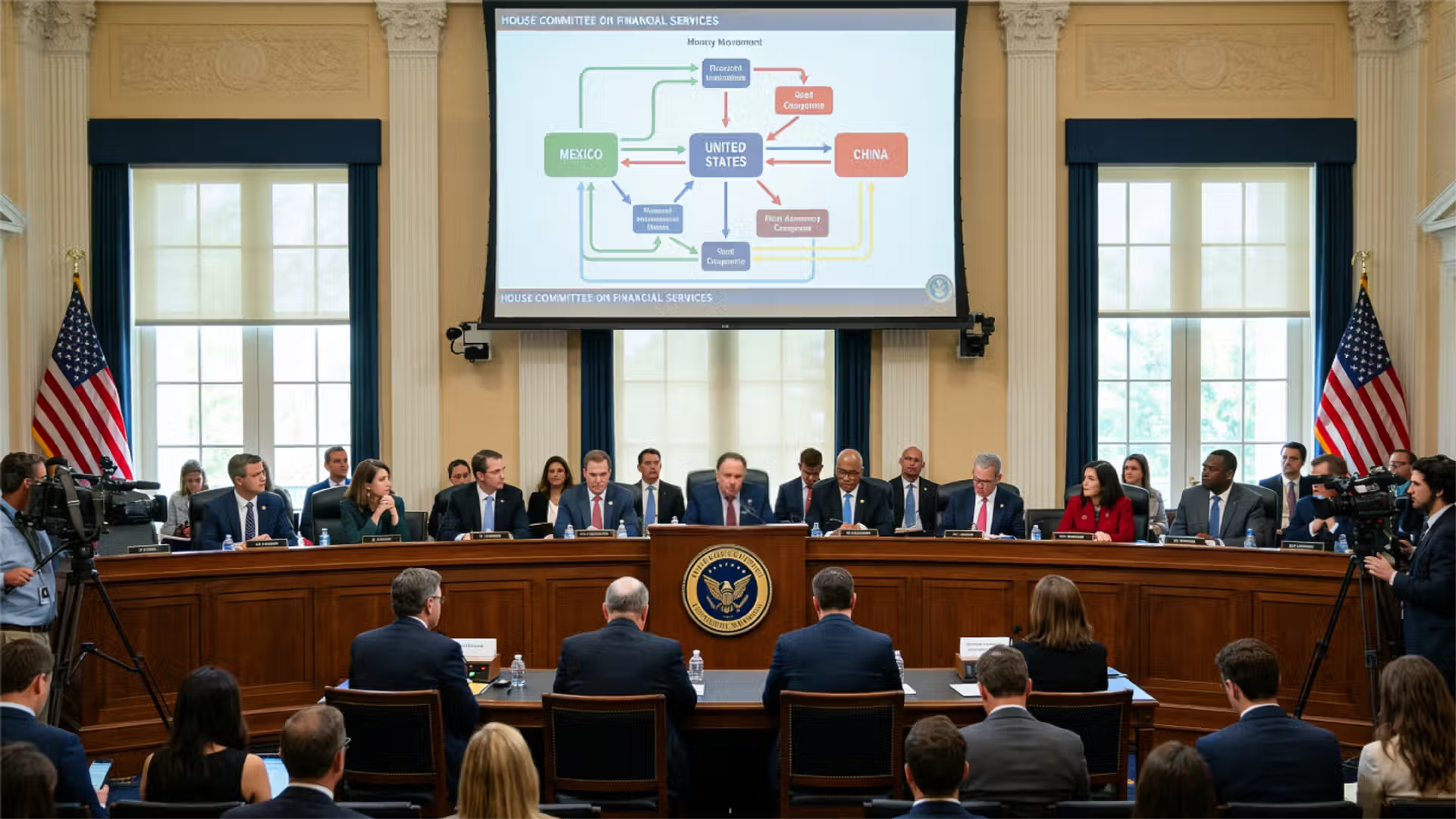
A prolific Chinese money laundering organization responsible for channeling over $92 million in drug trafficking proceeds has been fully dismantled by U.S. authorities, culminating with the sentencing of its last three members. All three pleaded guilty to laundering illicit funds, closing the final chapter of a sweeping investigation that stands as a milestone in the fight against financial crime. The case exposes the sophisticated tactics, global networks, and compliance gaps that continue to fuel large-scale money laundering operations in the United States.
Table of Contents
How Chinese Money Laundering Organizations Launder Drug Proceeds
Chinese money laundering organizations have emerged as a preferred avenue for drug cartels and transnational criminal networks seeking to clean vast amounts of illicit cash generated by narcotics sales in the United States. The CMLO at the heart of this case laundered drug money through a blend of traditional and innovative techniques, leveraging both legitimate and front businesses, cross-border connections, and an array of technology-driven tactics to obscure the origins of criminal proceeds.
These organizations often act as third-party money launderers. They collect bulk cash from drug traffickers operating in the U.S., pool it together, and then use shell companies, layered transactions, and trade-based money laundering mechanisms to introduce the illicit funds into the formal financial system. The criminal proceeds frequently pass through multiple accounts, often under the control of straw men or using fraudulent identification documents, before being wired overseas or reinvested into legitimate-seeming enterprises.
In this recent case, U.S.-based members of the CMLO functioned as cash couriers and managers. They picked up bulk cash shipments, deposited the funds into business accounts under their control, and made use of encrypted communications and constantly shifting identities to evade detection. Shell corporations, often with minimal or fraudulent documentation, became the vehicles for these deposits, sometimes exceeding $10,000 at a time—a red flag for banks under the Bank Secrecy Act (BSA).
The laundering process did not end with cash deposits. To further complicate tracing efforts, the organization moved funds internationally, structured transfers to avoid reporting requirements, and at times, commingled illicit proceeds with legitimate revenue. This layering of transactions—intended to distance the funds from their illicit origins—remains a hallmark of sophisticated money laundering operations.
Legal and Regulatory Responses: U.S. Law Enforcement’s Multifaceted Approach
Combating transnational money laundering requires a coordinated, multi-agency response, combining the investigative resources of the Drug Enforcement Administration (DEA), Internal Revenue Service Criminal Investigation (IRS-CI), and the U.S. Department of Justice (DOJ). Cases like this rely on a blend of law enforcement powers and regulatory frameworks to detect, investigate, and prosecute offenders.
The Bank Secrecy Act (31 U.S.C. §§ 5311 et seq.) remains a cornerstone of the U.S. AML regime. It imposes stringent recordkeeping, customer due diligence, and suspicious activity reporting requirements on financial institutions. Banks are obligated to file Currency Transaction Reports (CTR) for cash deposits exceeding $10,000, as well as Suspicious Activity Reports (SAR) when they detect patterns indicative of money laundering or structuring.
In this operation, the use of multiple accounts, deposits above the $10,000 threshold, and the presence of shell companies should have triggered bank compliance teams to escalate reviews. While U.S. banks have made significant investments in transaction monitoring, the volume and complexity of these schemes can overwhelm even robust compliance programs.
Beyond the BSA, the U.S. utilizes the Money Laundering Control Act (18 U.S.C. §§ 1956, 1957), which criminalizes the act of conducting financial transactions with proceeds derived from specified unlawful activities, including drug trafficking. The defendants in this case faced charges under both conspiracy and substantive counts of money laundering, each carrying severe penalties, including lengthy prison terms and asset forfeiture.
The U.S. Sentencing Guidelines play a critical role in determining penalties. Factors such as the amount laundered, the level of organization, and the use of sophisticated means can dramatically increase sentencing ranges. For financial institutions and professionals, failure to identify and report these activities can result in regulatory fines, enhanced scrutiny, and reputational damage.
The Evolution of Laundering Tactics and Compliance Challenges
As law enforcement agencies become more adept at identifying traditional laundering tactics, criminal organizations adapt their methods, embracing new technologies and exploiting gaps in regulatory oversight. Chinese money laundering organizations have shown exceptional agility, often outpacing bank compliance controls and leveraging the global nature of financial markets.
Several key tactics used by the CMLO in this case underscore the evolving nature of the threat:
- Rapidly changing communications: Members used encrypted apps and frequently switched phone numbers to evade surveillance.
- Sophisticated identity management: Fake identification documents, including driver’s licenses, facilitated the opening of business accounts and cash deposits at major U.S. banks.
- Use of shell companies: These entities, sometimes dormant or fraudulent, provided a layer of separation between criminal proceeds and their ultimate destination.
- Trade-based money laundering: While not the dominant method in this case, many Chinese groups facilitate the movement of funds through over- or under-invoicing of goods, further complicating the audit trail.
Financial institutions face significant challenges in detecting these patterns. The convergence of bulk cash pickups, third-party deposits, and the use of front companies can be difficult to flag using conventional rules-based transaction monitoring. Criminal networks often structure deposits just below reporting thresholds—a practice known as “smurfing”—or spread activity across multiple institutions and geographies.
The global nature of these operations also complicates compliance. Funds may be wired to countries with limited AML oversight or where regulatory cooperation is weak. Chinese money laundering organizations often have cross-border reach, moving illicit proceeds through networks in Asia, Latin America, and beyond.
Enforcement Actions and the Dismantling of the CMLO Cell
The arrest, prosecution, and conviction of all six members of this Chinese money laundering ring are the result of sustained investigative efforts by federal law enforcement, leveraging intelligence, surveillance, and financial analysis. This case was prosecuted under the umbrella of Operation Take Back America, an initiative that brings together the DOJ’s Organized Crime Drug Enforcement Task Forces (OCDETF) and Project Safe Neighborhoods, among others.
Through a combination of undercover operations, coordinated surveillance, and advanced financial forensics, investigators were able to map the flow of funds, identify key operatives, and unravel the network’s command structure. The prosecution relied on voluminous financial records, intercepted communications, and evidence of identity fraud to build a compelling case.
The defendants, once confronted with the scale of the evidence, entered guilty pleas, acknowledging responsibility for laundering tens of millions of dollars in drug proceeds. Their admissions and cooperation further enabled authorities to trace remaining assets, recover criminal proceeds, and develop typologies that will inform future investigations.
The sentences faced by the convicted individuals reflect the gravity of the offenses. Each count of conspiracy to launder money and substantive money laundering carries up to 20 years in prison, while transactions involving criminally derived property above $10,000 add additional penalties. Sentencing will ultimately reflect statutory factors, the U.S. Sentencing Guidelines, and the role of each participant.
With this cell fully dismantled, U.S. authorities have dealt a major blow to one of the more prolific Chinese money laundering organizations operating on American soil. The case sends a strong message to both domestic and transnational criminal networks regarding the risks and consequences of engaging in large-scale money laundering.
Lessons Learned and the Future of AML Enforcement
The successful takedown of this $92 million money laundering ring offers valuable lessons for financial institutions, compliance professionals, and regulators. As money laundering networks become more sophisticated, a multi-layered approach to detection, investigation, and prosecution is essential.
Financial institutions must continue to invest in advanced analytics, artificial intelligence, and cross-institutional information sharing to identify and disrupt emerging typologies. Enhanced customer due diligence, especially regarding beneficial ownership of shell companies and the use of third-party intermediaries, is critical for effective AML compliance.
Regulators should maintain a focus on strengthening global cooperation, particularly in regions vulnerable to being used as conduits for illicit funds. The integration of public and private sector intelligence—through initiatives such as the Financial Crimes Enforcement Network’s (FinCEN) public-private partnerships—can accelerate threat identification and response.
Finally, continued vigilance, regular staff training, and a culture of compliance remain the frontline defense against money laundering. This case demonstrates both the scale of the challenge and the effectiveness of determined, coordinated action.
Conclusion: The Dismantling of the CMLO and the Ongoing Battle Against Financial Crime
The prosecution and conviction of all members of this prolific Chinese money laundering organization represents a landmark victory for U.S. law enforcement in the fight against financial crime. Through the combined efforts of multiple agencies, authorities were able to unravel a complex scheme, recover illicit proceeds, and set a precedent for future investigations into transnational money laundering.
Yet, the case also underscores the ongoing evolution of money laundering tactics and the need for financial institutions to remain one step ahead. As criminal organizations continue to innovate, the public and private sectors must adapt, leveraging technology, regulatory cooperation, and intelligence-led approaches to disrupt illicit finance at scale.
The battle against money laundering is far from over. However, cases like this demonstrate that with robust AML frameworks, vigilant compliance programs, and coordinated enforcement, even the most sophisticated criminal networks can be brought to justice.
Related Links
- U.S. Department of Justice: Money Laundering and Asset Recovery Section
- FinCEN: Bank Secrecy Act Regulations
- DEA: Combating Transnational Criminal Organizations
- IRS Criminal Investigation: Money Laundering Investigations
- U.S. Code: 18 U.S.C. §§ 1956, 1957 – Money Laundering Control Act
Related Links
- Massive Europol €4.5 Million Money Laundering as a Service Bust Sparks Concerns
- Unmasking the “Money Laundering as a Service” Syndicate
Source: U.S. DOJ
Some of FinCrime Central’s articles may have been enriched or edited with the help of AI tools. It may contain unintentional errors.
Want to promote your brand with us or need some help selecting the right solution or the right advisory firm? Email us at info@fincrimecentral.com; we probably have the right contact for you.