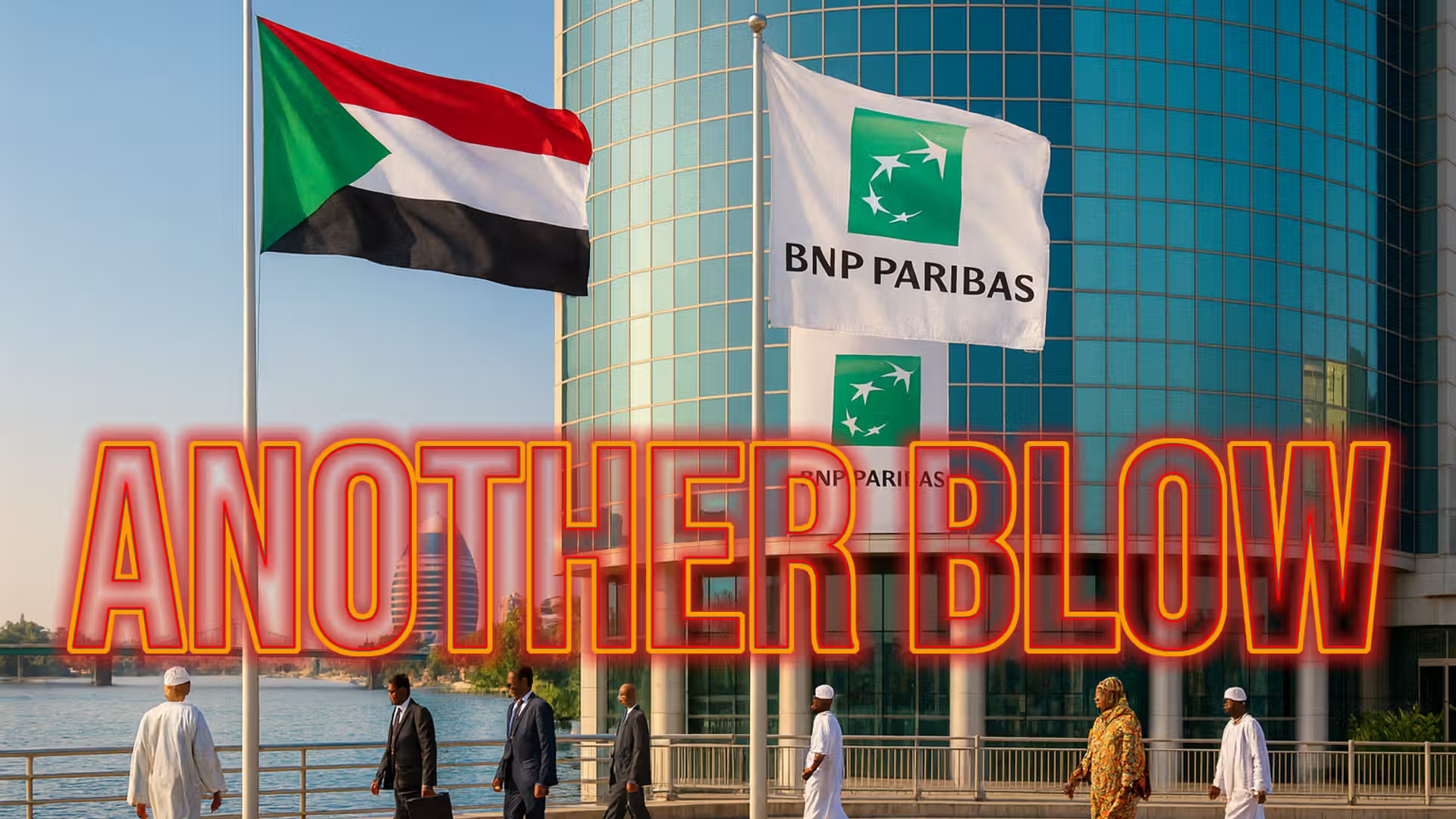
A New York jury has found BNP Paribas liable for facilitating atrocities committed by the regime of Omar al-Bashir in Sudan, delivering one of the most consequential civil verdicts ever rendered against a global financial institution. The decision followed years of litigation and weeks of courtroom testimony from Sudanese victims who described how the regime’s access to international banking channels allowed it to finance repression, forced displacement, and violence. The case marks a defining moment for corporate accountability in conflict finance and revives scrutiny of BNP Paribas’s historical compliance conduct.
Table of Contents


How Sudan’s regime used BNP Paribas’s network to bypass sanctions
Between the late 1990s and 2009, Sudan was subject to extensive U.S. and international sanctions. The regime of Omar al-Bashir, accused of genocide and mass displacement in Darfur, faced restrictions designed to isolate it financially and prevent access to hard currency. Yet Sudan continued to sell oil abroad, purchase weapons, and pay its military. The mechanism that made this possible, according to evidence presented at trial, was a web of commercial transactions routed through BNP Paribas’s network. Letters of credit, guarantees, and other trade-finance instruments were issued by the bank to facilitate exports and imports involving Sudanese state-owned enterprises. These operations, although structured through non-U.S. subsidiaries, still relied on U.S.-dollar clearing in New York. By processing these payments, BNP Paribas allegedly allowed the regime to move sanctioned revenues through legitimate financial channels, converting blocked assets into freely usable funds.
For Sudan, those funds were lifeblood. Oil sales financed the government’s budget, paid the army, and maintained political patronage networks. As international isolation intensified, access to BNP Paribas’s services provided a rare bridge to global markets. The plaintiffs described this system as “state money laundering” conducted under the veneer of commercial normalcy.
The jury agreed that the bank’s involvement materially contributed to the regime’s ability to sustain its campaigns of violence. It concluded that even without direct intent to aid atrocities, BNP Paribas’s actions were a substantial factor in making them possible. This reasoning, rarely applied to financial institutions, opens a new chapter in the intersection of human-rights law and financial compliance.
The mechanics of atrocity financing through trade finance
Trade finance is often viewed as low-risk within AML frameworks, but the Sudan case exposes how these instruments can be repurposed for sanctions evasion and illicit state financing. Letters of credit serve as payment guarantees between exporters and importers. When one party is a sanctioned entity, they can transform from a tool of commerce into a vehicle of circumvention.
Court documents revealed how BNP Paribas structured transactions for Sudanese companies directly linked to government ministries. Proceeds from oil sales were paid into accounts at foreign banks, confirmed by letters of credit issued or advised by BNP Paribas. The payments were then routed through correspondent accounts in the United States, where dollar settlement occurred. On paper, the operations appeared routine. In substance, they provided the regime with access to U.S. currency otherwise denied under sanctions law.
Compliance alerts reportedly surfaced within the bank’s network during this period. Internal teams flagged exposure to sanctioned jurisdictions and questioned the legitimacy of counterparties. Yet escalation processes failed. Senior management, prioritizing profitability and client retention, allowed the operations to continue. The jury’s decision implicitly recognized that failure to act on red flags constitutes complicity when harm follows.
For regulators and AML officers, this case underscores how trade-finance risk is underestimated. Screening tools often focus on names and ownership but overlook contextual risk—the geopolitical environment, the end use of funds, and the cumulative exposure created by multiple small transactions. Sudan’s experience shows how a sanctioned regime can launder not just money but legitimacy through persistent access to international finance.
The human cost behind financial transactions
Beyond compliance failures, the Sudan verdict is a reminder that money flows have tangible consequences. The atrocities committed by the al-Bashir regime between 2003 and 2009 led to the deaths of hundreds of thousands of civilians and the displacement of millions. Villages in Darfur were burned, civilians targeted, and resources diverted toward maintaining power through violence. The funds enabling this came from oil exports and trade deals that passed through global banks.
The plaintiffs in the New York case recounted the destruction of their homes, loss of family members, and forced displacement. Their testimony personalized what would otherwise have been an abstract discussion about financial compliance. The jury’s empathy bridged the gap between spreadsheets and human suffering. By linking a specific financial mechanism to real-world harm, the court established a narrative of accountability unprecedented in modern banking litigation.
This moral dimension now permeates discussions about AML and sanctions enforcement. Regulators increasingly emphasize the social impact of financial crime: terrorism financing, corruption, and human-rights abuses are no longer seen as distant outcomes but as foreseeable consequences of weak oversight. The BNP Paribas verdict amplifies that message. It asserts that banks cannot claim ignorance when the risks are both evident and avoidable.
A turning point for compliance and liability in global banking
The New York judgment is likely to become a landmark in compliance jurisprudence. It expands the notion of responsibility from active participation to passive facilitation. BNP Paribas did not fund atrocities directly, but its services maintained the financial oxygen of a sanctioned regime. The precedent may embolden future plaintiffs to pursue similar actions against other institutions linked to regimes in Syria, Myanmar, or Russia.
For BNP Paribas, the verdict reopens a chapter the bank believed closed after its 2014 settlement with U.S. authorities for sanctions violations. That earlier case resulted in a record fine of nearly nine billion dollars and commitments to strengthen compliance frameworks. Yet the persistence of Sudan-related litigation suggests that structural reform was incomplete.
The market reaction was immediate. BNP Paribas shares fell more than eight percent in Paris trading, the sharpest single-day drop since the 2014 scandal. Analysts estimate that potential follow-on claims could reach billions if other Sudanese victims join new proceedings. Credit-rating agencies have signaled they may review the bank’s litigation exposure, underscoring how legal risk now intersects directly with financial stability.
For the wider banking sector, the lesson is clear. Sanctions compliance is no longer a technical matter confined to checklists and screening algorithms. It is an existential governance issue that determines whether a financial institution can maintain credibility in global markets. The verdict also reinforces the extraterritorial reach of U.S. jurisdiction: any transaction clearing in dollars may fall under American law, regardless of where it originates.
BNP Paribas’s official response and intention to appeal
In the wake of the verdict, BNP Paribas released a detailed statement expressing its firm disagreement with the jury’s conclusions. The bank described the outcome as “manifestly wrong” and asserted that the court prevented it from presenting critical evidence that would have contextualized its historical activities. It emphasized that the decision applies solely to the three plaintiffs involved and should not be interpreted as establishing broader culpability.
BNP Paribas reaffirmed its unwavering commitment to appeal the judgment, stating that it will pursue all available legal avenues to overturn what it views as an unjust and incomplete evaluation of the facts. The bank also stressed that it faces no external pressure to settle and that speculation about a potential settlement amount—rumored to reach as high as ten billion dollars—is unfounded.
According to its official position, BNP Paribas believes that the verdict ignores substantial evidence of internal compliance measures and mischaracterizes its role in transactions that occurred under complex geopolitical conditions. The bank maintains that it has long since restructured its compliance systems, invested heavily in AML and sanctions controls, and cooperated transparently with authorities across jurisdictions.
Despite these assurances, the verdict’s symbolism outweighs its monetary value. It cements BNP Paribas’s place at the center of a global debate about moral accountability in finance. The institution that once portrayed itself as a reformed actor now faces a renewed test of its credibility. How it conducts its appeal—openly, assertively, and grounded in transparency—will determine whether it can restore confidence among regulators and investors.
The coming appeal process promises to attract intense attention. Legal observers expect BNP Paribas to challenge the scope of U.S. jurisdiction and the causal link between financial facilitation and human-rights abuses. Whatever the outcome, the case has already reshaped expectations for global banks. It reminds every compliance officer that transactions are not neutral abstractions—they are acts with consequences.
Related Links
- U.S. Department of the Treasury – Office of Foreign Assets Control (OFAC) Sanctions List Search
- Financial Crimes Enforcement Network (FinCEN) – Anti-Money Laundering Act of 2020
- U.S. Department of Justice – Money Laundering and Asset Recovery Section
- United Nations Security Council – Sudan Sanctions Committee
- European Banking Authority – Guidelines on Risk Factors and Enhanced Due Diligence
Other FinCrime Central Articles About BNP Paribas
Source: Le Figaro
Some of FinCrime Central’s articles may have been enriched or edited with the help of AI tools. It may contain unintentional errors.
Want to promote your brand, or need some help selecting the right solution or the right advisory firm? Email us at info@fincrimecentral.com; we probably have the right contact for you.