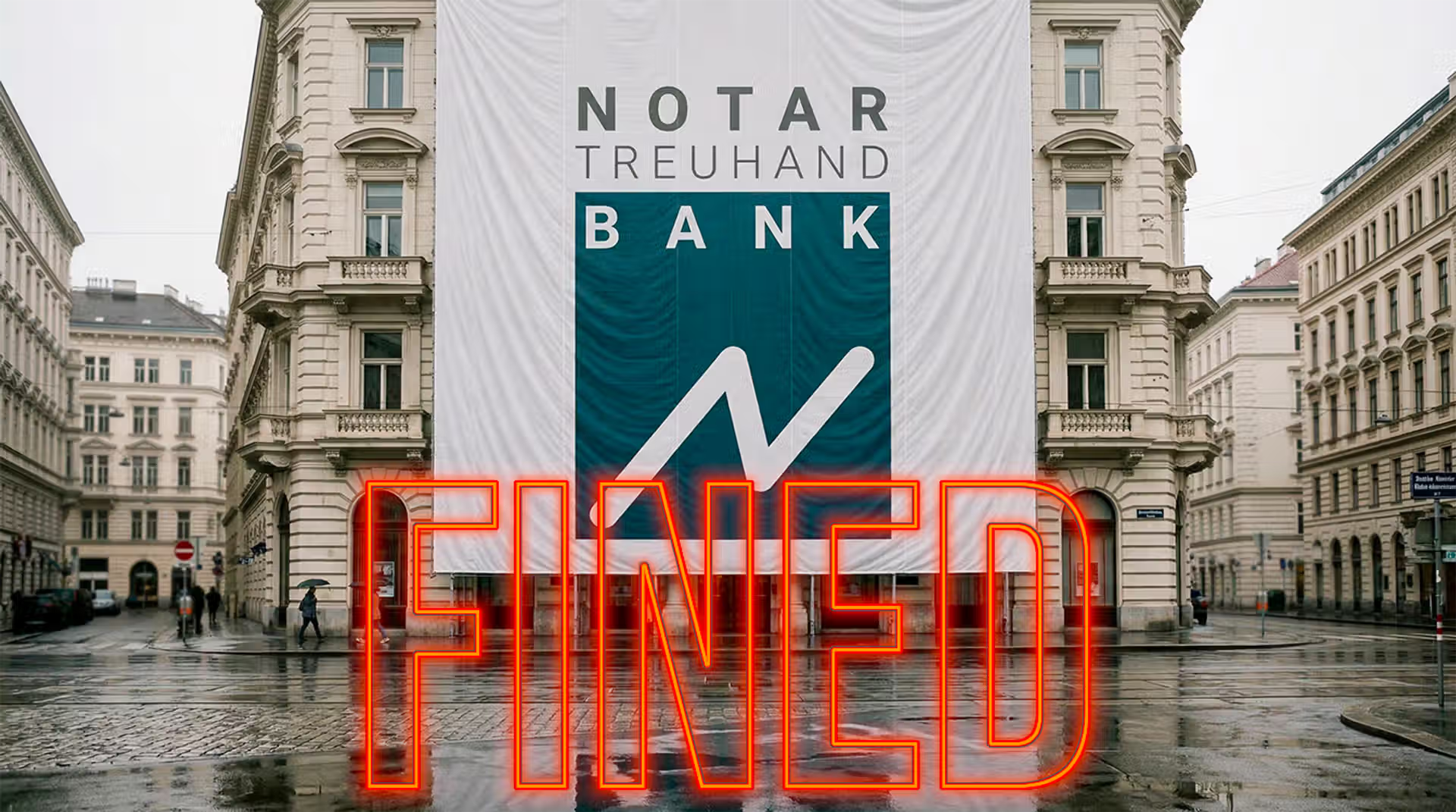
The Austrian Financial Market Authority has imposed a fine of 127,500 EUR against NOTARTREUHANDBANK AG for significant breaches of due diligence obligations. This enforcement action stems from the institution failing to maintain adequate strategies and controls designed to prevent money laundering and terrorist financing. Regulators found that the bank did not sufficiently monitor business relationships or verify that transactions aligned with customer risk profiles. Such lapses represent a serious violation of the Financial Markets Anti-Money Laundering Act within the Austrian jurisdiction. This penal order remains subject to appeal as the legal process continues to unfold.
Table of Contents


Financial Markets Anti-Money Laundering Act Compliance
The recent enforcement action by the Austrian Financial Market Authority highlights a critical gap in the operational framework of NOTARTREUHANDBANK AG. At the heart of this case lies the Financial Markets Anti-Money Laundering Act, a piece of legislation known locally as the Finanzmarkt-Geldwäsche-Gesetz. This law mandates that every credit institution operating within the Austrian borders must establish a robust system of internal controls. These controls are not merely suggestions but are foundational requirements meant to safeguard the integrity of the global financial system. When a bank fails to implement appropriate strategies, it creates a vacuum where illicit funds can flow without detection. The FMA determined that the bank in question lacked the necessary procedures to ensure that its business activities remained transparent and compliant with the rigorous standards expected of a specialized fiduciary institution.
The specifics of the breach involve a failure to document and execute ongoing monitoring. In the world of modern finance, the concept of know your customer is not a one-time event that occurs only during the onboarding process. Instead, it is a continuous obligation that requires banks to constantly evaluate the behavior of their clients. For NOTARTREUHANDBANK AG, the regulator identified a systemic lack of checking regarding transactions conducted during the course of business relationships. Without these checks, a bank cannot truly know if the money passing through its accounts matches the stated business activities or the risk profile of the account holder. This lack of alignment is a red flag for money laundering, as it suggests that funds from unknown or illegitimate sources could be integrated into the legal economy through the bank’s services.



Transaction Monitoring and Source of Funds Verification
The inability of the bank to match transactions with its knowledge of the customer represents a breakdown in the most basic defensive layer of anti-money laundering protocols. Effective monitoring requires a bank to have a deep understanding of what constitutes normal activity for each specific client. When a transaction occurs that falls outside of these established parameters, the system should trigger an immediate investigation. In this instance, the FMA found that NOTARTREUHANDBANK AG did not have the commensurate controls to perform this function effectively. This is particularly concerning for a bank that deals with notary trust accounts, where the nature of the transactions involves high-value transfers related to real estate, estate settlements, and corporate structures.
Furthermore, the bank failed to adequately determine the source of funds in written form. Determining where money originates is a cornerstone of the due diligence process, especially when dealing with high-risk jurisdictions or complex corporate entities. The law requires that this information be not only gathered but also documented in a way that allows for independent audit and regulatory review. By failing to maintain these written records, the bank hindered its own ability to prove that it was not facilitating the movement of criminal proceeds. The FMA emphasizes that the level of detail in these investigations must be proportional to the size and the activity of the business relationship. For an institution with the specific profile of NOTARTREUHANDBANK AG, the expectation for precision is naturally higher given the fiduciary nature of its operations.
Regulatory Oversight and Fiduciary Responsibility
The Austrian Financial Market Authority serves as the primary watchdog for the national financial sector, and its decision to levy a fine of 127,500 EUR serves as a deterrent to other market participants. This penalty reflects the gravity of failing to adhere to the FM-GwG. The regulator’s role is to ensure that all banks, regardless of their specialized niche, adhere to a uniform standard of vigilance. In the case of NOTARTREUHANDBANK AG, the breach was not a single isolated incident but rather a failure to have the correct systems and procedures in place over a period of time. This suggests a structural weakness in the compliance department of the bank, where the internal audit and risk management functions failed to identify and correct these shortcomings before the regulator intervened.
Fiduciary institutions like those serving notaries hold a unique position of trust in the Austrian economy. They handle sensitive transactions that are often the final step in legitimizing the ownership of assets. If these institutions are not performing their due diligence, the entire chain of legal verification is compromised. The FMA expects that the strategies and procedures for monitoring are not only written down but are actively lived out in the daily operations of the bank. This includes training staff to recognize suspicious patterns and ensuring that the IT systems used for transaction screening are updated to reflect the latest money laundering typologies. The absence of these measures at NOTARTREUHANDBANK AG led directly to the administrative fine and the public disclosure of their compliance failures.
Systemic Risks and Future Compliance Trajectories
The implications of this case extend beyond the immediate financial penalty. It serves as a reminder that the Austrian regulatory environment is becoming increasingly intolerant of procedural lapses in the fight against financial crime. Institutions are now expected to demonstrate a proactive approach to risk management. The fact that the penal order against NOTARTREUHANDBANK AG is not yet final indicates that the bank may choose to contest the findings or the amount of the fine. However, the reputational damage associated with such a public sanction is often more costly than the fine itself. Clients and partners of the bank will now look more closely at its internal processes, and future regulatory examinations will likely be significantly more rigorous.
For the wider financial industry, the lesson is clear: compliance is not a static goal. As criminals develop more sophisticated methods for hiding the origins of their wealth, banks must respond with equally sophisticated detection tools. The failure to match transactions to risk profiles is a common theme in recent enforcement actions across Europe. This suggests that many banks are struggling to keep pace with the volume of data they process. To avoid similar sanctions, institutions must invest in advanced analytics and ensure that their compliance teams are properly resourced. The case of NOTARTREUHANDBANK AG illustrates that even specialized banks with a specific client base are not immune to the requirements of the FM-GwG and will be held accountable for any deviations from the law.
Key Points
- The Austrian FMA issued a 127,500 EUR fine against NOTARTREUHANDBANK AG for systemic AML failures.
- Violations centered on the lack of adequate controls for the ongoing monitoring of business relationships.
- The bank failed to verify if customer transactions matched their established risk profiles and known business activities.
- Inadequate documentation of the source of funds was identified as a key breach of the Financial Markets Anti-Money Laundering Act.
- This enforcement action underscores the regulatory requirement for written procedures and active transaction screening.
Related Links
- FMA News and Sanctions
- Austrian Financial Markets Anti-Money Laundering Act
- FATF Recommendations on Fiduciary Transparency
- European Banking Authority AML Standards
- Federal Ministry of Finance Austria Compliance Portal
Other FinCrime Central Articles About Austria
- Online Platform InvestNow Faces FMA Action Over Alleged AML Failures
- Austrian FMA Bans KuCoin EU From New Business for Compliance Failures
- Austrian National Boarding Flight to Dubai Seized With $1.45M in Cash at Lagos Airport
Source: FMA
Some of FinCrime Central’s articles may have been enriched or edited with the help of AI tools. It may contain unintentional errors.
Want to promote your brand, or need some help selecting the right solution or the right advisory firm? Email us at info@fincrimecentral.com; we probably have the right contact for you.