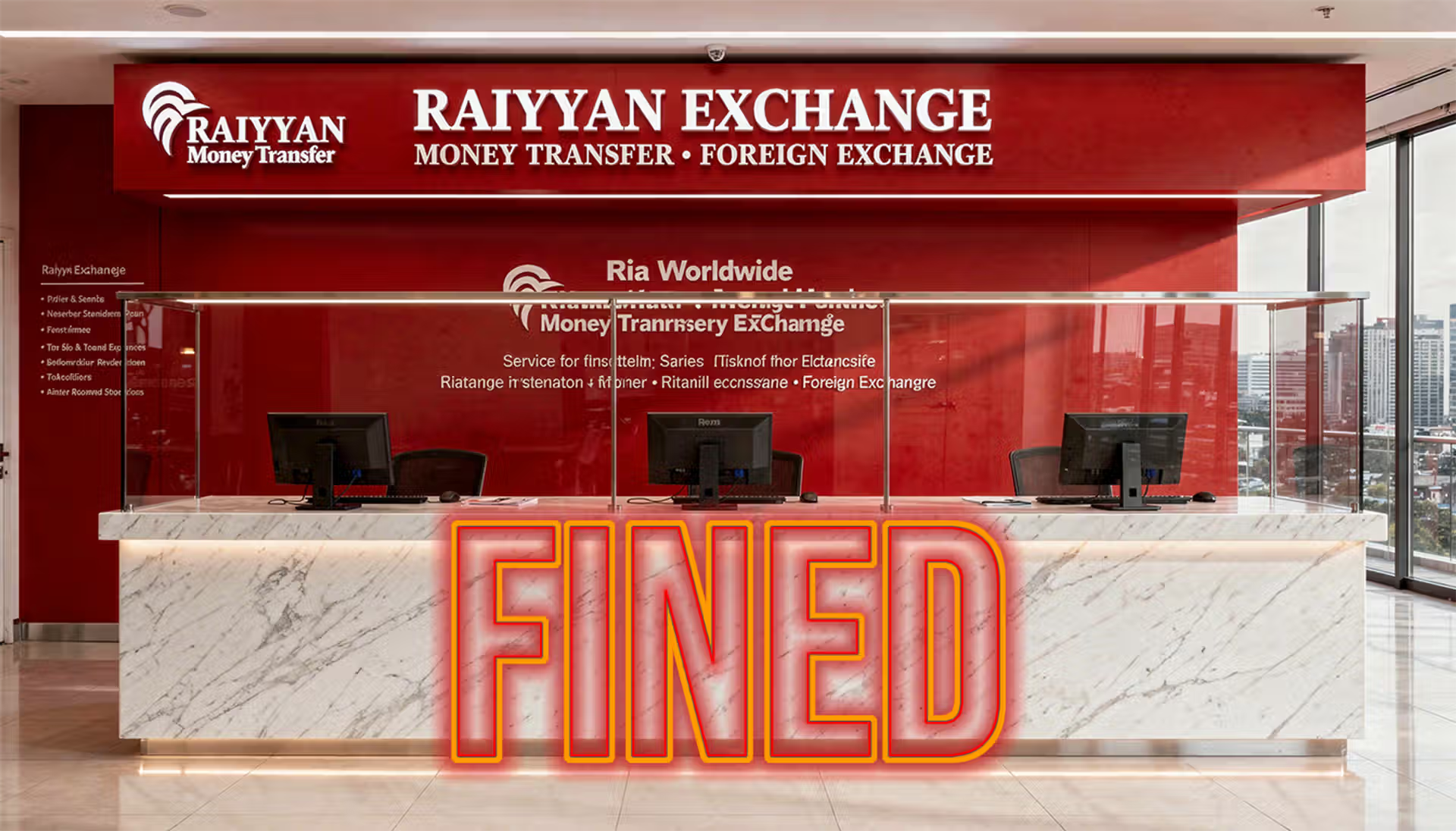
Australia’s financial crime intelligence agency, the Australian Transaction Reports and Analysis Centre (AUSTRAC), has refused the renewal of registration for independent remitter Yellow Sands Trading Pty Ltd, which operated under the name Raiyyan Exchange. This decision immediately prohibits Raiyyan Exchange from providing any money transfer services within Australia. AUSTRAC’s refusal stemmed from the discovery of serious, systemic weaknesses in the company’s internal controls for managing and mitigating the risks associated with money laundering and terrorism financing. The regulator emphasized that businesses failing to uphold their anti-money laundering obligations create an unacceptable vulnerability in the nation’s financial system, making them attractive targets for criminal exploitation. This action underscores the strict enforcement environment Australia maintains to protect the integrity of its financial sector from illicit activity.
Table of Contents


Deficiencies in Remittance AML Program Compliance
The regulatory action against Raiyyan Exchange highlights the critical requirement for all Australian remittance providers to maintain a robust and compliant anti-money laundering program. AUSTRAC identified multiple, severe deficiencies indicating that Raiyyan Exchange lacked the fundamental capability to properly identify, assess, and manage its money laundering and terrorism financing risks as mandated by the Anti-Money Laundering and Counter-Terrorism Financing Act 2006 (AML/CTF Act). These requirements necessitate comprehensive measures, including customer due diligence, transaction monitoring, and risk-based controls tailored to the specific nature of a money transfer business. The failure of the company to effectively establish and implement these controls was the direct cause of the registration renewal refusal. This refusal, a severe regulatory outcome, effectively removes the entity from the regulated sector, preventing its future operation.
The remittance industry is globally recognized as being highly vulnerable to exploitation by organized crime groups due to the high volume, cross-border nature of its transactions, and the frequent use of cash. Detective Superintendent Peter Faux from the NSW Police Force State Crime Command’s Organised Crime Squad stressed that law enforcement is acutely aware of this vulnerability and works closely with AUSTRAC to identify and investigate both registered and unregistered remittance service providers suspected of engaging in criminal activities. The partnership between the financial regulator and police indicates that the identified compliance failures at Raiyyan Exchange were considered not merely administrative errors, but a serious potential gateway for criminal funds to enter or exit Australia. Weak compliance, as noted by Acting AUSTRAC CEO Katie Miller, acts as an open invitation for criminals seeking to exploit regulatory cracks for money laundering purposes.
The Heightened Risk of Offsetting Arrangements
A significant focus of anti-money laundering risk in the remittance sector is the use of offsetting arrangements, a business model central to many alternative remittance providers like Raiyyan Exchange. This practice, often referred to as hawala or hundi, allows for the international transfer of value without the physical movement of funds, by settling credits and debits between two or more dealers operating in different jurisdictions. While these arrangements facilitate financial inclusion and legitimate commerce, AUSTRAC’s National Risk Assessment on Money Laundering 2024 specifically highlighted them as posing a heightened money laundering and terrorism financing risk.
The inherent risk lies in the opacity and lack of transactional visibility. Offsetting transactions can easily be manipulated to conceal the true amount of illicit funds transferred, obscure the identities of the parties involved, and bypass the mandatory reporting thresholds under the AML/CTF Act. For instance, a remittance provider can accept proceeds of crime in Australia and then, instead of initiating a traceable wire transfer, issue an instruction to an overseas counterpart to pay a beneficiary. The Australian provider then settles the internal debt with the overseas partner through legitimate or complex means, completely disconnecting the original deposit of criminal cash from the final disbursement of funds. This methodology requires reporting entities to actively monitor both the payer and payee sides of every transfer, a crucial obligation Raiyyan Exchange evidently failed to meet, thereby exposing itself to criminal abuse.
Regulatory Power to Ensure System Integrity
The action taken by AUSTRAC against Yellow Sands Trading Pty Ltd, trading as Raiyyan Exchange, demonstrates the agency’s unwavering commitment to utilizing its full regulatory authority to safeguard Australia’s financial system. Under the AML/CTF Act, AUSTRAC possesses the explicit power to refuse, suspend, or cancel the registration of a remittance service provider if they fail to satisfy the necessary criteria, particularly concerning their AML/CTF controls. This is distinct from a civil penalty, which is often a large fine; the refusal of registration is an existential action that permanently removes the business’s legal ability to operate in its core service area.
The decision serves as a clear and forceful deterrent to other businesses, reinforcing the message that neglecting mandatory AML/CTF obligations will result in severe consequences, up to and including the permanent loss of the license to operate. AUSTRAC’s proactive stance, in collaboration with law enforcement, aims to create a hostile operating environment for criminal elements. By maintaining strict control over the register of remittance providers, the regulator ensures that only entities capable of demonstrating a genuine and effective commitment to compliance are permitted to handle cross-border transfers, thereby minimizing systemic risk and protecting the community from the downstream effects of serious financial crime. The continuous threat of action by AUSTRAC keeps compliance as a top priority for all reporting entities in the Australian financial sector.
Sustained Enforcement for Financial Security
The refusal of registration renewal for Raiyyan Exchange is part of a sustained regulatory enforcement strategy by AUSTRAC designed to address the persistent exploitation of regulated channels by organized crime. Money laundering continues to be assessed as a critical risk to Australia’s security and prosperity, with sectors like remittances and casinos historically being key pathways for laundering criminal proceeds. By targeting the fundamental control weaknesses in the AML/CTF programs of remitters, the regulator addresses the weakest link that criminals seek to exploit. The expected vigilance includes rigorous due diligence on customers and third-party affiliates, enhanced scrutiny of high-risk jurisdictions, and timely submission of suspicious matter reports (SMRs). Ultimately, the regulatory integrity of the remittance sector hinges on every registered provider viewing their AML obligations not merely as a regulatory hurdle, but as an essential defense against the misuse of their services for global crime and terrorism financing. This single refusal of registration sends a powerful, sector-wide message about the non-negotiable nature of effective compliance.
Key Points
- AUSTRAC’s refusal to renew Raiyyan Exchange’s registration highlights a complete failure in the company’s anti-money laundering (AML) controls.
- The independent remitter was found to have serious deficiencies in its ability to understand, manage, and mitigate money laundering and terrorism financing risks, breaching the AML/CTF Act.
- This regulatory action, coordinated with the NSW Police Force, removes the company’s legal ability to provide money transfer services in Australia, indicating a critical risk to the financial system’s integrity.
- The case specifically underscores the vulnerability of the remittance sector, particularly where offsetting arrangements are used, which criminals exploit to obscure the source and destination of illicit funds.
- AUSTRAC’s use of its refusal power is a strong statement that non-compliance will result in the loss of operational license, serving as a powerful deterrent across the financial sector.
Related Links
- Australian Transaction Reports and Analysis Centre Official Website
- The Anti-Money Laundering and Counter-Terrorism Financing Act 2006
- AUSTRAC Remittance Sector Register Search
- AUSTRAC Money Laundering in Australia National Risk Assessment
- Financial Action Task Force (FATF) Recommendations
Other FinCrime Central Articles About AUSTRAC’s Latest Actions
- AUSTRAC Fines Cryptolink as Crypto ATMs Emerge as Laundering Hubs
- AUSTRAC Investigation Unmasks Gambling Funded Gold Laundering
- How AUSTRAC’s Enforceable Undertaking Shaped NAB’s AML/CFT Compliance
Source: AUSTRAC
Some of FinCrime Central’s articles may have been enriched or edited with the help of AI tools. It may contain unintentional errors.
Want to promote your brand, or need some help selecting the right solution or the right advisory firm? Email us at info@fincrimecentral.com; we probably have the right contact for you.