An exclusive article by Fred Kahn
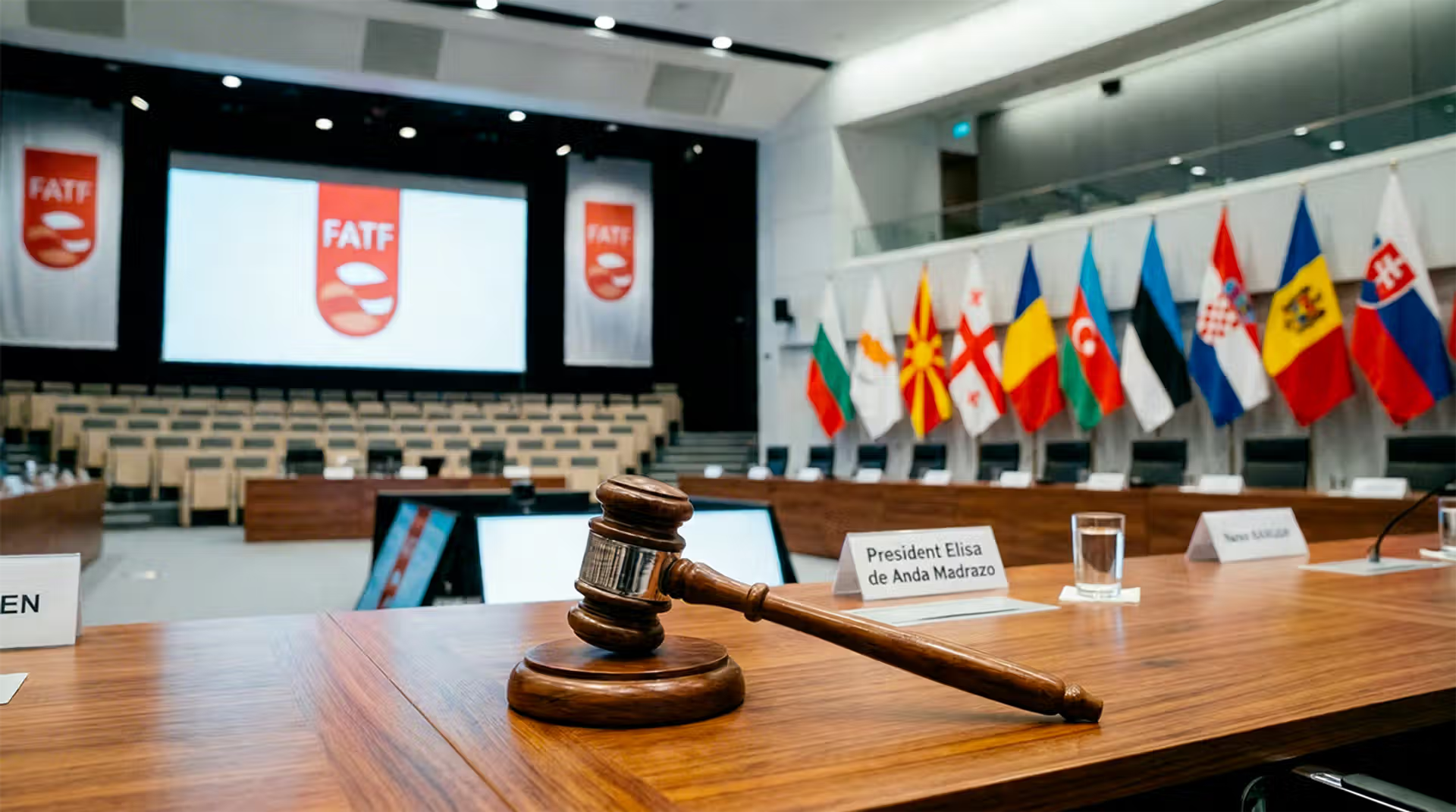
Global regulatory authorities have imposed massive financial penalties on institutions failing to detect illicit movement of wealth, yet these measures frequently facilitate a strategic migration rather than a genuine cessation of criminal activity. AML Regulatory frameworks often act as a sieve rather than a barrier, allowing sophisticated actors to transition from monitored environments to the dark corners of the global economy. While the traditional banking sector continues to invest heavily in automated surveillance and compliance personnel, the unintended consequence remains the redirection of dirty money into opaque, unregulated channels. This displacement creates a significant intelligence gap for law enforcement agencies, who now struggle to monitor fragmented, informal networks that lack centralized data repositories. Stringent enforcement in one jurisdiction or sector inevitably compels illicit actors to seek the path of least resistance within the expansive global financial ecosystem.
Table of Contents


Addressing the Mechanical Reality of Shadow Financial Displacement
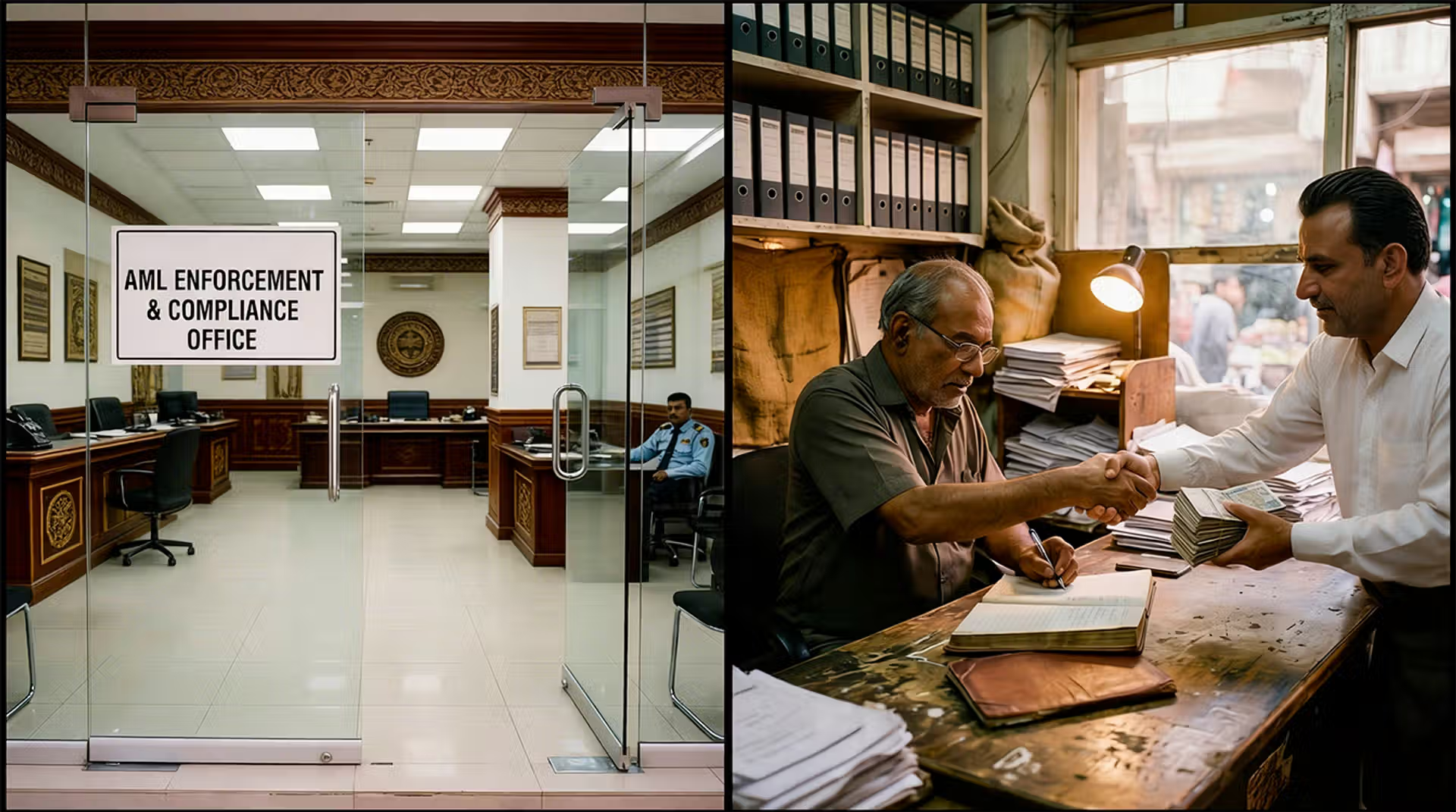
The current architecture of global financial oversight focuses primarily on the formal banking sector, creating a high barrier for entry that illicit organizations are increasingly adept at circumventing through lateral movement. When Tier 1 financial institutions enhance their internal scrutiny to mitigate risk, the immediate result is often a process of broad de-risking, where entire categories of customers or specific geographic regions are excluded from the financial grid to minimize institutional liability. This exclusion does not eliminate the underlying demand for financial services among those cast out, nor does it halt the movement of capital by sophisticated criminal enterprises. Instead, it serves as a powerful catalyst for the growth of informal value transfer systems that operate entirely outside the peripheral vision of state authorities. These systems, while historical in origin, have been modernized to facilitate the rapid movement of wealth across international borders without leaving a digital footprint for traditional investigators to analyze.
The reliance on heavy punitive measures as a primary deterrent has fostered a defensive compliance culture where the fundamental objective is to avoid regulatory wrath rather than to actively identify and dismantle criminal networks. As banks tighten their internal controls to protect their licenses, the displacement effect becomes more pronounced, pushing illicit transactions into the world of physical cash smuggling and highly complex trade-based schemes. Trade-based money laundering involves the manipulation of shipping invoices and the deliberate over-valuation or under-valuation of physical goods to move value across borders under the guise of legitimate commerce. Because these transactions are deeply embedded within the massive, multi-trillion-dollar volume of legitimate global trade, they are significantly harder to detect than a suspicious wire transfer. The sheer scale of international mercantile activity provides a perfect veil for those looking to relocate their financial footprints away from the specialized eyes of financial intelligence units.



The Expansion of the Hawala Network and Informal Systems
The phenomenon of institutional de-risking has had a profound and lasting impact on the landscape of financial crime, effectively acting as an accelerant for the expansion of the hawala system and other non-bank networks. When a legitimate money transfer operator loses its correspondent banking relationship due to the perceived risk of the jurisdiction it serves, the demand for cross-border remittances remains unchanged. Those who rely on these services for survival are frequently forced to utilize unregulated brokers who operate on systems of mutual trust and ledger-based balancing rather than the physical movement of currency through traditional bank accounts. For a criminal organization, this environment is essentially ideal, as it offers a pre-existing, liquid, and highly secretive infrastructure for moving the proceeds of narcotics trafficking, human smuggling, or high-level corruption.
As the fintech layer of the global economy continues to evolve, it also offers new and sophisticated avenues for the relocation of illicit capital. While many digital payment platforms are technically subject to the same regulations as traditional banks, the speed of technological innovation often outpaces the speed of regulatory oversight. Smaller, more agile firms may lack the comprehensive monitoring tools or the historical data sets of a global bank, making them attractive targets for complex layering operations. Illicit actors often utilize a series of rapid-fire transactions across multiple digital platforms to create a labyrinth of confusion for auditors. By the time a suspicious activity report is generated and reviewed, the funds have typically been converted into assets that are much harder for authorities to freeze, such as high-value physical commodities or decentralized digital tokens. This migration represents a tactical retreat from the highly fortified front lines of the banking sector into the more porous and less understood borders of emerging financial technology.
Analyzing Displacement Metrics Against Genuine Crime Suppression
Quantifying the success of global anti-money laundering efforts remains one of the greatest challenges for international bodies and national governments. Traditionally, success is measured by the volume of suspicious activity reports filed or the total value of administrative fines issued to non-compliant firms for procedural failures. However, these metrics track regulatory activity and institutional fear rather than the actual volume of criminal profit suppressed or confiscated. If a specific policy leads to a measurable decrease in detected laundering within the formal banking sector but simultaneously causes a larger increase in the use of underground banking, the policy has technically failed to reduce crime despite appearing successful on a regulatory balance sheet. The persistent lack of reliable data on informal sectors makes it nearly impossible to determine if the total amount of criminal wealth in circulation is actually shrinking or merely changing form.
True reduction of illicit financial activity requires a holistic approach that follows the flow of value into the shadows, yet many jurisdictions lack the specialized resources or the legal framework to police informal economies effectively. In many emerging markets, the informal economy accounts for a significant portion of the total gross domestic product, making it easy for illicit flows to blend in with legitimate but unrecorded local commerce. When international regulators pressure these nations to adopt strict Western standards, the result is often a form of cosmetic compliance that satisfies international reviewers while the actual illicit activity moves to the local marketplace or unregulated precious metal exchanges. This dynamic creates a false sense of security in the global north while the underlying criminal enterprises continue to thrive, diversify their portfolios, and find new ways to integrate their wealth into the legitimate economy through professional enablers.
Moving Beyond Mechanical Compliance to Effective Neutralization
The ongoing relocation of illicit finance suggests that the current global strategy of applying targeted pressure solely on the formal financial sector has reached a point of diminishing returns. To move beyond mere displacement, there must be a fundamental shift toward international cooperation that prioritizes the sharing of high-level intelligence over purely administrative and bureaucratic exercises. If the goal is to truly neutralize criminal organizations, the focus must expand to include the professional enablers, such as lawyers, accountants, and real estate agents, who facilitate the final integration of dirty money into the legitimate economy. Without addressing the specific points where the informal and formal financial worlds intersect, regulators will continue to engage in a global game of tactical displacement where every success in one area is immediately offset by a new vulnerability in another.
We must also recognize that the digital age has provided criminal actors with tools for obfuscation that were unimaginable when the first generation of anti-money laundering laws was drafted. Privacy-enhancing technologies and decentralized finance protocols allow for the transfer of significant value without the need for a central intermediary that can be subpoenaed or fined. As these technologies become more accessible and user-friendly, the incentive to use the traditional banking system for large-scale laundering operations will continue to diminish. This does not mean the underlying crime has been eliminated; it simply means it has successfully relocated to a digital space where the current regulatory rulebook is largely irrelevant. Addressing this modern reality requires a radical rethink of what financial transparency looks like in a world where value is increasingly decentralized and decoupled from traditional institutional oversight.
Key Points
- Regulatory displacement occurs when stringent banking controls force illicit actors into less transparent informal networks or cash-centric economies.
- The practice of broad de-risking has unintentionally fortified the hawala system by removing legitimate competition from high-risk geographic regions.
- Current success metrics in the financial sector focus on the volume of documentation rather than the actual amount of criminal profit neutralized.
- Trade-based schemes and emerging fintech layering represent the newest frontiers for the strategic relocation of global illicit financial flows.
Related Links
- Financial Action Task Force Guidance on the Risk-Based Approach
- United Nations Office on Drugs and Crime Report on Money Laundering and Globalization
- International Monetary Fund Policy Paper on the Impact of De-risking
- Wolfsberg Group Statement on Anti-Money Laundering Effectiveness
Other FinCrime Central Articles About Informal Value Transfer Systems
- Analyzing Global Hawala Networks as a Major Money Laundering Vector
- Daigou Surrogate Shopping and the High Cost of Regulatory Failure
- How US Remittance Tax May Fuel Underground Money Networks
Some of FinCrime Central’s articles may have been enriched or edited with the help of AI tools. It may contain unintentional errors.
Want to promote your brand, or need some help selecting the right solution or the right advisory firm? Email us at info@fincrimecentral.com; we probably have the right contact for you.