The Crown Prosecution Service recently announced the freezing of 85 luxury properties worth $108 million linked to a Chinese national suspected of large-scale financial crimes. This enforcement action utilizes the Proceeds of Crime Act to address concerns regarding the legitimacy of funds used to acquire high-value London real estate. Investigators allege the individual, identified as Su Jiangbo, utilized illicit gains from illegal gambling operations in China to fund a massive property spending spree. The case highlights a significant intersection between international fugitive status, the use of investment citizenship, and the vulnerability of the British housing market to illicit capital. This legal intervention marks a proactive shift by U.K. authorities to challenge the flow of suspicious wealth into the domestic economy through civil recovery mechanisms.
Table of Contents



Su Jiangbo AML investigation
The Su Jiangbo AML investigation represents a landmark use of Unexplained Wealth Orders to target assets totaling over $100 million within the British capital. According to official records from the Crown Prosecution Service, the individual referred to as Mr. X is actually a fugitive wanted by the Datian county court in the Fujian province of China. Law enforcement in Asia identifies the suspect as a key figure in illegal gambling, fraud, and cybercrime syndicates. While the subject has not faced criminal charges within the United Kingdom, the civil recovery process allows the state to freeze assets based on the suspicion that they represent the proceeds of unlawful conduct. This specific case involves a vast portfolio of 85 flats, including a penthouse worth $13 million overlooking St. Paul’s Cathedral. The scale of these acquisitions, occurring over a short window between late 2023 and mid 2025, triggered red flags regarding the underlying source of the wealth. Authorities are now demanding a transparent accounting of how a foreign national on a wanted list managed to move such significant capital into the regulated British financial system. The focus remains on whether professional enablers and financial institutions conducted sufficient due diligence to identify the true origin of the $108 million.
The legal complexity of the Su Jiangbo AML investigation is intensified by the international dimensions of the suspect’s activities. Fujian provincial police had already flagged the individual as a high-priority target before the London property acquisitions reached their peak. This timeline suggests a coordinated effort to export capital out of China and park it in stable Western assets before judicial authorities could intervene. In London, the sheer volume of the transactions should have theoretically necessitated a deep dive into the beneficial ownership of the purchasing companies. Under the current regulatory regime, the failure to flag a sudden influx of $108 million from a politically or judicially exposed person represents a systemic risk to the integrity of the London financial hub. The Crown Prosecution Service is working alongside international partners to trace the flow of funds back to the alleged gambling rings in Southeast Asia. This case underscores the necessity for real-time intelligence sharing between global law enforcement agencies to prevent the successful placement of criminal proceeds. As the civil recovery investigation progresses, the burden of proof rests heavily on the defense to show that every dollar used in these transactions was earned through legitimate business enterprises.




Strategic Use of Investment Citizenship for Asset Placement
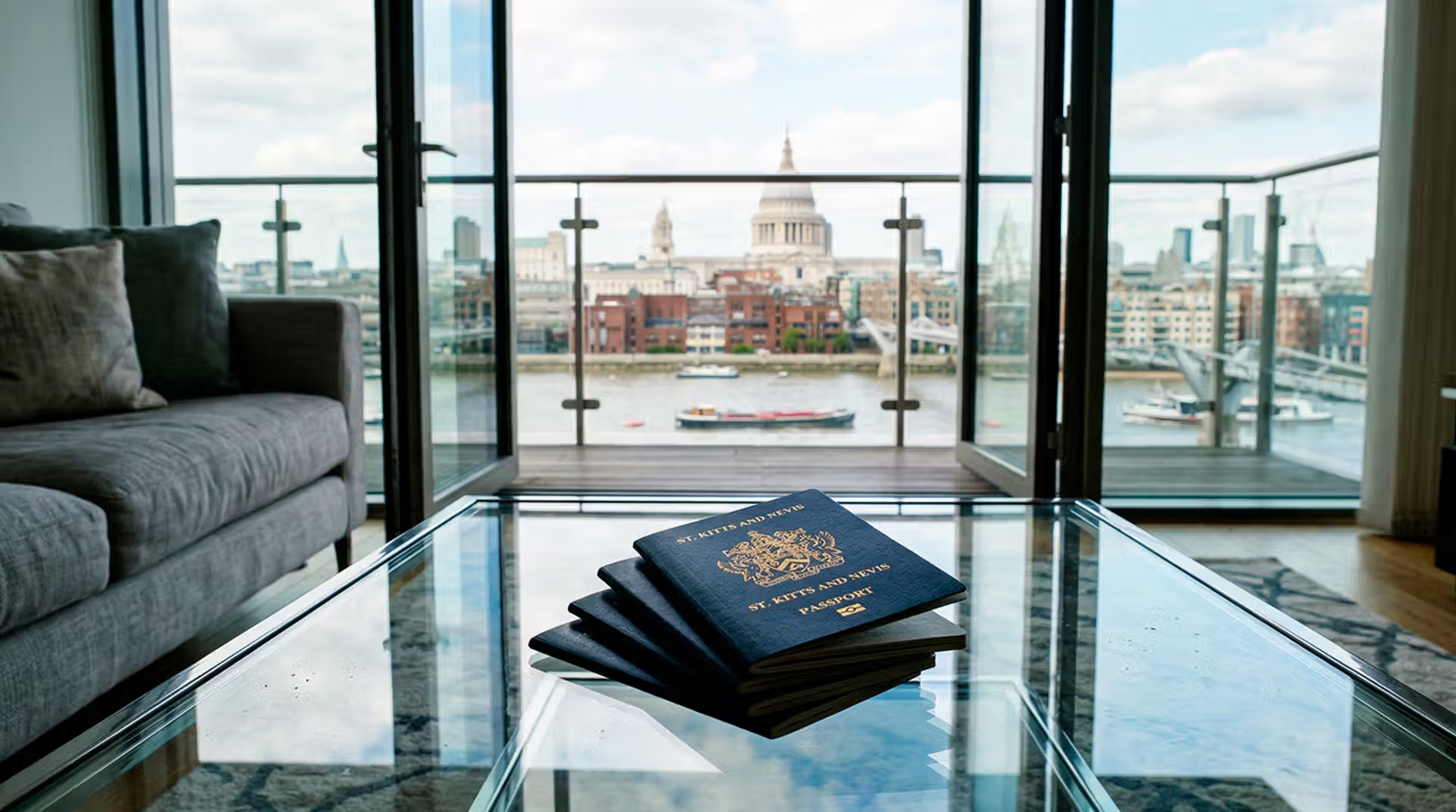
A critical component of this money laundering case involves the strategic acquisition of a St. Kitts and Nevis passport, a common tool in citizen-by-investment schemes. Such documents, often referred to as golden passports, allow individuals to bypass certain visa requirements and establish corporate entities with less immediate scrutiny. Su Jiangbo allegedly used this Caribbean citizenship to register 12 different companies in the United Kingdom corporate registry, Companies House. At least 10 of these domestic firms were then utilized as vehicles to purchase the 85 properties across central and south London. Under the current U.K. Money Laundering, Terrorist Financing and Transfer of Funds Regulations, the use of such passports should technically trigger enhanced due diligence. However, the ease with which these companies were formed and used for bulk property deals suggests a gap in the practical application of these safeguards. The investigation notes that the suspect also holds Cambodian citizenship, further complicating the jurisdictional profile presented to banks and legal firms. By layering ownership through multiple corporate shells and using alternative nationalities, the suspect managed to obscure his status as a fugitive wanted for serious crimes in China. This highlights how offshore identity products can be weaponized to integrate suspect funds into stable, high-value asset classes like London real estate.
Beyond the initial acquisition of identity documents, the use of shell companies in this case served as a classic layering technique. By spreading the $108 million across 10 different corporate entities, the suspect reduced the visibility of any single massive transaction. This fragmentation is a standard tactic used to avoid triggering the internal reporting thresholds of financial institutions and real estate agents. Furthermore, the selection of a St. Kitts and Nevis passport provided a layer of plausible deniability regarding the suspect’s primary residence and tax obligations. When a foreign investor presents a passport from a Commonwealth nation, they may be perceived as a lower risk than an individual applying directly from a jurisdiction known for high levels of capital flight. The Su Jiangbo case illustrates that the mere possession of an investment citizenship document should be viewed as a high-risk indicator in its own right. Regulatory bodies have frequently warned that these schemes are vulnerable to abuse by individuals looking to distance themselves from their criminal history in their home countries. The ongoing investigation aims to determine exactly how many financial gatekeepers were presented with these documents and whether any of them performed the necessary cross-checks against the international most wanted lists. The intersection of corporate secrecy and secondary citizenship remains one of the most significant hurdles for modern anti-money laundering enforcement.
Vulnerabilities in the New Build Real Estate Sector
The acquisition of 85 apartments in brand new developments reveals specific vulnerabilities within the real estate sector that money launderers frequently exploit. New build projects are particularly attractive for bulk deals, where a single buyer can purchase dozens of units off plan before they are even completed. In the case of the Triptych Bankside development, the suspect purchased 15 flats for approximately $26.5 million without ever visiting the site. Such transactions are often welcomed by developers who are eager to secure large capital injections to de-risk their projects. While law firms and real estate agents are legally required to perform anti-money laundering checks, the developers themselves may not have the same level of direct regulatory responsibility. This creates a fragmented oversight environment where sophisticated actors can slip through the cracks. Experts suggest that criminals favor the new build market because it allows for the rapid placement of large sums of cash into a single, manageable portfolio. Once these properties are acquired, they can be used to generate rental income that appears entirely legitimate, effectively completing the integration phase of the laundering cycle. The current investigation is examining the role of various law firms involved in the conveyancing process to determine if they met their statutory obligations to verify the source of funds for such unusually large and complex transactions.
The attractiveness of the London new-build market for illicit finance is partly due to the speed and anonymity it offers. Developers often market these properties globally, attracting offshore investors who may never intend to live in the units. This “buy to leave” phenomenon provides a perfect cover for laundering operations, as the properties function more like high-stakes savings accounts than residential homes. When a single individual is able to negotiate a bulk deal for 15 units at once, the financial incentive for the seller to overlook minor discrepancies in the buyer’s profile becomes significant. This inherent conflict of interest within the real estate industry is a major point of concern for the Financial Action Task Force. In the Su Jiangbo case, the absence of the buyer from the physical location of the sale is a classic red flag that should have prompted more rigorous questioning regarding the source of wealth. The investigation suggests that the suspect’s ability to commit nearly $24 million to a single development without raising alarm bells highlights a failure in the “know your customer” protocols of the associated legal and brokerage firms. To combat this, authorities are calling for a more holistic approach to real estate regulation, where every party in the transaction chain is held strictly accountable for identifying the ultimate beneficial owner and the legitimacy of their capital.
Future Implications for Unexplained Wealth Orders
The freezing of $108 million in real estate serves as a litmus test for the effectiveness of Unexplained Wealth Orders in the current legal landscape. Introduced in 2018, these orders were designed to empower authorities to seize assets from individuals who cannot justify their wealth relative to their known lawful income. However, the process is far from automatic and involves a high burden of proof during the subsequent civil recovery stages. Su Jiangbo now faces a three-month window to provide documented evidence that the millions used for his London portfolio were obtained through legal means. If he fails to satisfy the High Court, the Crown Prosecution Service may move toward permanent forfeiture of the properties. This case is being closely watched by anti-corruption advocates and international regulators as a sign of whether the U.K. is willing to aggressively pursue high-net-worth individuals with suspicious backgrounds. The outcome will likely influence how future cases involving international fugitives and offshore wealth are handled by British courts. It also emphasizes the need for tighter cooperation between international law enforcement agencies to ensure that fugitives cannot simply buy their way into safe havens. As the investigation continues, the focus will remain on the transparency of the global financial system and the ability of national authorities to pierce the veil of corporate secrecy.
The long term success of the Unexplained Wealth Order regime depends on the ability of the state to win high-stakes legal battles against well-funded defendants. In the Su Jiangbo case, the defendant is expected to deploy a sophisticated legal team to argue that his funds were the result of legitimate business ventures in Cambodia and Singapore. This highlights the “asymmetry of resources” often found in international money laundering cases, where individual suspects can spend millions on legal defense to protect billions in assets. If the Crown Prosecution Service successfully secures a forfeiture order for the 85 properties, it will send a powerful deterrent message to other transnational criminals viewing London as a “safe laundry.” Conversely, a failure to hold the assets could lead to criticisms that the U.K.’s anti-money laundering laws are more symbolic than functional. This case also brings into focus the role of professional enablers, such as solicitors and accountants, who facilitate these massive capital flows. There is increasing pressure for the government to not only seize the assets but also to prosecute the professionals who fail to report suspicious activity. The resolution of this $108 million freeze will provide a clear indication of the actual strength of the U.K. anti-money laundering framework against sophisticated transnational financial crime and whether the legal system can truly close the door on illicit wealth.
Key Points
- The Crown Prosecution Service froze 85 luxury properties worth 108 million dollars linked to Su Jiangbo.
- The suspect used a St. Kitts and Nevis golden passport to create 12 U.K. shell companies for property acquisitions.
- Su Jiangbo is a fugitive wanted by Chinese authorities for alleged illegal gambling and cybercrime activities.
- The legal action involves the use of Unexplained Wealth Orders to investigate the source of the 108 million dollars.
- Acquisitions included a high-value penthouse and multiple units in new London developments like Triptych Bankside.
Related Links
- Crown Prosecution Service News and Updates
- United Kingdom Proceeds of Crime Act 2002 Guidance
- Financial Action Task Force Guidance on the Real Estate Sector
- U.K. Government Unexplained Wealth Orders Fact Sheet
- National Crime Agency Civil Recovery and Tax Information
Other FinCrime Central Articles About London Being a Safe Harbor for Laundered Money Real Estate Investments
- London Real Estate Market Faces Continuous Questions Over $17M Deal By Sanctioned Criminal
- Dinosaur Bones and London Penthouses Exposed in a $2.3B Laundering Case
- Hidden Wealth Exposed London Mansion Linked to Iranian Sanctioned Banker
Source: OCCRP
Some of FinCrime Central’s articles may have been enriched or edited with the help of AI tools. It may contain unintentional errors.
Want to promote your brand, or need some help selecting the right solution or the right advisory firm? Email us at info@fincrimecentral.com; we probably have the right contact for you.