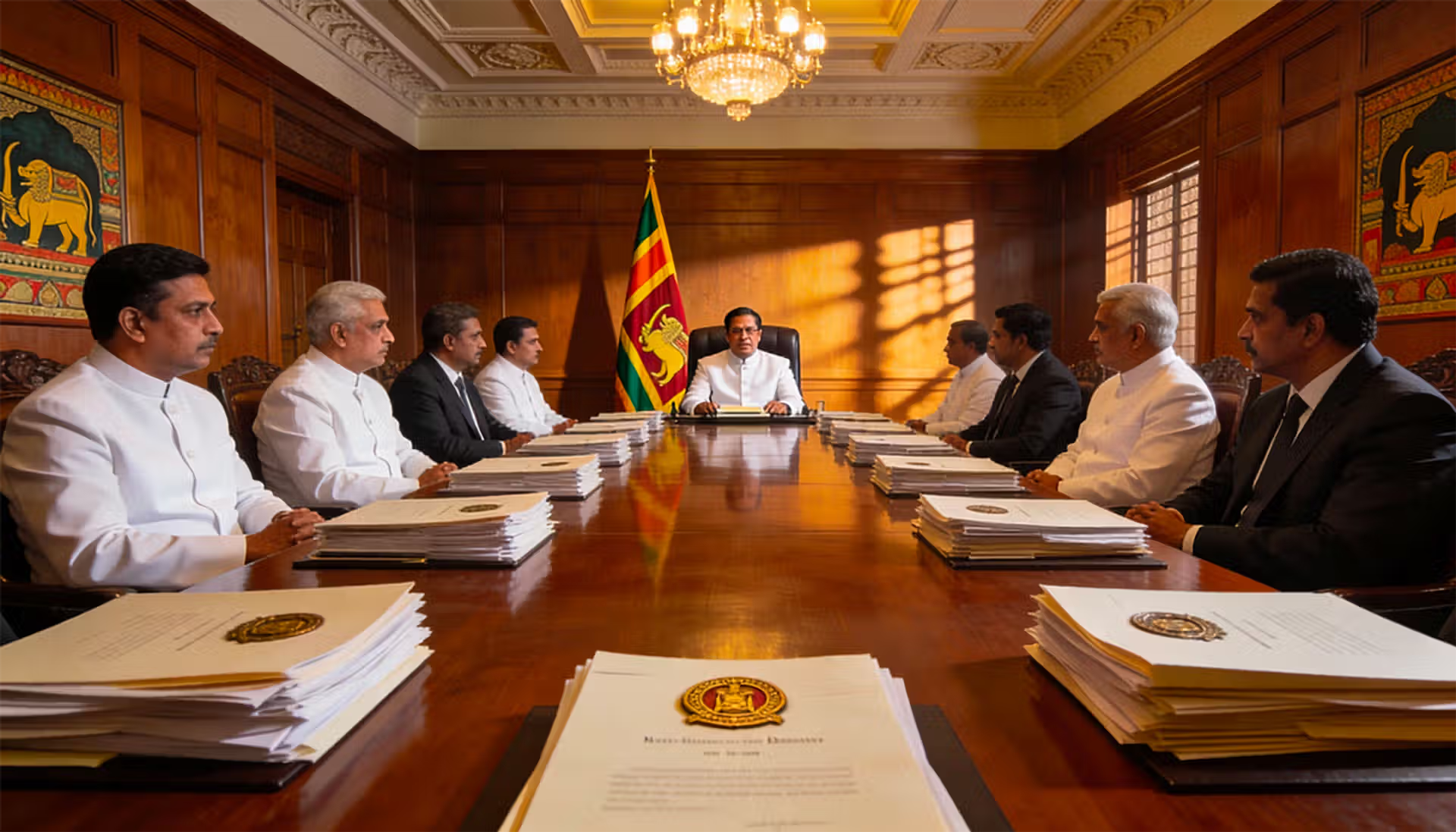
President Anura Kumara Dissanayake has initiated an urgent high-level oversight process to ensure Sri Lanka avoids the severe financial penalties and economic restrictions associated with international grey listing. The government is currently addressing critical gaps in legal frameworks and staffing to meet the stringent requirements of the Financial Action Task Force. By prioritizing these reforms, the administration aims to protect the national economy from the reputational damage and increased transaction costs that follow a negative evaluation. Failure to comply with global standards could lead to restricted access to international capital markets and a significant decline in foreign investor confidence.
Table of Contents


Sri Lanka Third Mutual Evaluation preparations
The current administration has placed the highest priority on the upcoming assessment conducted by the Asia Pacific Group on Money Laundering. This evaluation serves as a comprehensive audit of the ability of the nation to detect, prevent, and prosecute financial crimes. President Dissanayake has made it clear that the government must demonstrate both technical compliance with global recommendations and the practical effectiveness of its internal systems. To achieve this, a specialized operational committee has been tasked with monitoring the progress of over twenty-five different state institutions. The primary goal is to ensure that the country does not repeat the mistakes of the past, which previously led to inclusion on the watch list of the Financial Action Task Force. This heightened level of presidential involvement signals a shift toward greater accountability and a more robust approach to financial integrity.
Government officials are currently working under strict deadlines to rectify administrative bottlenecks that have historically hindered the enforcement of anti-money laundering protocols. The President has demanded that all pending legislative amendments be expedited to align domestic laws with international expectations. There is a specific focus on the eleven immediate outcomes defined by global regulators, which measure how well a country actually implements its laws in the real world. This includes the effectiveness of financial intelligence units, the success of criminal investigations, and the recovery of illicit assets. By framing this as a matter of national security and economic survival, the leadership is attempting to break through the bureaucratic inertia that often slows down complex legal reforms.
Strategic engagement with the private sector is also a critical component of this preparation phase. Banks, casinos, and real estate agents are being reminded of their obligations to report suspicious transactions and maintain rigorous customer due diligence records. The government recognizes that legal frameworks are only as strong as the entities tasked with day-to-day monitoring. Consequently, the central bank has stepped up its supervisory role to ensure that reporting entities understand the gravity of the upcoming evaluation. Any lapse in the private sector could be viewed as a systemic failure by international assessors, potentially triggering the very penalties the state is trying to avoid.



Mitigating the risks of global financial scrutiny
The threat of being placed on the grey list carries heavy consequences for any developing economy seeking stable growth. Such a designation alerts the global community that a jurisdiction has strategic deficiencies in its regimes to counter money laundering and terrorist financing. For Sri Lanka, this could mean that every international wire transfer or foreign investment project undergoes much higher levels of scrutiny, leading to delays and increased costs. The President has emphasized that the country must move beyond mere surface-level changes and instead focus on great structural improvements. This involves ensuring that the Financial Intelligence Unit of the Central Bank has the necessary resources and authority to operate without political interference.
Recent meetings with the Attorney General, the Inspector General of Police, and the Governor of the Central Bank have highlighted the need for a unified front against financial crime. One of the major challenges identified is the shortage of specialized personnel capable of handling complex forensic accounting and legal prosecutions. To address this, the government is considering the re-engagement of experienced retired professionals to bolster the ranks of investigative agencies. There is also a push to ensure that officers who have received specialized training in financial crimes remain in their positions rather than being rotated to unrelated departments. This strategy is designed to build a sustainable base of expertise that can satisfy the rigorous standards of international assessors during their visit.
Beyond staffing, the technological infrastructure of investigative bodies is receiving a significant upgrade. Modern money laundering schemes often utilize digital assets and complex shell company structures that require advanced data analytics to unravel. The administration is looking to implement new software solutions that can track cross-border fund movements in real time. By digitizing the surveillance process, the state hopes to reduce the time it takes to identify high-risk entities and initiate legal action. This technological shift is also intended to demonstrate to the Asia Pacific Group that the country is capable of handling contemporary financial threats that transcend traditional banking borders.
Strengthening institutional frameworks and legal compliance
The history of financial regulation in the country provides a cautionary tale regarding the dangers of complacency. Shortcomings identified during the evaluations in 2006 and 2014 eventually led to the 2017 grey listing, which the current government is desperate to avoid repeating. Current efforts involve a massive coordination exercise between the Ministry of Justice, the Ministry of Finance, and various law enforcement bodies. The President has instructed the Legal Draftsman’s Department to prioritize all work related to financial integrity to ensure that no technicality stands in the way of a positive review. This legal overhaul is intended to provide prosecutors with better tools to track the flow of illicit funds and to dismantle the networks that facilitate the movement of dirty money.
Furthermore, the government is looking to enhance its international cooperation mechanisms to facilitate the exchange of information with foreign jurisdictions. Money laundering is rarely a localized issue and often involves cross-border transactions that require seamless communication between global law enforcement agencies. By improving the speed and quality of response to mutual legal assistance requests, the nation hopes to prove its commitment to the global fight against organized crime. The upcoming report from the Special Task Force will provide a detailed roadmap of the remaining tasks that must be completed before the final assessment in November. This document is expected to highlight any remaining gaps in the system and propose immediate solutions to ensure full compliance with the mandates of the Financial Action Task Force.
Judicial efficiency is another area receiving intense scrutiny under the new presidential directives. Historically, the prosecution of financial crimes has been plagued by lengthy delays in the court system, often taking years to reach a verdict. This lack of swift justice is frequently cited by international bodies as a sign of an ineffective anti-money laundering regime. To counter this perception, the government is exploring the creation of specialized courts or dedicated benches to handle financial offenses exclusively. Speeding up the legal process serves as a deterrent to potential criminals and proves to global monitors that the nation possesses the political will to hold offenders accountable.
Enhancing economic stability through financial integrity
Ensuring a clean bill of health from international regulators is not just a legal necessity but a fundamental component of the broader economic recovery strategy. A stable and transparent financial system is essential for attracting high-quality foreign direct investment and for maintaining healthy relationships with international lenders. The President has linked the success of these anti-money laundering efforts directly to the principles of good governance and transparency. By cleaning up the financial sector, the government intends to create an environment where legitimate businesses can thrive without the unfair competition posed by entities involved in illicit activities. This focus on integrity is expected to lower the risk profile of the country in the eyes of global rating agencies and banking institutions.
The final months leading up to the evaluation will be characterized by intense activity across all levels of the state apparatus. There is a clear mandate to resolve any conflicts of interest and to ensure that leadership roles within key agencies are filled by qualified individuals. The use of one-year contracts for retired experts and the acceleration of promotions within the public service are tactical moves to ensure that the best available talent is focused on this single objective. As the November deadline approaches, the government is signaling to the world that it is prepared to take whatever steps are necessary to maintain its standing in the global financial community. The success of this initiative will be measured not just by a technical report but by the long-term resilience and credibility of the national economy.
Ultimately, the goal is to build a system that is resilient enough to withstand the scrutiny of the global financial community without requiring constant presidential intervention. The current focus on legislative reform, human resource management, and technological integration provides a solid foundation for this ambition. By treating the upcoming evaluation as a national priority, Sri Lanka is attempting to shed its past reputation and emerge as a responsible participant in the global financial system. The coming months will determine whether these efforts are sufficient to convince the international community that the nation has truly turned a corner in its fight against financial crime.
Key Points
- A special task force report is due within two weeks to outline the final steps required for full international compliance.
- President Dissanayake is personally overseeing the preparation for the third mutual evaluation to prevent international grey listing.
- The government is fast tracking legal and administrative reforms to meet the forty recommendations set by global regulators.
- Critical staffing shortages in investigative agencies are being addressed through the re engagement of experienced retired professionals.
- Failure to achieve a positive evaluation could lead to increased costs for cross border transactions and a decline in foreign investment.
Related Links
- United Nations Office on Drugs and Crime Anti-Money Laundering Portal
- FATF Methodology for Assessing Compliance with the FATF Recommendations
- APG Mutual Evaluation Reports and Procedures
- Sri Lanka Financial Intelligence Unit Statutory Acts
- High-risk and Other Monitored Jurisdictions FATF Grey List
Other FinCrime Central Articles About Sri Lanka
- Sri Lanka Governor Warns of Devastating 2026 Financial Integrity Review
- Sri Lanka Faces a Make-or-Break Moment in AML Reform
- Sri Lanka FIU fines Casinos: Bally’s, Bellagio, and NSB penalized
Source: Daily FT
Some of FinCrime Central’s articles may have been enriched or edited with the help of AI tools. It may contain unintentional errors.
Want to promote your brand, or need some help selecting the right solution or the right advisory firm? Email us at info@fincrimecentral.com; we probably have the right contact for you.