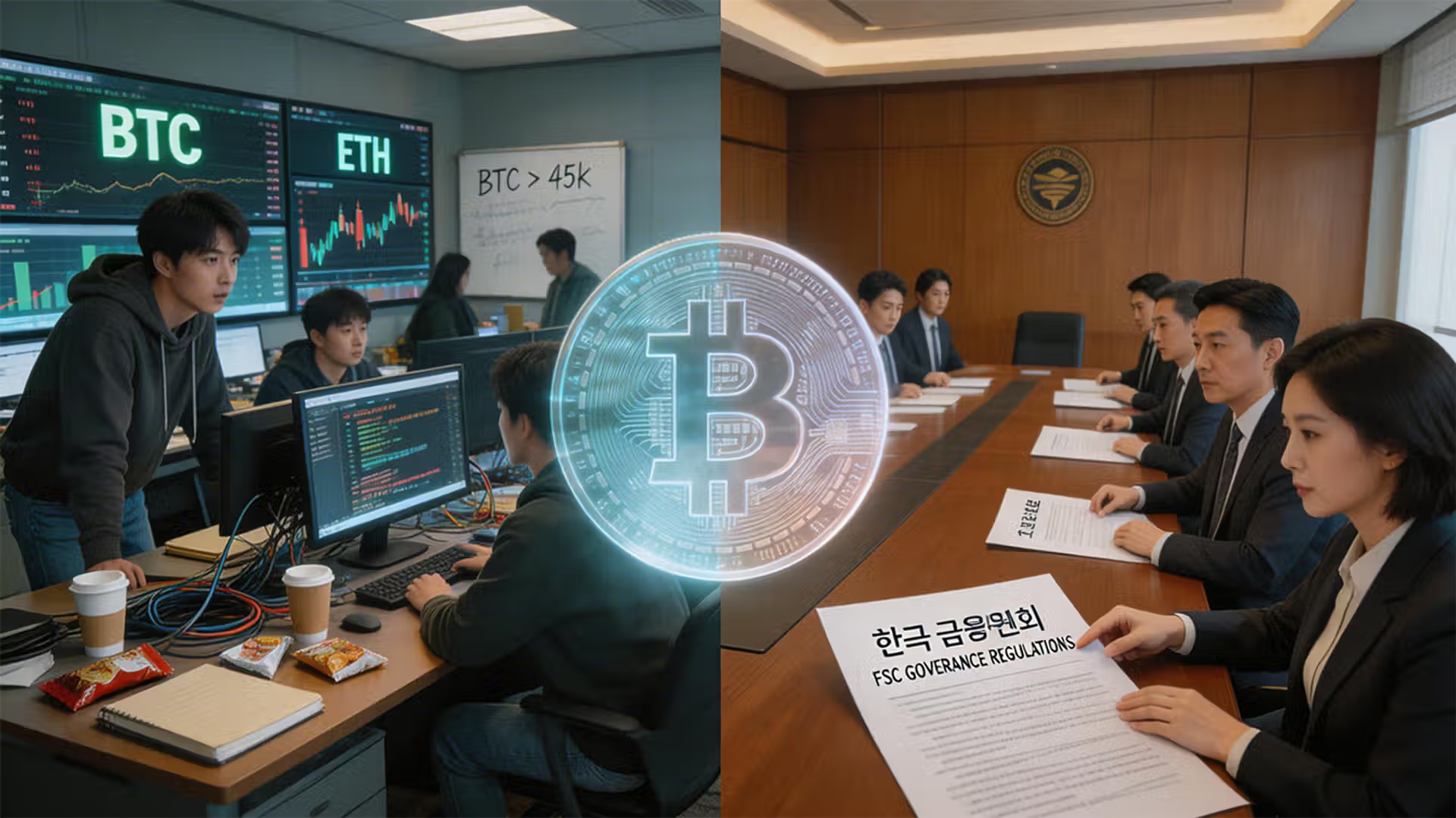
South Korea has officially moved to enforce a strict 20 percent ownership cap on digital asset exchanges, a decision that directly impacts a market where major platforms like Bithumb and Gopax are typically controlled by dominant shareholders with stakes exceeding 60 percent. This regulatory shift, spearheaded by the Financial Services Commission, aims to dismantle concentrated power structures that have historically obscured beneficial ownership and complicated anti-money laundering oversight. Under the new Digital Asset Basic Act, exchanges must restructure their entire equity composition within a three year period or face severe administrative penalties, including the potential revocation of their operating licenses. By mandating a more diversified shareholder base, the government seeks to instill traditional banking governance standards into the volatile virtual asset sector, ensuring that no single entity can bypass internal controls to facilitate illicit financial flows.
Table of Contents


Digital Asset Basic Act Compliance
The implementation of the Digital Asset Basic Act represents a watershed moment for the South Korean financial landscape, as it introduces a comprehensive legal framework designed to enhance market integrity and investor protection. This legislation is not merely a suggestion but a mandatory overhaul of how virtual asset service providers must organize their corporate governance to remain operational. By limiting the influence of individual major shareholders, the Financial Services Commission seeks to eliminate the opaque ownership structures that have frequently shielded ultimate beneficial owners from regulatory scrutiny. This move is particularly critical given the immense volume of retail trading in South Korea, which necessitates a level of transparency that matches the systemic importance of these platforms. The act requires that any individual or corporate entity holding a significant stake undergo a rigorous vetting process to ensure they meet the strict fit and proper requirements usually reserved for leaders of commercial banks and insurance companies.
Beyond the immediate mechanics of the equity cap, the act establishes a permanent reporting mechanism where exchanges must provide real-time updates on their shareholder registries to the Korea Financial Intelligence Unit. This level of granular oversight is intended to close loopholes that previously allowed concentrated blocks of shares to be utilized for market manipulation or the concealment of high-value money laundering schemes. The global regulatory community, including the Financial Action Task Force, has long advocated for such measures in jurisdictions with high crypto adoption. By anchoring these requirements in a formal legal act, the South Korean government provides a clear and uncompromising roadmap for compliance that signals the end of the era of discretionary self-regulation. For exchanges, this means that every board decision and every change in equity must now be justified under the watchful eye of state auditors who are focused on maintaining the purity of the national financial system.



Structural Impacts on Major Exchanges
The structural fallout of this 20 percent ownership mandate will be felt most acutely by the industry giants that have long enjoyed centralized control. For example, Bithumb Holdings currently maintains an equity stake exceeding 70 percent in its namesake exchange, a figure that is more than triple the new legal limit and represents a massive hurdle for restructuring. Similarly, international entities like Binance, which holds over 65 percent of the local platform Gopax, will be forced to find domestic or international buyers to significantly dilute their influence. This forced divestment is a complex financial maneuver that goes beyond simple share sales, as it requires the identification of multiple new investors who are themselves willing to undergo intense regulatory background checks. The sheer volume of equity that must move through the market in the coming years could lead to a significant reshuffling of the power dynamics within the Asian crypto corridor.
While the government has provided a three-year grace period for major exchanges to reach the 20 percent threshold, the pressure to begin this transition immediately is immense. A fire sale of equity could lead to undervalued transactions, yet waiting too long might leave companies unable to find qualified buyers before the deadline expires. Smaller platforms may receive an additional three years of flexibility, acknowledging the inherent difficulty that boutique firms face in attracting a diverse array of institutional capital. However, the overarching objective remains uniform across all tiers of the industry, which is the total decentralization of corporate power to ensure that no single bad actor can override anti-money laundering protocols through executive decree. This period of transition will likely see a surge in legal and financial consulting as these multi-billion-dollar entities attempt to pivot toward a more fragmented, yet more transparent, ownership model.
Beneficial Ownership and Transparency Mandates
At the fundamental core of this regulatory push lies the concept of beneficial ownership, which remains the primary tool for authorities to prevent the use of cryptocurrency for financial crimes. In the past, the use of complex webs of holding companies and offshore shell entities allowed individuals to maintain absolute control over South Korean exchanges while remaining technically invisible to regulators. The 20 percent cap acts as a mechanical barrier against these practices, making it statistically and legally much more difficult for a single individual to dominate a board of directors. By spreading ownership across a wider base of stakeholders, the law fosters a natural system of internal checks and balances where different investors have a financial and legal incentive to ensure the exchange complies with every facet of the law. This shift toward transparency is an essential step in maturing the crypto market from a speculative frontier into a legitimate pillar of the broader economy.
Furthermore, the Financial Services Commission has signaled that the rare exceptions allowing up to 34 percent ownership will be strictly limited to new market entrants under very specific, non-negotiable conditions. This indicates a strategic desire to foster fresh competition and innovation while simultaneously keeping a very tight leash on the established players who have dominated the market for years. The focus on beneficial ownership also aligns with the latest international guidelines, which urge member nations to tighten their definitions of control in the virtual asset space to prevent tax evasion and the funding of prohibited activities. For South Korean exchanges, this means that every shareholder, no matter how small their stake, must be prepared for deep dives into their financial history, source of wealth, and past business associations. The era of anonymous or silent partnership in the South Korean crypto industry is effectively over, replaced by a regime of total disclosure.
Governance Evolution in the Crypto Sector
The transition toward these new ownership limits represents a profound evolution of the South Korean crypto sector from an unregulated experiment to a professionalized financial subsector. While industry advocacy groups like the Digital Asset eXchange Alliance have voiced significant concerns regarding the infringement of property rights and the potential for stifled innovation, the government remains resolute in its stance that national financial stability outweighs individual corporate autonomy. The regulatory perspective is that a healthy, transparent market will ultimately attract more stable institutional investment from the West, which has historically been hesitant to enter markets with murky or concentrated governance structures. This evolution is seen as a necessary prerequisite for integrating digital assets into the mainstream economic fabric without compromising the security of the traditional banking system or the safety of retail investors.
As the 2029 deadline for full compliance approaches, the industry can expect a wave of mergers, acquisitions, and perhaps even initial public offerings as exchanges seek to diversify their lists of shareholders. This period of consolidation will likely result in a more sophisticated management class within the crypto space, as traditional financial experts are recruited to satisfy the new regulatory demands and navigate the complexities of diversified boardrooms. The long term impact will likely be a marked reduction in the frequency of exchange-related scandals, as the structural incentives for fraud and self-dealing are diminished by the presence of independent and competing shareholders. South Korea is essentially constructing a legal fortress against financial crime by ensuring that the metaphorical keys to the digital kingdom are never held by just one person or one company. This commitment to transparency sets a high bar for the rest of the world and establishes South Korea as a leader in the global fight against money laundering in the digital age.
Key Points
- South Korea is implementing a 20 percent maximum ownership limit for major shareholders in cryptocurrency exchanges to enhance corporate transparency and governance.
- The Digital Asset Basic Act provides a mandatory three-year window for established exchanges to restructure their equity and comply with these new transparency mandates.
- The Financial Services Commission intends to align the cryptocurrency industry with the same anti-money laundering standards used by the traditional banking sector.
- Major entities like Bithumb Holdings and Binance must significantly reduce their current stakes in local platforms to meet the upcoming legal requirements.
- Failure to adhere to these beneficial ownership rules can result in operational suspensions, heavy administrative fines, or the total loss of business licenses.
Related Links
- Financial Services Commission Official Regulatory Updates
- Korea Financial Intelligence Unit AML Compliance Guidelines
- FATF Recommendations on Virtual Assets and Beneficial Ownership
- Bank of Korea Research on Digital Asset Oversight
Other FinCrime Central Articles About Korean Regulation Updates
- KoFIU Announces AML/CFT Policy Agendas for 2026
- Korea Financial Intelligence Unit (KoFIU) Revamps Regulatory Compliance Standards
- Major Shift in South Korea’s KoFIU AML Response to Transborder Crime Tactics
Source: Coin Edition
Some of FinCrime Central’s articles may have been enriched or edited with the help of AI tools. It may contain unintentional errors.
Want to promote your brand with us or need some help selecting the right solution or the right advisory firm? Email us at info@fincrimecentral.com; we probably have the right contact for you.