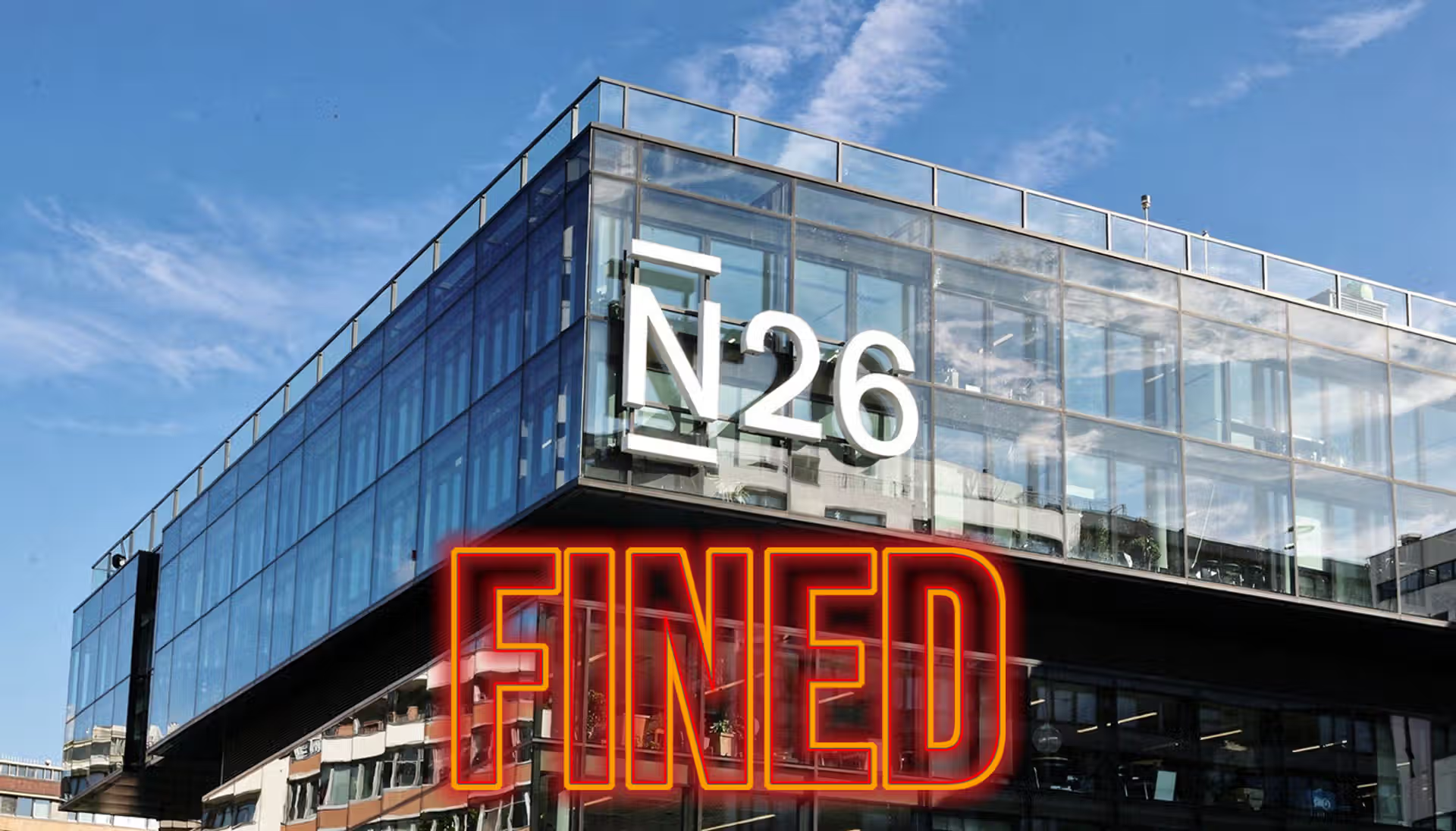
The German Federal Financial Supervisory Authority, BaFin, imposed a substantial €9.2 million fine on N26 Bank SE, due to systemic and repeated failings in the bank’s procedures for the prevention of money laundering. This significant penalty, legally binding since May 2024, followed a previous fine of €4.25 million issued in 2021 for similar violations, underscoring persistent compliance challenges at the rapidly expanding digital bank. The regulator’s ongoing scrutiny escalated with the appointment of a special monitor to oversee the implementation of remedial actions, highlighting the seriousness of the systemic deficiencies identified. This regulatory action is a clear signal that fast growth must not compromise the integrity of financial crime controls, especially within the fintech sector.
Table of Contents


Persistent Anti-Money Laundering Failures
Repeated breaches of German anti-money laundering (AML) law have been central to the regulatory actions taken against N26. The €9.2 million administrative fine was specifically imposed because the bank consistently filed reports of suspected money laundering activities with the Financial Intelligence Unit too late throughout 2022. Timely filing of suspicious activity reports (SARs) is a cornerstone of the global anti-money laundering regime, as delays can severely hamper the ability of law enforcement to interdict illicit funds and apprehend criminal networks. BaFin’s repeated findings underscore a struggle by the bank to scale its compliance infrastructure in pace with its immense customer growth, leading to a breakdown in fundamental protective mechanisms. In addition to the late SARs, a special audit conducted in 2024 revealed wider, serious deficiencies in the bank’s organizational setup, particularly concerning risk management and the overall organization of its lending business, further violating provisions of the German Banking Act (KWG). The combination of historical and recent failings points to an institutionalized weakness in ensuring a proper business organization capable of meeting its regulatory responsibilities in the fight against financial crime. This inability to establish and maintain robust controls necessitated the increased supervisory involvement and restrictive measures by the German watchdog.
The Enforcement Tools of BaFin and KWG
The German Banking Act (KWG) provides BaFin with extensive powers to address organizational and compliance deficiencies at supervised institutions. Specifically, Section 25a of the KWG mandates that credit institutions establish and maintain a proper business organization, which includes effective risk management and internal control mechanisms necessary for identifying, assessing, and managing all material risks, including those related to money laundering. When BaFin concludes that an institution’s organization is deficient, it must intervene. The actions against N26 included the appointment of a special representative, a supervisory tool explicitly authorized under the KWG, to monitor the execution of the ordered measures and report directly to the regulator. Furthermore, BaFin imposed additional capital requirements on the institution. Such requirements are intended to cover the heightened risks stemming from a non-compliant business organization, acting as a financial disincentive and a buffer against potential losses. The regulator also enforced specific business restrictions, such as prohibiting the bank from conducting new mortgage lending business in the Netherlands and securitizing claims from that business, directly mitigating risk exposure in a specific market where deficiencies were identified.
Impact of Growth and Technology on AML Compliance
The regulatory challenges faced by N26 are highly instructive for the broader fintech industry, illustrating the critical tension between aggressive expansion and the necessity of rigorous compliance. Digital banks, with their rapid onboarding processes and high volume of transactions across multiple jurisdictions, inherently face amplified anti-money laundering risks. The speed of growth at N26 demonstrably outpaced the development and implementation of commensurate control systems, leading to a volume of suspicious activity that overwhelmed its existing reporting mechanisms. This rapid scaling of operations without a corresponding investment in sophisticated, automated, and adequately staffed financial crime frameworks created vulnerabilities that were subsequently exploited by illicit actors. The case demonstrates that while technology enables massive scale, the responsibility for maintaining the integrity of the financial system—by verifying customer identities, monitoring transactions effectively, and filing timely SARs—remains firmly with the institution. Regulators worldwide are increasingly focused on whether a firm’s technology is leveraged effectively not just for customer acquisition, but also for robust financial crime mitigation, particularly in the realm of perpetual, real-time transaction monitoring.
Strengthening the Compliance Framework
The multi-faceted intervention by BaFin serves as a template for regulatory response to systemic compliance failures within the digital banking space. The enforcement actions necessitate a complete overhaul and strengthening of N26’s anti-financial crime framework. The bank is required to implement appropriate and effective measures to establish a proper business organization. For its compliance function, this involves dedicating substantial resources to personnel and technical infrastructure, a process which N26 has publicly stated it has undertaken, investing over €80 million. The focus must be on improving customer identification processes, enhancing transaction monitoring systems to proactively flag suspicious patterns, and significantly reducing the lag in suspicious transaction report submissions. The appointment of a special representative ensures continuous, independent oversight of this remediation process, providing BaFin with a direct line of sight into the bank’s efforts to close the compliance gaps. This oversight mechanism aims to enforce a sustainable cultural shift toward prioritizing regulatory adherence over unchecked expansion, ensuring the institution fully adheres to its obligations under the German Money Laundering Act and the KWG.
Key Points
- The N26 case highlights the necessity for digital banks to prioritize robust anti-money laundering controls over rapid customer acquisition.
- BaFin imposed a €9.2 million fine on N26 for consistently late submission of suspicious activity reports, a fundamental AML failure.
- The German regulator appointed a special representative to monitor the bank’s compliance remediation efforts, signaling deep concern over the organizational deficiencies.
- Additional capital requirements and restrictions on new mortgage lending in the Netherlands were levied to mitigate risk stemming from the identified systemic flaws.
- The compliance failures violate the German Banking Act (KWG), which mandates a proper business organization capable of effective risk management and control.
Related Links
- BaFin – Official Website
- The German Banking Act (Kreditwesengesetz – KWG)
- FATF Guidance on Digital Identity
- The German Money Laundering Act (Geldwäschegesetz – GwG)
Other FinCrime Central Articles About Neobanks Being Sanctioned
- Revolut Fined €3.5 Million for AML Failures: What It Means for Digital Banks
- Monzo Penalized £21 Million as FCA Targets AML Lapses
- €214k AML Fine Reveals Serious Gaps In Alipay Europe Controls
Source: Bafin
Some of FinCrime Central’s articles may have been enriched or edited with the help of AI tools. It may contain unintentional errors.
Want to promote your brand, or need some help selecting the right solution or the right advisory firm? Email us at info@fincrimecentral.com; we probably have the right contact for you.