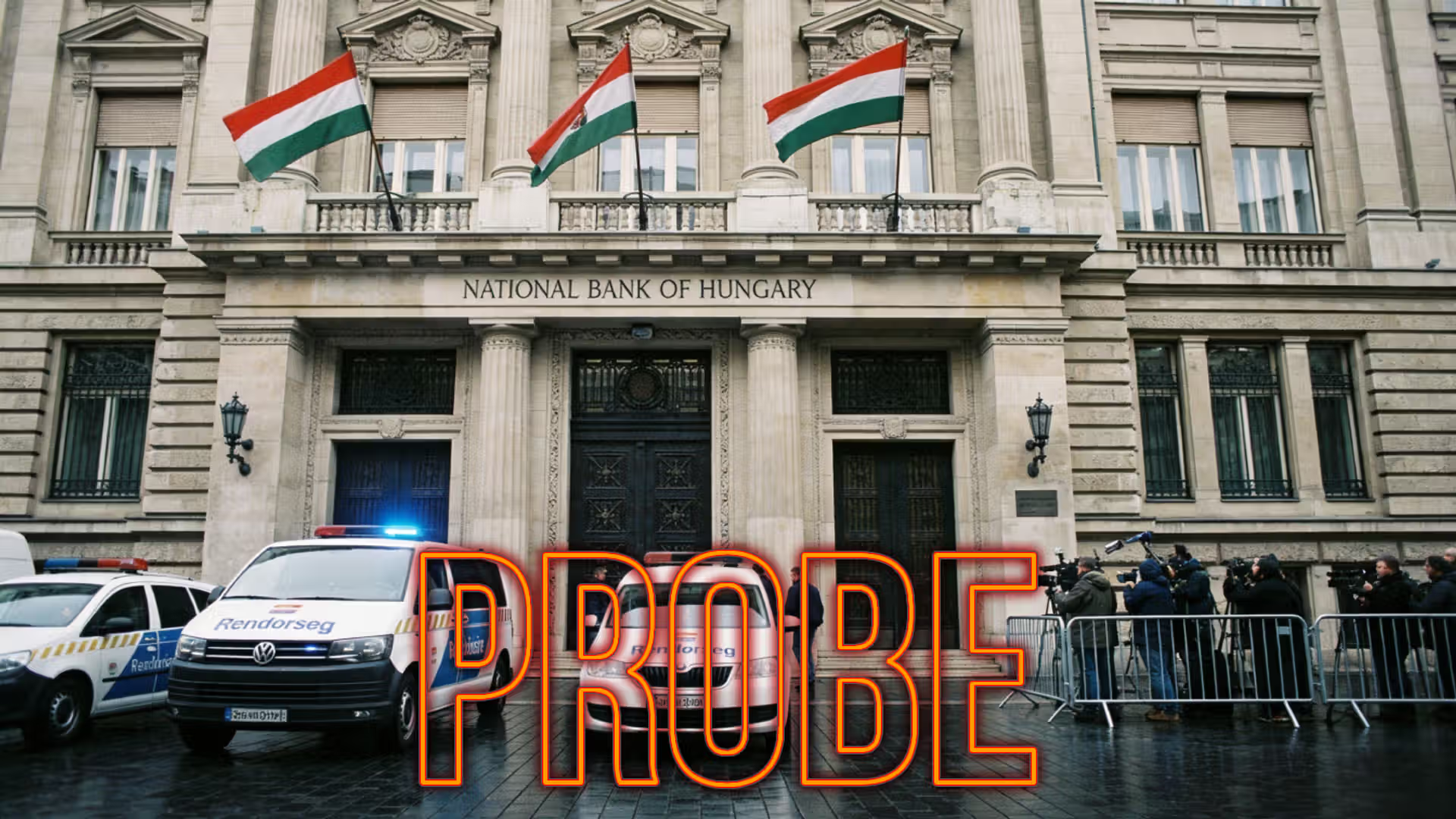
Hungarian prosecutors and police have successfully seized over 92 billion forints, equivalent to $300M, in banking accounts and securities during a massive investigation involving financial institutions linked to the central bank. The operational seizure targets deep structures of foundations created by the monetary authority years ago, highlighting major compliance vulnerabilities in state-adjacent entities. The National Bank of Hungary is cooperating fully with judicial authorities, delivering necessary documentation concerning activities that occurred before the current governance took office. This specific multi-million dollar asset freeze represents one of the largest regulatory and criminal enforcement actions in regional history regarding public assets and layered investment entities.
Table of Contents



Unpacking the Regulatory Impact of the Hungarian Central Bank Foundation Seizure
The structural scale of this money laundering probe reveals how public assets can be funneled through opaque investment systems to disguise their true origins. Investigators have targeted transactions tied directly and indirectly to the Pallas Athene Domus Meriti Foundation and the Neumann University Foundation, both established under previous central bank leadership. The State Audit Office initiated the scrutiny after identifying systemic issues regarding how public funds were deployed through asset management arms. By the time law enforcement officials briefed the public, the asset recovery process had successfully secured nearly ninety-two billion forints in liquid wealth and complex financial instruments. This aggressive seizure reflects a growing global trend where judicial authorities freeze assets early in financial crime investigations to prevent the flight of capital through cross-border networks. The cross-border mobility of illicit funds requires immediate, decisive containment strategies by state prosecutors.
To comprehend the full compliance breakdown, one must evaluate the total absence of traditional checks and balances within these state-adjacent vehicles. When state assets transfer into independent structures, standard transparency measures often dissolve. This creates an environment where money laundering risks escalate exponentially due to the lack of external oversight. Financial investigators are currently mapping every transaction executed by the asset management entities over a multi-year period to determine if placement, layering, and integration occurred systematically. The primary goal remains identifying whether these funds were intentionally obscured to mask unauthorized distributions or personal enrichment schemes. As regulatory bodies globally monitor this case, it underscores the critical necessity for comprehensive transaction monitoring even when dealing with entities birthed by a sovereign monetary authority.
The unfolding situation in Budapest has sent shockwaves through the regional financial sector, prompting compliance officers to reevaluate the risk profiles of all state-backed investment funds. Historically, public funds were viewed as low risk by default, but this investigation proves that structural design can introduce significant vulnerabilities. When public capital is blended with private equity models, the risk of asset diversion increases. Law enforcement agencies are using advanced data analytics to trace the historical flows of the ninety-two billion forints, looking for patterns that match classic laundering typologies such as round tripping or fictitious service invoicing. The sheer volume of data recovered during the recent raids suggests that this investigation will continue to expand, potentially capturing more interconnected entities across the European financial landscape.




Detailed Background of the Pallas Athene Domus Meriti Foundation and Neumann Structures
The background of the case involves the movement of massive amounts of state capital into independent foundations, which then utilized private equity frameworks and corporate layers to execute investments. According to official findings from the State Audit Office issued in March of the prior year, the asset management firm belonging to the Pallas Athene Domus Meriti Foundation oversaw nearly five hundred billion forints of total assets. Of this massive sum, four hundred seven billion forints originated entirely from public funds, raising immediate compliance and governance red flags. The audit agency stated that these substantial investments were processed through an essentially opaque corporate structure consisting of numerous secondary companies and private equity funds. This specific architecture severely restricted transparency, which eventually led the audit office to establish the suspicion of multiple criminal offenses and file an official complaint with the prosecutor’s office. A parallel criminal complaint was also submitted regarding the suspected mismanagement of public assets at the Neumann University Foundation, showing that the structural vulnerability extended across multiple central bank entities.
The deployment of four hundred seven billion forints of public money into private equity structures represents a classic risk scenario for financial crime analysts. Private equity funds inherently offer higher levels of confidentiality and less rigorous disclosure mandates compared to traditional public expenditures. By routing public capital through these vehicles, the creators of the foundations established a system where beneficial ownership and ultimate asset destinations became almost impossible to verify through standard auditing practices. This deliberate or negligent opacity forms the core of the money laundering suspicion, as it mimics the tactics used by sophisticated criminal syndicates to obfuscate the paper trail of illicitly acquired gains. Investigators are now tasked with peeling back each layer of the corporate onion to identify the natural persons who ultimately profited from these state-financed investment portfolios.
Furthermore, the involvement of an educational entity like the Neumann University Foundation demonstrates the diversity of the vehicles utilized in this alleged financial scheme. Educational and philanthropic foundations are frequently targeted by money launderers due to their favorable tax treatments and often relaxed regulatory reporting thresholds. When a central bank utilizes its sovereign prestige to fund such foundations, external compliance entities rarely subject them to enhanced due diligence. This systemic blind spot allowed the complex web of companies and funds to operate unhindered for years, accumulating vast wealth while shifting public resources into private or untraceable hands. The audit office report from March two thousand twenty five was the catalyst that finally pierced this veil of institutional immunity, forcing a full-scale criminal intervention.


Law Enforcement Operational Response and Current Scope of the Financial Investigation
The judicial response to these findings has resulted in a massive law enforcement operation targeting a vast web of interconnected corporate and individual actors. Over a recent forty-eight-hour window, prosecutors and police coordinated simultaneous searches across the premises of seventeen separate legal entities, securing a significant volume of physical documents and digital data. The ongoing criminal investigation currently implicates ninety-seven individuals, thirty-six corporate businesses, and eleven private equity funds, demonstrating the immense horizontal scale of the network under review. Senior police officials confirmed that the first major asset seizure occurred on April twenty three of the previous year, and consecutive enforcement actions have built the total frozen volume to the current three hundred million dollar mark. While law enforcement authorities are investigating the mismanagement of funds causing a particularly significant loss alongside laundering activities, no official criminal charges have been finalized against specific individuals at this stage of the judicial process.
The scale of the operational response, involving ninety-seven distinct individuals, highlights the complexity of the investigative task facing Hungarian authorities. Managing an anti-money laundering probe of this magnitude requires seamless coordination between forensic accountants, cybercrime units, and banking regulators. The digital data seized from the seventeen legal entities comprises terabytes of financial records, encrypted communications, and transaction logs that must be meticulously reconstructed. Police officials have indicated that the initial seizure in April of last year was merely the baseline, and subsequent discoveries within banking systems allowed them to systematically trace and freeze additional accounts. This rolling asset freeze strategy prevents targets from liquidating their positions or transferring wealth to offshore jurisdictions outside the reach of European mutual legal assistance treaties.
As the financial intelligence units analyze the relationships between the thirty-six businesses and eleven private equity funds, they are uncovering a highly sophisticated network of counterparty relationships. Many of these businesses appear to have existed solely to facilitate intercompany transfers, creating a noisy environment designed to defeat automated transaction monitoring systems. By routing funds through multiple corporate bank accounts within short timeframes, the network attempted to blend public funds with legitimate commercial flows. The forensic accounting team is working to isolate these specific layering paths to demonstrate a clear intent to conceal the origin and nature of the funds, which is a foundational requirement for securing formal money laundering convictions under domestic and European statutes.
Strategic AML Governance Failures and Future Implications for European State Entities
This case serves as a critical study of anti-money laundering governance failures within institutions that operate adjacent to the sovereign state. The former governor of the central bank, who held office from two thousand thirteen until March of two thousand twenty five, stated publicly that the monetary authority lacked a legal mandate to interfere with the operations or investments of these entities because the foundations acted independently. This defense highlights a classic structural loophole where public funds are transferred to independent legal vehicles that lack standard state procurement and transparency requirements, making them ideal targets for layering and integration placement phases. The political shift in Hungary has further accelerated the investigation, with the new prime minister asserting that past central bank operations must face rigorous scrutiny, leading to the creation of a dedicated parliamentary committee. For anti-money laundering compliance officers globally, this enforcement action demonstrates that even funds originating from a central banking authority require thorough transaction monitoring and source of wealth verification when flowing through private equity and opaque corporate shields.
The systemic lesson from this Hungarian banking scandal is that institutional independence must never equate to a compliance vacuum. When central banks set up external foundations, they must enforce identical, if not stricter, anti-money laundering controls than those required of commercial financial institutions. The assertion that the central bank could not intervene because the foundations were independent exposes a fatal flaw in regional regulatory architecture. This defense effectively argues that public funds can be stripped of their sovereign identity and protections simply by changing the legal classification of the holding entity. European regulatory bodies are likely to view this case as a catalyst for introducing stricter harmonization rules concerning how state entities manage external investment vehicles, ensuring that beneficial ownership transparency applies universally without exception.
In the broader context of continental compliance, this enforcement action signals a zero-tolerance approach toward high-level financial misconduct within the European Union border ecosystem. As parliamentary committees begin their detailed reviews, the documentation uncovered will likely provide a blueprint for how other jurisdictions can identify similar hidden vulnerabilities within their own state frameworks. Compliance professionals must absorb the reality that political changes can instantly expose historical transaction histories to intense judicial scrutiny. Ensuring robust, unassailable documentation regarding the source, path, and ultimate destination of every unit of currency is the only defense against future institutional liability. The three hundred million dollar seizure in Budapest is not an isolated event; it is an indicator of an era defined by aggressive asset recovery and structural accountability.
Key Points
- The Hungarian judiciary and law enforcement have frozen ninety-two billion forints, worth over three hundred million dollars, in an active laundering and fund mismanagement case.
- The criminal probe focuses on the financial transactions of the Pallas Athene Domus Meriti Foundation and the Neumann Foundation, both established by the central bank.
- The State Audit Office discovered that four hundred seven billion forints of public money flowed through highly opaque corporate networks and private equity funds.
- The ongoing enforcement operation currently spans ninety-seven individuals, thirty-six corporate entities, and eleven private equity funds across the financial sector.
Related Links
- Hungarian Prosecution Service Official Statements
- State Audit Office of Hungary Reports
- Central Bank of Hungary Anti Money Laundering Regulations
- Financial Action Task Force Mutual Evaluation of Hungary
Source: AOL, by by Krisztina Than
Some of FinCrime Central’s articles may have been enriched or edited with the help of AI tools. It may contain unintentional errors.
Want to promote your brand, or need some help selecting the right solution or the right advisory firm? Email us at info@fincrimecentral.com; we probably have the right contact for you.