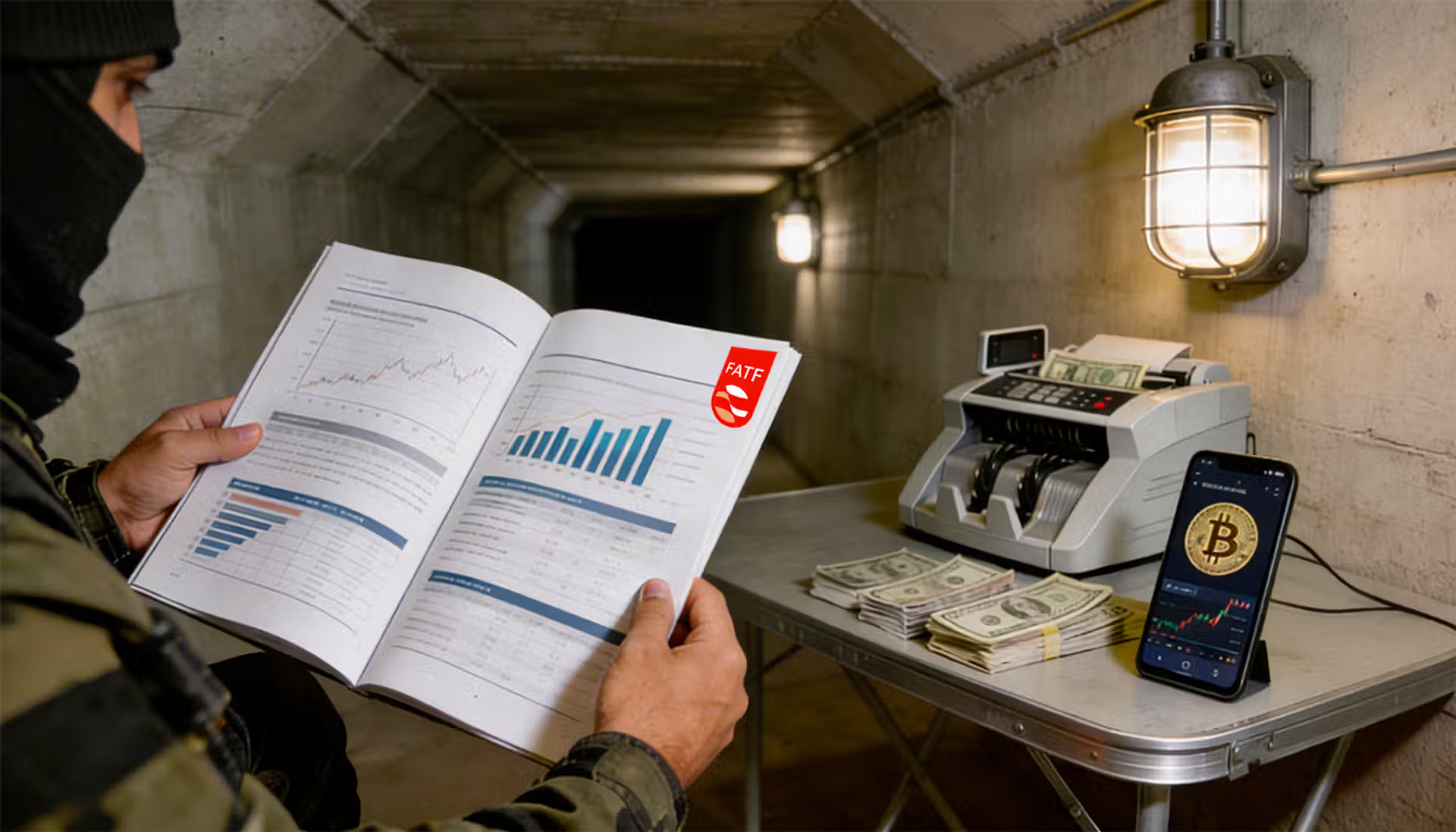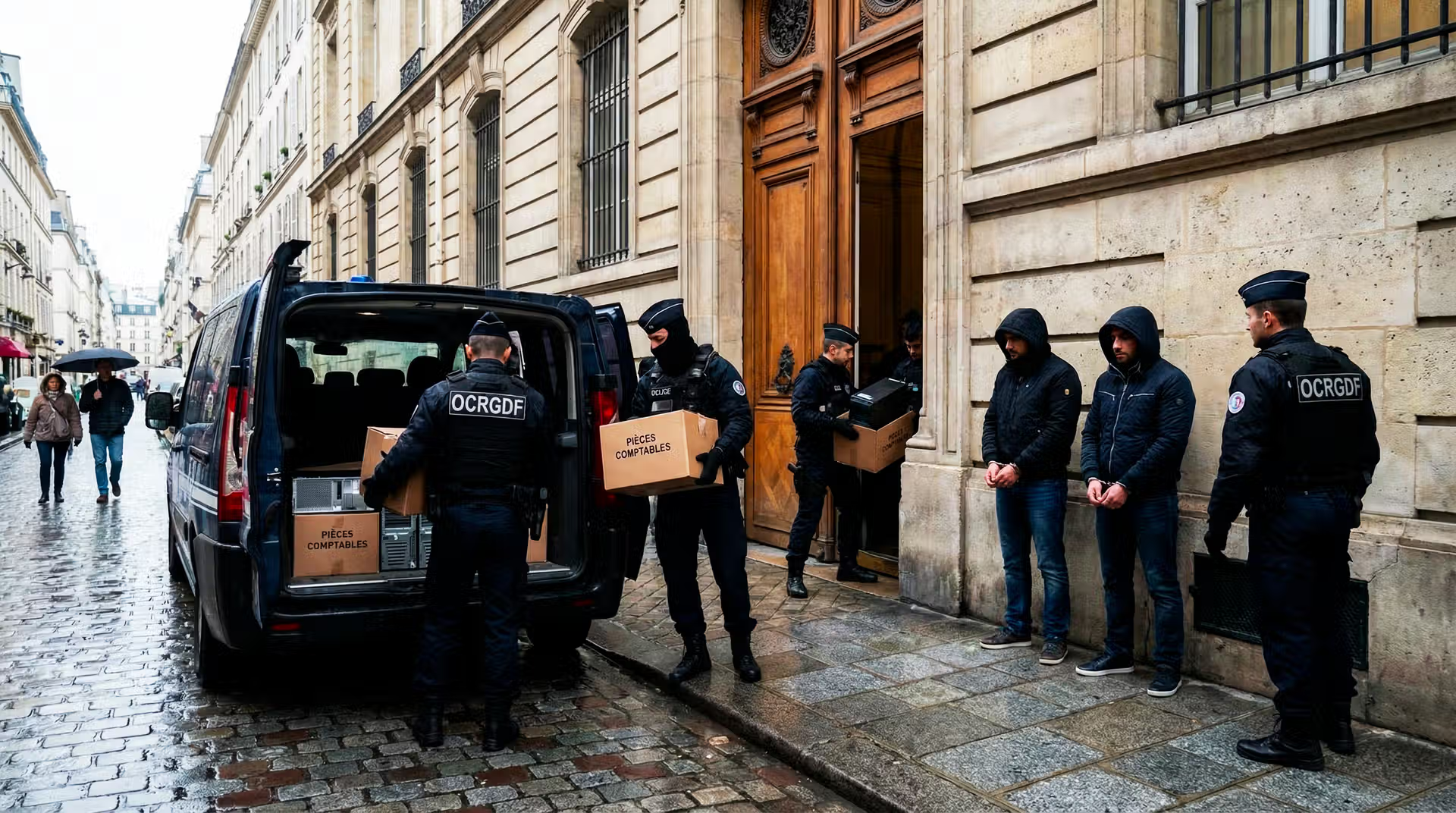
The growing misuse of global charity organisations for money laundering and terror financing has reached alarming proportions across multiple jurisdictions. Recent intelligence from Canada, the United Kingdom, and Australia reveals that Khalistani and Islamist networks have systematically exploited nonprofit channels to disguise illicit fund flows and sponsor extremist operations. Under the banner of humanitarian aid, these entities leveraged charitable registration, donor sympathy, and cross-border transfers to finance propaganda, recruitment, and violent activities. The revelations underscore how Canada’s charitable ecosystem has become a strategic target for infiltration, highlighting the urgent need for stronger AML vigilance over the global nonprofit sector.
Table of Contents


Background of the Holy Land Foundation Case
The Holy Land Foundation (HLF) was, until its shutdown in 2001, the largest Muslim charity in the United States. Its declared mission was to deliver humanitarian assistance to Palestinians displaced by conflict. After 9/11, U.S. authorities scrutinised it under Executive Order 13224, froze its assets, and eventually indicted its leadership. The government alleged that between 1995 and 2001, HLF had raised over US $56 million, some portion of which was directed into so-called zakat committees that were affiliated with the Islamist militant group Hamas. A retrial in 2008 resulted in guilty verdicts on charges including conspiracy, tax violations, providing material support to a foreign terrorist organisation, and money laundering. The sentences ranged up to 65 years in prison for key operators.
At its core, the government’s theory was that HLF served as a front that channelled money into Hamas-controlled social welfare arms, enabling recruitment, ideological indoctrination, and maintenance of institutional infrastructure in Gaza and the West Bank. Because those zakat committees performed charitable functions (orphans, food, education), they offered a cover for the transfer of funds that might otherwise raise red flags. The layering, commingling, and complex routing across jurisdictions illustrated classic laundering techniques adapted to a charitable context.
The case remains controversial. Critics point to due process concerns and reliance on hearsay or anonymous evidence. But from an AML lens, the structural lessons are more enduring than the legal debates.
Money Laundering Mechanics in the Case
Placement and Commingling
Donors contributed to HLF believing they were giving to humanitarian aid. These funds entered legitimate banking channels. At the placement stage, the money was mixed with other charitable inflows before disbursement. Because HLF had volume and legitimacy, individual transfers did not stand out. The charity structure itself served as a trafficking vehicle to mask origin and destination—exactly what money laundering seeks to achieve.
Layering Through Zakat Committees
HLF funds were transitioned to hundreds of smaller zakat committees purportedly delivering social services. Those committees were alleged to be affiliated with or controlled by Hamas. The layering occurred when HLF transferred funds, in small increments and via indirect channels, to these committees. From there, further subdivisions of funds went into operational support, procurement, and ideological projects. Each transaction appeared as charitable transfer rather than a direct terror funding conduit.
Integration via Local Projects and Infrastructure
Once funds had been layered, they were reintegrated into the “real economy” of Gaza and West Bank through infrastructure, schools, charities, salaries, and social programs. Some funds even supported curriculum and youth recruitment programs. This reinvestment made recovery or tracing more difficult, because the funds had blended into local economic lifelines.
Cross-jurisdictional and Informal Channels
To move funds internationally, HLF used banking, agencies, intermediaries, and possibly cash couriers. The use of third party conduits, shell entities, and cross-border transfers complicated traceability. The layering across jurisdictions added obstacles to regulatory oversight.
Beneficial Ownership Concealment
Although zakat committees were ostensibly independent entities, evidence in the prosecution alleged that Hamas maintained control over many committees, which meant beneficial ownership was obscured. Hence, the actual persons influencing fund flows remained hidden behind nonprofit governance formalities.
Circular Transfers and Recycling of Donations
In some instances, funds circulated back to the U.S. or to donor pools for further distribution. Recycling allowed HLF to claim expanded donation revenue, making outward flows less conspicuous. Such circularity is a known laundering trick, reinforcing the appearance of legitimate income.
Compliance Failures and AML Blind Spots
Weak Due Diligence and Risk Assessment
HLF enjoyed access to major U.S. banks for years before designation. The financial institutions that serviced it failed to detect that some downstream beneficiaries were high risk. They did not adequately assess the nonprofit vulnerability, especially given HLF’s overseas operations and messaging. Under U.S. Bank Secrecy Act / anti-money laundering rules, charities require the same customer identification and beneficial ownership scrutiny as other entities. Yet bank examiners note that nonprofit customers lack sector-specific BSA rules, making oversight discretionary.
Insufficient Monitoring of Grant Recipients
Grant disbursements formed the heart of HLF operations. But banks and oversight authorities had limited visibility into the beneficiaries of those grants or the operational controls within the receiving entities. Funds passed to partner organizations that might themselves be fronts. Without robust downstream monitoring (know your grantee), the transfer risk went unchecked.
Reliance on Charity Legitimacy for Shielding
Because HLF presented as a humanitarian actor, regulators and auditors treated it with deference. Its organizational registration, audit reports, and public legitimacy created a veneer of trust that masked deeper risks. AML programs sometimes assign lower scrutiny to nonprofits deemed socially beneficial, which is a dangerous bias.
Gaps in International Cooperation
HLF’s cross-border operations in the Palestinian territories meant that U.S. regulators depended on counterpart jurisdictions for oversight. But those jurisdictions often lacked equivalent financial crime regimes or enforcement capacity. Without mutual legal assistance and harmonised AML/CFT rules, tracing fund flow in Gaza or West Bank proved extremely difficult.
Delayed Freezing and Asset Blocking
Designation under EO 13224 allowed the U.S. government to block HLF assets. But that is a reactive tool. Proactive surveillance, Suspicious Activity Report (SAR) regimes, enhanced due diligence, and earlier red flags might have led to disruption before the scale grew. Asset freezing after-the-fact is necessary but insufficient as a deterrent.
Weak Transparency and Disclosure
Some of the supporting evidence in the case came from seized documents, informants, and covert surveillance rather than self-reporting by HLF. The opacity hiding the beneficial ownership and internal grant decisions hindered detection until the case escalated.
What the Case Teaches the AML Community
Risks in Charitable Sector Must Be Elevated
The FATF’s Recommendation 8 underscores that nonprofits are vulnerable to abuse and require proportionate safeguards. Many jurisdictions struggle to operationalize guidance. AML programs should classify charitable contributions to foreign or high risk regions as inherently higher risk and adjust control levels accordingly.
Adopt a Risk-Based Approach with Red Flag Indicators
Some red flags: (1) donation surges from geography with extremist ties, (2) excessive grants to small partner entities lacking transparency, (3) grantees with weak governance or overlapping leadership, (4) tangled cross-jurisdiction fund flows, (5) repeated use of informal or cash networks. An effective risk matrix must account for these in onboarding and continuous monitoring.
Enhance Grantee Due Diligence and Monitoring
It is not enough to validate the recipient’s registration. AML teams should conduct ongoing monitoring, require beneficiary reports, perform site visits if possible, and cross check for links to designated organizations. Third-party evaluations and audit clauses in grant agreements help increase visibility.
Strengthen Beneficial Ownership Disclosure
Nonprofits must reveal the ultimate controllers or decision makers. AML rules should force transparency of trustees, directors, and those with decision power. Even in jurisdictions where nonprofit anonymity is common, AML regulation must override that in higher risk contexts.
Leverage International Cooperation and Information Sharing
Cross-border AML/CFT centers, mutual legal assistance treaties, templated grant reporting standards, and joint investigations are key. For cases like HLF that traverse jurisdictions, no single regulator holds all the pieces. Coordinated oversight is essential.
Proactive Suspicious Activity Reporting
Banks, fintech, and payment providers should file SARs when charitable donations or grant flows map to unusual patterns. Rather than wait for law enforcement, institutions should flag and escalate internally. Regulators should require NGOs and financial service providers to report anomalies.
Organisational Governance and Internal Controls Are Critical
Charities should adopt internal AML/CFT controls: segregation of duties in grant approvals, thresholds for due diligence, board oversight of high risk grants, and verification of grantee outcomes. A strong compliance culture reduces misuse risk.
Use of Sanctions and Preventive Designation Powers
Governments should maintain legal authority to designate entities that pose terror or proliferation risk. That power can freeze assets and curb future funding. However, designation must be accompanied by transparency, due process, and evidentiary rigor to avoid abuse claims.
Final Thoughts on the Case’s Legacy
The Holy Land Foundation case represents a paradigmatic instance of charity laundering. It demonstrates how well-intentioned social welfare rhetoric can mask a labyrinth of layering, commingling, and reinvestment into extremist structures. For AML professionals, the lesson is stark: do not afford nonprofits a free pass. Treat them as any other entity susceptible to abuse, especially when they deal in politically or geographically sensitive zones.
When insights from the case are internalised, compliance frameworks can evolve. By reinforcing due diligence, grantee oversight, beneficial ownership transparency, and international cooperation, the financial crime community can limit the exploitation of nonprofits by malign actors. The challenge remains high, but the HLF case stands as both warning and guide.
Related Links
- U.S. Department of the Treasury Office of Terrorist Financing and Financial Crime
- FATF Best Practices on Combating the Abuse of Non-Profit Organisations
- FinCEN / U.S. bank agencies joint fact sheet on charities and AML due diligence
- U.S. Office of Foreign Assets Control (OFAC) sanctioned entity list
- FATF website on AML / CFT standards
Other FinCrime Central Articles About the Fight Against Terrorism Financing
- How Online Fundraising Empowers Terrorism Financing Networks
- The Growing Danger of Crowdfunding Abuse for Terrorism Financing: What You Need to Know
- Fighting Terrorism Financing: The Nonprofit Tax Bill at the Center of Debate
Source: News18, by Manoj Gupta
Some of FinCrime Central’s articles may have been enriched or edited with the help of AI tools. It may contain unintentional errors.
Want to promote your brand, or need some help selecting the right solution or the right advisory firm? Email us at info@fincrimecentral.com; we probably have the right contact for you.