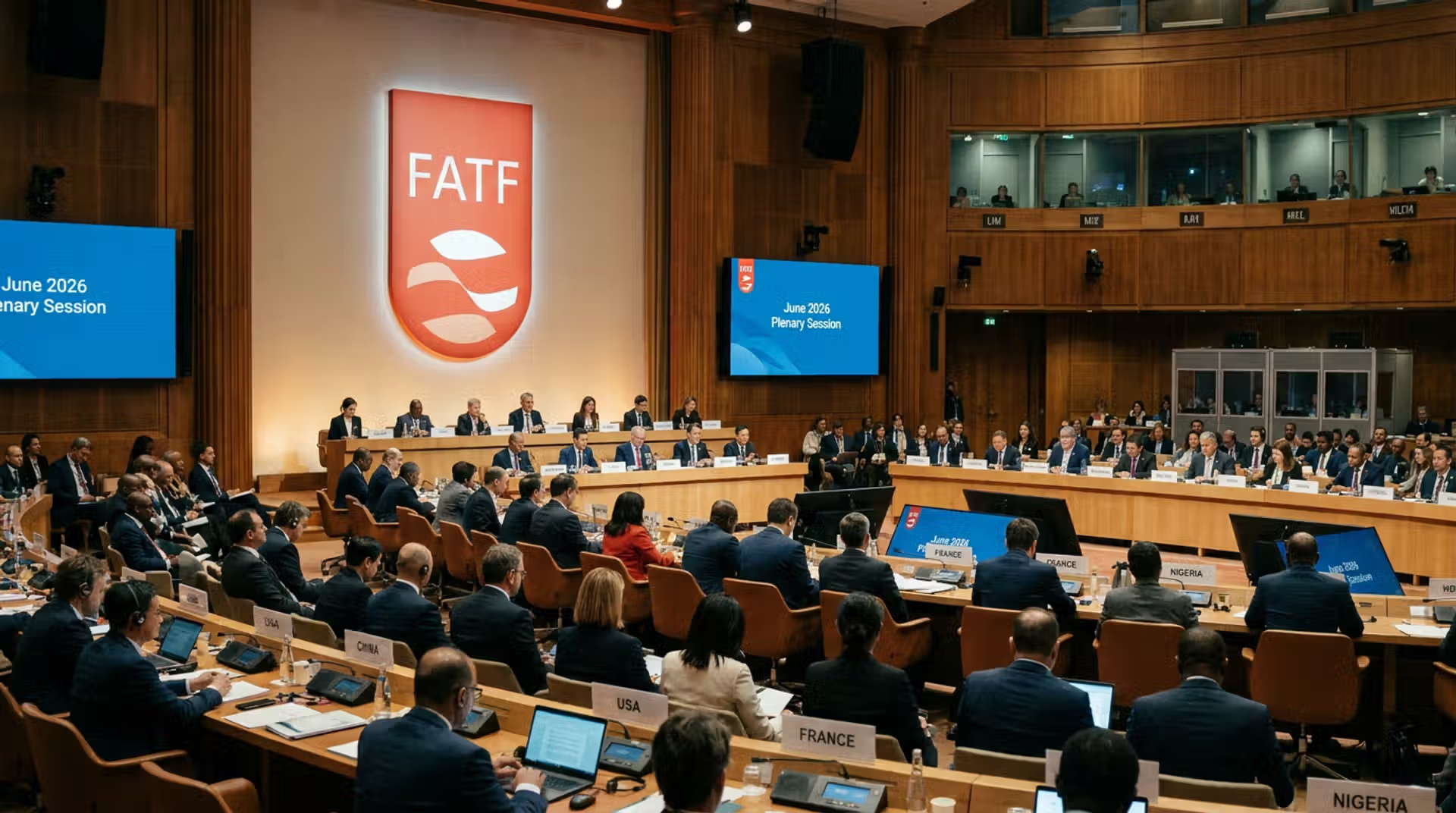
The Financial Action Task Force concluded its final plenary session under the Mexican presidency in Paris, introducing pivotal adjustments to its high-risk and increased-monitoring lists. During the intensive three-day sessions held from 17 June to 19 June 2026, international delegates evaluated the structural deficiencies of various nations, resulting in critical modifications to the global financial crime watchlists. Compliance departments worldwide must immediately integrate these strategic updates into their client risk rating models and automated transaction screening systems to ensure alignment with expanding international expectations.
Table of Contents



Global Compliance Frameworks
The integrity of the international financial architecture relies entirely on the consistent application of risk-based supervision, transparent corporate registries, and effective anti-money laundering controls. Jurisdictions that fail to maintain robust defensive legal frameworks risk becoming attractive safe havens for transnational organized crime syndicates, aggressive proliferation financing networks, and systemic tax evasion schemes. Under the leadership of Elisa de Anda Madrazo, the organization wrapped up a highly productive two-year presidential cycle that consistently emphasized the practical effectiveness of regulatory frameworks over the mere baseline presence of legislative text. Peer review mechanisms, known professionally as mutual evaluations, rigorously assess how effectively a targeted country identifies, investigates, and prosecutes complex financial offenses while ensuring that competent authorities maintain rapid access to accurate beneficial ownership records. Nations failing to meet these critical international benchmarks often suffer severe, long-lasting economic consequences, including defensive de-risking by large correspondent banks, increased international transaction friction, elevated borrowing costs, and a sharp reduction in foreign direct investment inflows. During the June 2026 plenary, delegates officially adopted the mutual evaluation reports for Canada and Türkiye, providing both jurisdictions with a highly structured, transparent path to address identified structural vulnerabilities within their domestic legal systems, financial intelligence units, and law enforcement agencies.




High-Risk and Increased-Monitoring Lists
The global financial compliance framework divides monitored nations into two distinct categories based on their level of strategic sovereign risk and active political cooperation with international standard-setting bodies. The high-risk jurisdictions subject to a call for action, commonly referred to across the banking sector as the blacklist, include countries with severe, systemic institutional deficiencies that refuse to align with international financial standards or engage in cooperative peer review processes. Following the latest evaluation cycle in Paris, this restrictive list remains completely unchanged, requiring global compliance networks to maintain maximum defensive postures against designated territories. The organization continues to urge all member states and independent jurisdictions to apply intensive countermeasures and enhanced due diligence protocols to safeguard the international network from the pervasive fraud and state-sponsored financial crimes originating from these high-risk areas. Meanwhile, the jurisdictions under increased monitoring, professionally known as the grey list, contain countries that are actively working with the international body to resolve identified strategic deficiencies within agreed, strict timelines. The June 2026 plenary introduced significant, structural modifications to this specific list, implementing a series of strategic additions and removals that alter the baseline compliance requirements for international banking networks, cross-border payments, and corporate due diligence operations.


Detailed Watchlist Breakdown and Movement Summary
The status of international financial monitoring reveals a clear division between cooperative jurisdictions undergoing active legislative reform and non-cooperative states facing severe, permanent global financial restrictions. The high-risk blacklist consists of exactly 3 countries, maintaining a completely static layout from previous quarterly review cycles:
- Democratic People’s Republic of Korea
- Iran
- Myanmar
The increased monitoring grey list now encompasses 22 jurisdictions following the structural changes enacted during the Paris meetings. The modifications are detailed through specific additions and deletions that highlight the evolving risk profiles of these nations:
- Bosnia and Herzegovina (Newly Added)
- Iraq (Newly Added)
- Bulgaria
- Cameroon
- Croatia
- Democratic Republic of the Congo
- Haiti
- Kenya
- Lebanon
- Mali
- Monaco
- Mozambique
- Nigeria
- Philippines
- Senegal
- South Africa
- South Sudan
- Syria
- Tanzania
- Venezuela
- Vietnam
- Yemen
The plenary officially celebrated the successful compliance progress and subsequent removal of Algeria and Namibia from the increased monitoring list. Both nations successfully completed their extensive action plans, demonstrated effective risk-based supervision across high-risk sectors, cleared their technical deficiencies, and passed comprehensive on-site verifications conducted by international assessment teams. Conversely, Bosnia and Herzegovina and Iraq made high-level political commitments to address their institutional gaps, forcing compliance officers to apply immediate enhanced due diligence to all transactions involving these newly added jurisdictions. Bosnia and Herzegovina must focus on optimizing international cooperation mechanisms, improving financial intelligence dissemination, and increasing oversight of non-bank financial institutions. Iraq has committed to reinforcing its risk-based supervisory framework for commercial banking institutions, accelerating money laundering investigations, and ensuring rapid judicial processing of illicit asset forfeiture cases.
Future Strategic Priorities and Emerging Threats
As the organization prepares for the incoming United Kingdom presidency under the leadership of Giles Thomson, starting in July 2026, global compliance priorities are shifting rapidly toward modern financial crime typologies and technological vulnerabilities. The upcoming strategy will heavily focus on disrupting the vast financial networks powering organized scam compounds, which blend sophisticated cyber fraud with human trafficking and forced labor on an unprecedented global scale. Additionally, India’s Vivek Aggarwal will assume the vice presidency, assisting the executive leadership in driving public-private partnerships, cross-border data sharing initiatives, and standardizing asset recovery frameworks. Technology remains a central pillar of ongoing regulatory concern, resulting in the publication of an operational guide targeting terrorist financing methods executed across social media networks and instant messaging applications. Furthermore, the seventh targeted update on digital currencies revealed that many nations still lag significantly behind in enforcing the travel rule, which requires the mandatory collection and transmission of originator and beneficiary data during cryptocurrency transfers, presenting an ongoing vulnerability that transnational criminal syndicates continue to exploit to obfuscate the origin of illicit capital.
Key Points
- The blacklist remains completely unchanged, with Iran, Myanmar, and the Democratic People’s Republic of Korea subject to maximum global countermeasures.
- Bosnia and Herzegovina, along with Iraq, were newly added to the grey list following high-level political commitments to reform.
- Algeria and Namibia were successfully removed from the increased monitoring list after executing comprehensive anti-money laundering overhauls.
- The total number of grey-listed jurisdictions stands at 22 following the conclusion of the June 2026 plenary session.
- The incoming United Kingdom presidency will prioritize global fraud detection and the enforcement of the travel rule for virtual asset providers.
Related Links
- Outcomes of the FATF Plenary June 2026
- Jurisdictions under Increased Monitoring June 2026
- High-Risk Jurisdictions Subject to a Call for Action June 2026
- Financial Action Task Force Home Page
Other FinCrime Central Articles About the Latest FATF Reports
- FATF Upgrades Indonesia to Full Technical Compliance
- The FATF Regional Compliance Progress Across the Caribbean Perimeter
- FATF Evaluation of Financial Oversight Progress in Central Africa
Source: FATF
Some of FinCrime Central’s articles may have been enriched or edited with the help of AI tools. It may contain unintentional errors.
Want to promote your brand, or need some help selecting the right solution or the right advisory firm? Email us at info@fincrimecentral.com; we probably have the right contact for you.