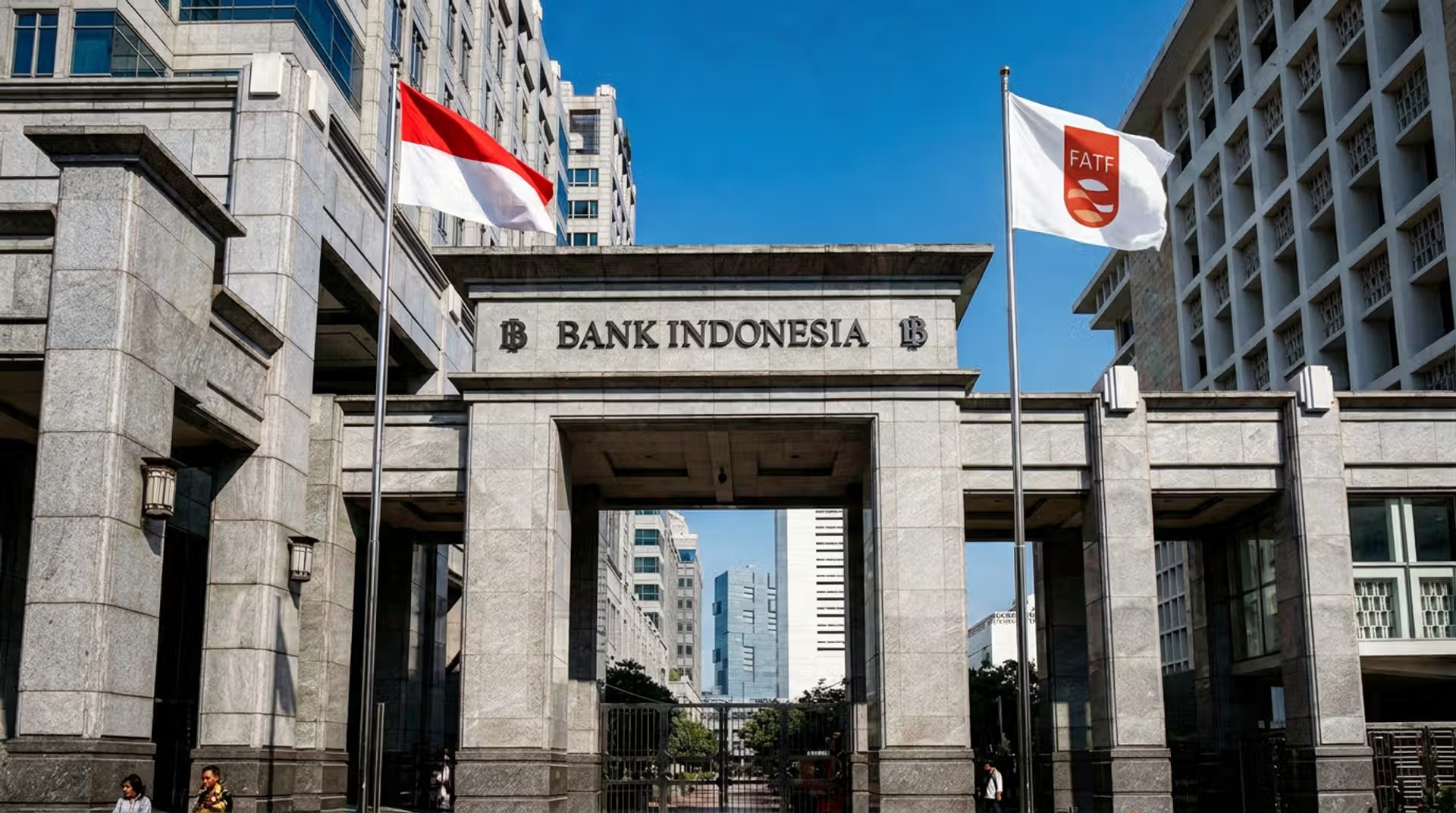
The Financial Action Task Force (FATF) has officially upgraded Indonesia to a compliant status following the publication of its third enhanced follow-up report in June 2026. This technical assessment, completed by senior policy experts, confirms that the jurisdiction has effectively resolved the minor and major deficiencies originally identified in its 2023 mutual evaluation. The regulatory changes implemented over the past three years demonstrate a serious commitment to strengthening the integrity of the domestic financial system against security threats. By aligning its legal framework with global anti-money laundering and counter terrorist financing standards, the nation secures its position as a proactive participant in international security operations.
Table of Contents



Strengthening United Nations Sanctions Listing Processes
The fundamental framework governing how the jurisdiction proposes individuals and entities for international sanctions has undergone critical structural updates. Historically, international assessors noted minor deficiencies regarding the specific information transmitted to United Nations sanctions committees when local authorities made proposals for designations. Under the previous regime established in 2023, the domestic task force held a clear mandate for managing proposals directed toward the relevant oversight committees. Potential targets were first processed through a domestic directory maintained by the national police and validated by the judicial system in Jakarta. While the operational authorities utilized a reasonable basis standard in practical settings, the governing decrees did not explicitly codify this evidentiary baseline within the statutory text.
To rectify these structural gaps, the financial intelligence unit enacted a specialized decree in December 2025 that explicitly mandates the application of a reasonable basis standard. This regulatory instrument ensures that the national police and the specialized task force utilize an objective baseline that remains distinct from the standard of proof required in formal criminal trials. Furthermore, the updated decree dictates strict adherence to the formal criteria established by international sanctions committees. Any submission for an international listing must now include comprehensive identity metrics to prevent false matches, a detailed statement of the case, and supporting documentation detailing the relationship between the target and existing listed entities. The Ministry of Foreign Affairs is also required to manage disclosures regarding the proposed status of the state based on broader geopolitical considerations.




Acceleration of Domestic Determinations and Operational Timelines
A historical vulnerability in the local counter terrorist financing architecture involved the lack of specific time mandates for assessing foreign and domestic designation proposals. Under the original 2023 review, the regional task force managed incoming requests from foreign states through diplomatic channels, while the financial intelligence unit compiled the necessary evidence to substantiate the listing criteria. Although the workflow distributed operational responsibilities across the national police and intelligence agencies, the absence of an explicit statutory timeline created risks of operational delay.
The introduction of the 2025 regulatory changes addressed this issue by imposing an explicit obligation on the national police and the task force to conduct prompt deliberations. Empirical data provided during the review period demonstrated that the competent authorities now achieve an average turnaround time of two days when evaluating whether a proposed target meets the necessary legal thresholds. When managing outward requests to foreign jurisdictions, the domestic task force transmits complete data profiles to ensure that the receiving nation has sufficient information to validate the reasonable grounds standard. Additionally, the collection mechanisms allow authorities to solicit intelligence and sensitive information ex parte, ensuring that targets are not notified prior to the formal evaluation process.


Implementation of Immediate Asset Freezing Obligations
The most substantial technical deficiencies identified during the 2023 mutual evaluation related to the speed and scope of the asset freezing framework. Previously, the judicial system could take up to thirty days to confirm a designation based on the primary counter terrorism legislation. Although alternative regulations permitted the financial intelligence unit to issue temporary administrative circulars to postpone financial transactions for twenty days, this mechanism relied entirely on administrative discretion rather than imposing a blanket, mandatory obligation. This structural gap meant that asset freezing actions did not consistently occur without delay, as required by the international standards.
This vulnerability was resolved through comprehensive amendments to the joint regulation on the domestic directory of suspects, which introduced a universal obligation for all natural and legal persons to freeze funds immediately and without prior notice. The administrative workflow has been optimized to ensure that the entire dissemination and asset freezing process concludes within a strict twenty-four-hour window. The national police chief must immediately broadcast updates to supervisory agencies, which then utilize digital platforms to notify financial institutions and non-financial businesses. Financial corporations receive updates via a specialized reporting system, while designated non-financial professions utilize the global anti-money laundering interface. The public directory is also maintained transparently on the website of the financial intelligence unit to ensure widespread public accessibility.
Expanding the Scope and Safeguards of Financial Sanctions
The legal updates executed in 2025 significantly expanded the definitions and boundaries of property subject to freezing actions, bringing local rules into alignment with global expectations. The freezing mandate applies uniformly to all funds and assets owned or controlled by a designated entity, irrespective of whether the specific property can be linked to a distinct terrorist plot. The scope encompasses funds that are wholly or partially owned, directly or indirectly controlled, or derived from assets belonging to listed targets. Furthermore, the prohibition extends to any third party acting at the direction of a sanctioned individual, and all citizens and domestic entities are strictly forbidden from making economic resources or financial services available to these targets.
To ensure equitable enforcement, the updated framework includes formal protections for innocent third parties and clear operational guidelines for managing legitimate financial exclusions. The primary legislation holds financial sectors and other service providers harmless from civil or criminal liability when they implement freezing actions in good faith. Third parties with pre-existing contractual agreements can petition judicial authorities to protect their rights. Additionally, a new decree introduced a dedicated deliberation mechanism to process exemptions for basic necessities and extraordinary expenses. The website of the financial intelligence unit has also been upgraded to feature public infographics and direct operational links to international ombudsperson offices, providing clear pathways for managing false positives and navigating the formal de-listing process.
key Points
- Indonesia achieved a complete technical compliance upgrade for Recommendation 6, moving from partially compliant to compliant.
- The jurisdiction established a strict twenty-four-hour operational window to execute targeted financial sanctions without prior notice.
- Evidentiary requirements were enhanced by explicitly codifying a reasonable basis standard for all domestic and international listings.
- Universal freezing obligations were extended to cover all natural and legal persons, including non-financial businesses and professions.
- Specialized administrative mechanisms were introduced to handle asset exemptions for basic human needs and extraordinary expenses.
Related Links
- Financial Action Task Force Mutual Evaluation Report of Indonesia
- Financial Action Task Force Consolidated Assessment Ratings
- Financial Action Task Force Enhanced Follow-Up Reports
- United Nations Security Council Sanctions Committee Guidelines
- United Nations Office of the Ombudsperson De Listing Process
Other FinCrime Central Articles About FATF Country Reports
- The FATF Regional Compliance Progress Across the Caribbean Perimeter
- FATF Evaluation of Financial Oversight Progress in Central Africa
- FATF Report: Dual Realities of Singapore Financial Oversight
Source: FATF
Some of FinCrime Central’s articles may have been enriched or edited with the help of AI tools. It may contain unintentional errors.
Want to promote your brand, or need some help selecting the right solution or the right advisory firm? Email us at info@fincrimecentral.com; we probably have the right contact for you.