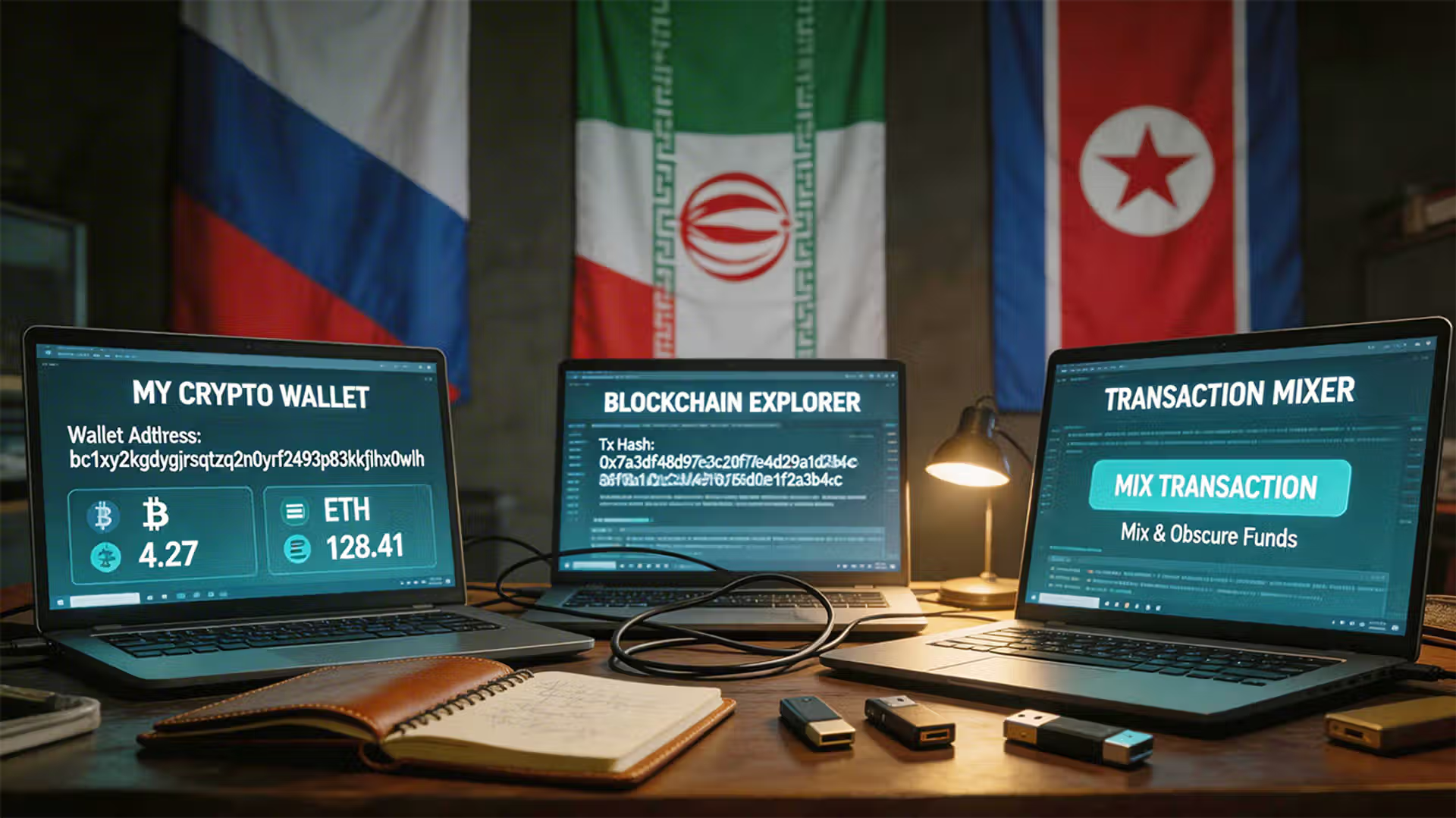
Economic experts and international regulators have identified a massive scale of illicit financial activity totaling 350 billion dollars linked to systemic sanctions evasion and organized crime. This underground financial network utilizes digital assets to bypass traditional banking oversight, allowing hostile states and criminal syndicates to move vast sums of capital across borders. A recent comprehensive report detailing these 164 documented cases highlights how Russia, North Korea, and Iran have pioneered new methods for laundering funds through specialized exchanges. The findings emphasize that while 350 billion dollars is the verified amount, the actual volume of laundered wealth likely reaches into the trillions. Consequently, global law enforcement agencies are facing an unprecedented challenge in curbing these sophisticated digital money laundering operations.
Table of Contents


Crypto Money Laundering Shadow War
The evolution of digital finance has created a specialized ecosystem where money laundering acts as the primary engine for state survival under international pressure. According to recent data, the documented 350 billion dollars laundered through cryptocurrency markets represents a critical failure in global financial gatekeeping. This shadow war is not merely a collection of isolated crimes but a coordinated effort by specific jurisdictions to replace the traditional dollar-based settlement system with unregulated digital ledgers. The primary focus of these activities involves layered transactions designed to obscure the origin of funds, often moving through multiple jurisdictions before being integrated into the legitimate economy. Because digital assets offer near-instantaneous movement, the velocity of money laundering has increased, making it difficult for regulators to freeze assets before they are liquidated. The complexity of these schemes is further heightened by the use of privacy coins and mixing services, which serve to sever the audit trail that investigators rely on during forensic accounting.
The scale of this issue is particularly evident in the way sanctioned entities utilize infrastructure like the Garantex exchange. This platform alone is credited with processing over 100 billion dollars in transactions, with a staggering 82 percent of that volume tied directly to sanctioned individuals and organizations. Such high percentages suggest that these platforms are not merely passive service providers but are actively engineered to facilitate money laundering at a sovereign scale. The report by Alexander Browder suggests that the 350 billion dollar figure is just the visible peak of a much larger iceberg, as many operations never enter public court records or regulatory filings. For the global financial system, this represents a permanent leakage point where illicit wealth can be laundered and then used to fund further cyber operations or military expansion. The intersection of state-sponsored hacking and traditional money laundering has created a feedback loop where stolen assets provide the liquidity needed to bypass economic restrictions.



Systematic Sanctions Evasion Through Digital Assets
Hostile nations have mastered the art of using digital currency to neutralize the impact of international trade barriers and financial freezes. Iran provides a clear example of this trend, where the government has leveraged digital assets to facilitate the sale of oil, generating over 100 million dollars in profit through carefully managed crypto channels. This process involves converting physical commodities into digital wealth that can be moved without the oversight of the SWIFT banking system. When geopolitical tensions rise, such as the recent military strikes in Tehran, the flow of capital out of domestic exchanges like Nobitex increases by as much as 700 percent. This surge indicates a highly responsive and sophisticated laundering mechanism that allows state actors to safeguard their wealth in overseas accounts during times of crisis. These maneuvers are not accidental but are part of a broader strategy to ensure that the domestic economy remains insulated from the full force of global sanctions.
North Korea has adopted an even more aggressive stance, combining state-sponsored theft with intricate laundering cycles. By targeting the cryptocurrency industry directly, North Korean hackers have successfully seized billions of dollars, including a record 1.5 billion dollar breach of the Bybit exchange in early 2025. Once these funds are stolen, they undergo a rigorous laundering process that involves hopping between different blockchains and utilizing decentralized finance protocols to mask the destination. This systematic approach allows the regime to generate significant state revenue that is entirely independent of traditional exports or foreign aid. The ability to launder 4.1 billion dollars through 19 distinct hacks demonstrates a level of technical proficiency that rivals many private sector cybersecurity firms. For international observers, this highlights the dual threat posed by crypto: it is both a target for high-value theft and a primary vehicle for laundering the proceeds of those crimes.
Regional Concentration of Illicit Financial Flows
The geographic distribution of money laundering activity reveals that the most developed financial markets are often the most vulnerable to exploitation. The United States currently holds the largest share of documented cases, accounting for nearly 24 percent of the global total. This high concentration is attributed to the deep liquidity available in American markets and the higher frequency of targets for cyber-enabled fraud. Money laundering in the United States often involves a mix of domestic criminal proceeds and international funds seeking a gateway into the Western financial system. Despite the presence of strict Anti-Money Laundering and Know Your Customer regulations, the decentralized nature of digital assets allows bad actors to find entry points through smaller, less compliant intermediaries. This creates a persistent challenge for domestic agencies like FinCEN, which must monitor millions of micro-transactions to identify the larger patterns of institutional laundering.
Russia follows closely behind the United States, representing over 11 percent of the total volume of laundered crypto assets. The Russian ecosystem is characterized by a high degree of state tolerance for cybercriminal activity, provided that such activity aligns with national interests or targets foreign adversaries. This environment has fostered a sophisticated network of over-the-counter desks and localized exchanges that prioritize anonymity over regulatory compliance. The prevalence of money laundering in this region is a direct reflection of the need to circumvent extensive international sanctions imposed following various geopolitical conflicts. By integrating cryptocurrency into the national financial strategy, the Russian state can maintain trade relationships and fund operations that would otherwise be blocked by the global banking community. This regional concentration of illicit flows suggests that money laundering is becoming a tool of statecraft, used to project economic power and maintain internal stability despite external pressures.
Future Regulatory Challenges and Enforcement Gaps
One of the most concerning aspects of the current money laundering landscape is the significant lack of accountability and successful prosecutions. Data indicates that 79 percent of the 164 documented cases have not resulted in a conviction, highlighting a major gap between the detection of illicit activity and the legal consequences for those responsible. This enforcement deficit is partly due to the jurisdictional complexities involved in digital asset crimes, where the perpetrator, the victim, and the servers used for laundering may all be in different countries. Without a unified international framework for prosecuting crypto-related money laundering, bad actors can continue to operate with a high degree of impunity. Furthermore, the rapid pace of technological innovation often outstrips the ability of legislative bodies to update relevant laws. This creates “regulatory havens” where laundering can occur without violating local statutes, even if the activity is illegal in the country where the funds originated.
To address these vulnerabilities, international bodies like the Financial Action Task Force are pushing for more stringent implementation of the Travel Rule and other monitoring standards. However, the adoption of these measures is inconsistent across the globe, allowing illicit funds to flow toward the path of least resistance. The shift toward decentralized finance and unhosted wallets presents a further obstacle, as these technologies remove the need for centralized intermediaries that regulators typically target. If the current trend continues, the volume of laundered wealth in the crypto market will likely continue to grow, providing hostile states with the resources needed to undermine global security. The transition from documented cases to effective enforcement requires not only better technology but also a higher level of diplomatic cooperation to close the loopholes that currently facilitate the 350 billion dollar shadow war. Strengthening the prosecution of these crimes is essential to maintaining the integrity of the global financial order and preventing the normalization of state-sponsored money laundering.
Key Points
- The documented volume of cryptocurrency money laundering has reached 350 billion dollars over a twenty year period.
- Russia, North Korea, and Iran are identified as the primary state actors utilizing digital assets for sanctions evasion.
- A significant majority of global crypto laundering cases currently remain unprosecuted, with a 79 percent failure rate in convictions.
- The United States and Russia are the two nations most impacted by the proliferation of illicit digital financial transactions.
Related Links
- Financial Action Task Force Guidance for a Risk-Based Approach to Virtual Assets
- United Nations Office on Drugs and Crime Report on Transnational Organized Crime and Crypto
- Department of the Treasury National Money Laundering Risk Assessment
- European Union Agency for Law Enforcement Cooperation Internet Organised Crime Threat Assessment
- Office of Foreign Assets Control Sanctions Compliance Guidance for the Virtual Currency Industry
Other FinCrime Central Articles About Crypto Used for Sanctions Evasion
- North Korea’s Crypto Networks Lose $7.74M in Money Laundering Crackdown
- Billions Laundered Through Garantex’s Surviving Shadow Crypto Empire
- Escalated Digital Asset Outflows from Iranian Platforms During Conflict
Source: OCCRP
Some of FinCrime Central’s articles may have been enriched or edited with the help of AI tools. It may contain unintentional errors.
Want to promote your brand with us or need some help selecting the right solution or the right advisory firm? Email us at info@fincrimecentral.com; we probably have the right contact for you.