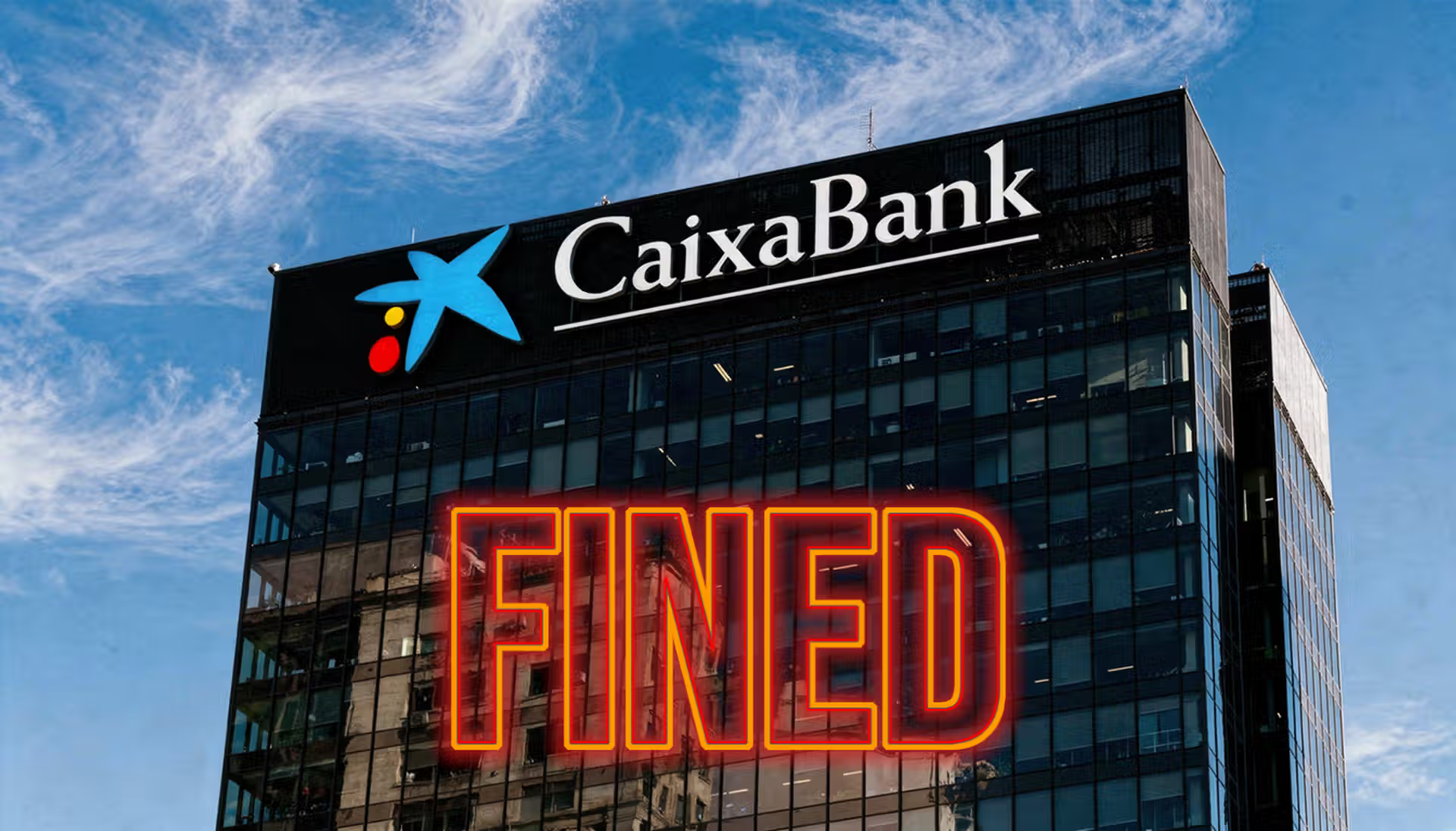
Spanish regulators have officially confirmed a massive fine of 17,601,000 euros against CaixaBank due to serious failures in preventing money laundering. This significant administrative decision was formally published in the Official State Gazette under resolution BOE-A-2025-26201 on December 11, 2025. The document outlines how the financial entity failed to uphold its legal obligations during high-value property transactions that occurred years ago. These findings are the result of an extensive investigation by the Ministry of Economy and the Council of Ministers regarding the institution’s internal control systems. This penalty represents one of the largest sanctions ever imposed on a Spanish bank for non-compliance with financial security laws.
Table of Contents


Administrative governance protocols
The core of this regulatory action stems from the controversial sale of the Cepsa Tower in Madrid, a transaction that eventually exposed a massive laundering scheme involving nearly 100 million euros. This operation involved the former chairman of the energy giant Cepsa, Khadem al-Qubaisi, who allegedly used a complex web of shell companies and offshore accounts to orchestrate the acquisition and resale of the iconic skyscraper. Investigations revealed that the real estate deal was not merely a commercial venture but a vessel for concealing the illicit origins of enormous capital flows. Financial authorities determined that the bank facilitated these movements by allowing the funds to pass through its accounts without performing the mandatory scrutiny required for such high-risk profiles. The proceeds from the sale, which was also known as the Torre Foster, were funneled through specialized corporate vehicles that obscured the identity of the ultimate beneficial owner. Despite the obvious red flags associated with the volume of the transaction and the political exposure of the individuals involved, the bank did not flag the activity as suspicious in a timely manner. This failure allowed a massive sum of money to be integrated into the legal financial system, undermining the integrity of the Spanish property market and the national economy. The case has become a primary example of why financial institutions must maintain rigorous oversight when handling multi-million euro real estate assets that involve complex international structures.
Identifying Internal Oversight Deficiencies
A deep dive into the administrative file reveals that the sanctioned entity, which was formerly Bankia, exhibited systemic weaknesses in its internal control departments during the period when these transactions were processed. Inspectors found that the organization lacked the necessary depth in its due diligence procedures to catch the sophisticated methods used by the participants in the Cepsa scandal. The law is very clear that credit institutions have a proactive duty to investigate any operation that lacks an obvious economic or lawful purpose. In this specific instance, the sheer scale of the funds moving through the corporate accounts should have triggered immediate enhanced monitoring protocols. Instead, the bank relied on outdated risk assessment tools that failed to account for the specific dangers of large-scale property flipping by foreign executives. Furthermore, the communication between the front-line staff and the compliance department was found to be insufficient, leading to a breakdown in the reporting chain. The Spanish government emphasized that the 17,601,000 euro fine is not just a reaction to a single error, but a consequence of repeated administrative omissions that occurred over several fiscal years. These omissions created a vulnerable environment where criminal actors could exploit the financial infrastructure for their own gain without fear of detection. By the time the authorities stepped in to investigate, the illicit profits had already been distributed across various jurisdictions, making recovery efforts significantly more difficult for the state.
Modern Requirements for Financial Vigilance
Current legislation in Spain, specifically Law 10/2010, mandates that all obliged subjects must prioritize transparency and the identification of beneficial owners in every transaction. The failure to do so is classified as a very serious infraction, which carries the heaviest possible administrative penalties under the national framework. Financial entities are expected to use all available technological and human resources to verify that the wealth of their clients is derived from legitimate sources. This includes a thorough analysis of the tax history, professional background, and economic rationale of any person or company seeking to move significant capital. The resolution published in the state gazette serves as a warning to the entire banking sector that administrative negligence will be met with severe consequences. Regulators are now moving toward a more data-driven approach to supervision, using advanced algorithms to detect patterns that suggest laundering or terrorist financing before they can cause lasting damage. This shift requires banks to invest heavily in their compliance software and to ensure that their staff receive ongoing training in the latest criminal tactics. The complexity of the modern financial world means that simple checkbox exercises are no longer sufficient to protect the integrity of the market. Institutions must foster a culture of ethics where compliance is viewed as a fundamental pillar of the business rather than a bureaucratic burden that slows down profitable deals. The high value of this fine reflects the potential damage that can be done when a major player in the market fails to fulfill its role as a gatekeeper.
Long-Term Implications for Corporate Responsibility
Looking ahead, the imposition of this record-breaking penalty will likely force a major reassessment of how banks handle high-net-worth clients and large-scale corporate financing. The public disclosure of the sanction causes significant reputational harm, which can often be more costly than the monetary fine itself in terms of investor confidence and client retention. As the European Union continues to harmonize its anti-money laundering directives, the pressure on Spanish institutions to align with global best practices will only intensify. This case highlights the reality that administrative liability remains with the surviving entity after a merger, ensuring that corporate transitions do not become a way to evade responsibility for past failures. The government has signaled that it will continue to monitor the real estate and financial sectors with increased frequency to prevent the recurrence of such high-profile scandals. For the banking industry, the path forward involves a greater commitment to transparency and a willingness to cooperate more closely with the Executive Service of the Commission for the Prevention of Money Laundering and Monetary Offences. By strengthening their internal defenses and embracing a more proactive stance on risk management, financial organizations can help to build a more secure and trustworthy economic environment. The ultimate goal of these enforcement actions is to ensure that the Spanish financial system remains a hostile place for those who seek to hide the proceeds of crime, thereby protecting the interests of the public and the stability of the nation’s markets. This landmark decision marks a turning point in the enforcement of financial standards, demonstrating that no institution is too large to be held accountable for its administrative lapses.
Key Points
- The Council of Ministers has confirmed a 17,601,000 euro penalty for CaixaBank for failing to prevent money laundering activities.
- This fine is directly linked to the massive 100 million euro scandal surrounding the sale of the Cepsa Tower in Madrid.
- Regulators identified that the bank failed to apply enhanced due diligence on high-risk clients and ignored suspicious transaction alerts.
- The administrative sanction was officially published in the state gazette under the resolution BOE-A-2025-26201 in December 2025.
- This enforcement action underscores the strict liability of financial institutions in Spain to act as a barrier against criminal capital flows.
Related Links
- Spanish Law 10/2010 on Money Laundering Prevention
- Ministry of Economy and Digital Transformation Press Portal
- SEPBLAC Financial Intelligence Unit Guidelines
- FATF Fourth Round Mutual Evaluation Report for Spain
Other FinCrime Central Articles About Spain’s AML Fight
- Al Qubaisi Faces Justice in €100 Million Madrid’s Cepsa Tower Money Laundering Scandal
- Spanish Banks to Freeze Accounts Not Adhering to KYC Requirements
- ING Spain Fined €3.91 Million for Concealing Money Laundering Suspicion
Source: BOE
Some of FinCrime Central’s articles may have been enriched or edited with the help of AI tools. It may contain unintentional errors.
Want to promote your brand, or need some help selecting the right solution or the right advisory firm? Email us at info@fincrimecentral.com; we probably have the right contact for you.