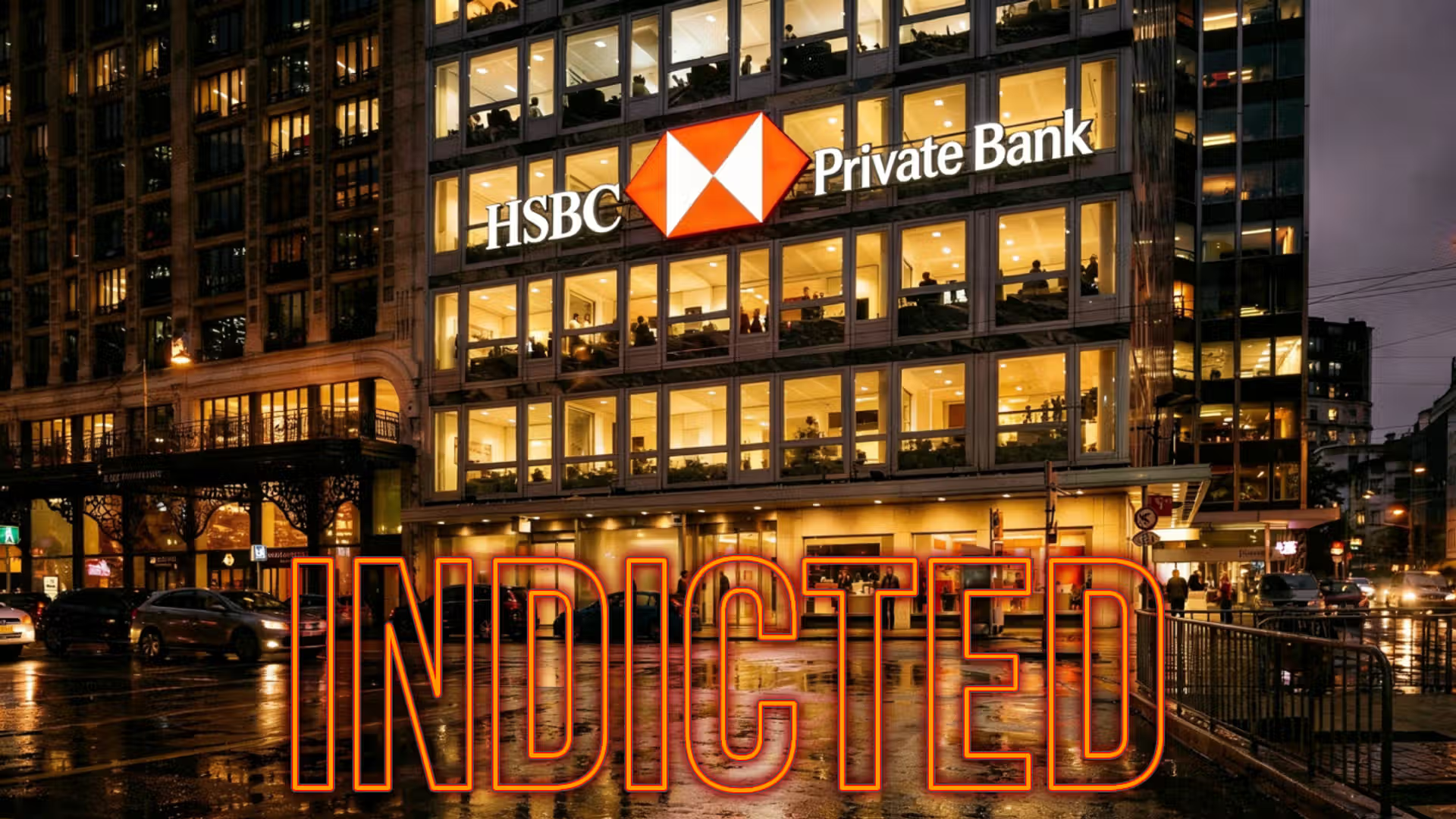
Banks in Spain are intensifying their enforcement of know-your-customer (KYC) requirements, and the consequences for customers who fail to comply can be severe. Beginning in May 2025, major Spanish financial institutions announced mass account freezes for clients whose documentation is incomplete or outdated. This article explains why Spanish banks have adopted such stringent measures, examines the regulatory and legal framework behind the crackdown, and offers practical guidance to avoid losing access to your funds.
Table of Contents
KYC Compliance: Essential for Preventing Money Laundering and Terrorist Financing
Know-your-customer rules are at the heart of anti–money laundering (AML) and counter‑financing of terrorism (CFT) efforts. Under Spain’s implementation of the EU’s Fourth and Fifth AML Directives, banks must verify each client’s identity and continuously monitor transactions for suspicious activity. Without proper KYC:
- Financial institutions cannot assess risk levels accurately.
- Unverified clients become potential conduits for illicit funds.
- Compliance failures expose banks to hefty fines and reputational damage.
Over the past decade, regulators in Spain have imposed record penalties on banks for AML lapses—up to tens of millions of euros per infraction. As of May 2025, the Bank of Spain requires all credit institutions to complete KYC renewals for every client, not just high‑risk profiles.
Spanish Banks’ New Enforcement Wave: Mass Account Freezes
Starting May 9, 2025, banks such as Banco Santander, BBVA, CaixaBank and others began automated reviews of their entire retail customer base. Any account with missing or expired identification documents, unverified source‑of‑funds declarations, or unexplained transactions became subject to immediate blocking. Key features of this initiative:
- Automated KYC screening every 90 days.
- Instant account freeze if documentation is incomplete.
- Notification window of just 48 hours to provide missing information.
A senior compliance officer at one leading Spanish bank told El País: “We cannot afford any gaps in our due diligence. Even a single expired ID or an unverified transfer forces us to freeze the account until we can clear the compliance check.”
Regulatory Mandates Driving Account Blocking
EU Directives Transposed into Spanish Law
Spain’s AML laws stem from EU directives, principally:
- Fourth AML Directive (EU 2015/849), transposed into Spain’s Ley 10/2010, requires enhanced due diligence for all customer relationships.
- Fifth AML Directive (EU 2018/843) expanded KYC obligations to virtual asset service providers and reinforced beneficial‑owner transparency.
Under Ley 10/2010, Article 12 mandates banks to identify and verify the identity of customers before establishing any business relationship. Failure to comply can result in administrative sanctions of up to €1 million per offence.
Bank of Spain Circulars
In March 2025, the Bank of Spain issued Circular 4/2025, requiring monthly KYC reconciliation and mandating that banks freeze any account flagged for missing data within 24 hours. Article 16 of that circular specifically states: “Institutions must implement automated systems to suspend accounts until KYC requirements are fulfilled.” The goal is to eliminate manual delays and ensure uniform enforcement.
Real‑World Impact: Thousands of Accounts Frozen Overnight
Banks across Spain have reported a substantial uptick in account freezes since adopting stricter KYC controls. Rather than isolated incidents, these actions reflect a systematic, bank‑wide enforcement: any client profile with incomplete documentation or unverified transactions is flagged and suspended. This widespread response underscores how essential up‑to‑date identification and clear transaction records are in maintaining uninterrupted access to banking services.
Why Banks Can’t Risk Non‑Compliance
Financial Penalties and Regulatory Scrutiny
The Comisión Nacional del Mercado de Valores (CNMV) and the Bank of Spain regularly audit banks’ AML controls. Recent fines include:
- €20 million on a major bank for failing to conduct due diligence on high‑net‑worth individuals.
- €12 million for gaps in beneficial‑owner verification at a second institution.
Reputational damage also carries long‑term costs: customer attrition, share‑price declines, and strained regulator relations.
Protecting the Wider Financial System
KYC compliance prevents Spain from becoming a haven for illicit funds. Spain ranks among the top 10 EU countries at risk for money laundering according to the FATF. By enforcing KYC strictly, banks help:
- Disrupt criminal networks.
- Safeguard legitimate businesses and consumers.
- Maintain Spain’s standing in global finance.
Conclusion
Spanish banks’ decision to freeze accounts en masse for KYC non-compliance marks a significant shift toward zero‑tolerance enforcement. Customers must proactively keep their identification, source‑of‑funds documentation, and contact details up-to-date to avoid losing access to their money. Banks, in turn, must invest in robust automated systems to carry out these checks swiftly and fairly. This stringent regime underscores the crucial role KYC plays in protecting both institutions and clients from financial crime and regulatory penalties.
Related Links
- Bank of Spain Official Website
- EU AML Directives Overview
- CNMV Portal for Market Supervision
- FATF Country Profile: Spain
- EUR-Lex: Fourth AML Directive (EU 2015/849)
Other FinCrime Central News About Spain
- ING Spain Fined €3.91 Million for Concealing Money Laundering Suspicion
- Spain’s AML Reforms: Strengthening Gambling Regulations to Combat Financial Crime
- Assad Family Money Laundering Case Moves to Málaga Court
Source: okdiario