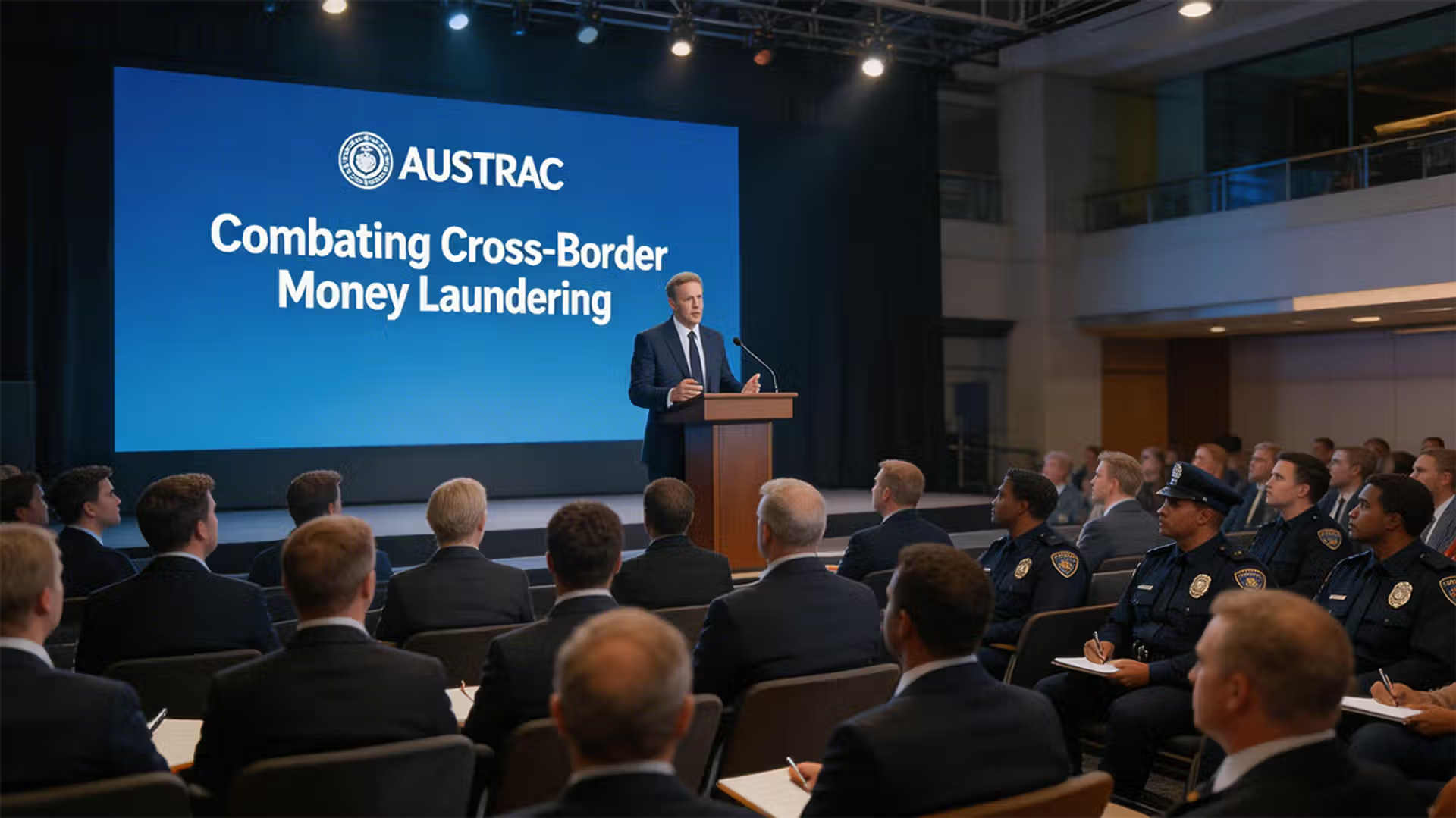
Cross-Border Money Laundering remains a critical focal point for the head of the Australian Transaction Reports and Analysis Centre, who delivered a significant keynote address at a financial crime conference in Sydney on March 3, 2026. This gathering brought together a diverse group of stakeholders, including representatives from government agencies, financial institutions, academic bodies, and the broader regulatory community. The presentation occurred at a critical juncture for the Asia Pacific region, as the landscape of illicit money movement undergoes a rapid and technology-driven transformation. The speech served to frame the current risk environment and set the strategic priorities for the collective defense against sophisticated networks operating across the maritime and continental borders of the region.
Table of Contents


Cross-Border Money Laundering
The current operational environment for financial crime has shifted from domestic concerns to a highly integrated, regional ecosystem. Modern money laundering organizations now function as professional service providers, creating structured networks that span Southeast Asia and the Pacific. These entities do not merely move funds occasionally; they have established a default setting where international flows are the primary vehicle for concealing the origins of illicit wealth. This systemic integration links industrial-scale scam operations with digital payment channels and traditional asset classes like real estate. The speed and scale of these operations have surpassed historical benchmarks, as criminal groups leverage the same connectivity that supports legitimate regional trade, migration, and digital services. Australia remains a primary target within this system due to its deep economic and social ties to the neighboring jurisdictions, making it an attractive destination for the integration of funds generated through offshore criminal activities.
The lifecycle of these illicit funds typically follows a three-stage process involving generation, movement, and final landing. A significant portion of the capital is currently being produced by large-scale scam centers located in Southeast Asia. These are not small-scale fraud rings but massive, scripted operations that utilize social engineering to target victims globally across multiple time zones. Because the victims, the technical infrastructure, and the operators are often located in entirely different countries, the resulting financial crime is geographically fragmented. This fragmentation poses a severe challenge for regulators, as the opportunities for detection are dispersed across several different legal and financial systems, often allowing the initial criminal act to go unnoticed until the funds have already been layered through multiple layers of the international financial architecture.



Digital Payment Channels and Crypto Risks
Technological innovation has fundamentally altered the economics of moving illicit wealth across international boundaries. The rise of cryptocurrency and advanced digital payment platforms has removed much of the friction traditionally associated with international banking. Criminal organizations now utilize digital exchanges, peer-to-peer platforms, and specialized automated teller machines to move funds between jurisdictions in a matter of seconds. These channels provide a high degree of anonymity and speed, significantly reducing the number of natural intervention points where law enforcement or financial institutions can successfully halt a suspicious transaction. This shift represents a move away from traditional banking rails toward a more decentralized and rapid form of value transfer that often evades standard monitoring protocols designed for slower, paper-based systems.
Despite the heavy reliance on digital tools for the initial movement of money, a hybrid model of money laundering has become the industry standard for professional criminal groups. Cryptocurrency is frequently used for the rapid transit and layering of funds, but the ultimate goal remains the conversion of these digital assets back into fiat currency. Once converted, the money is integrated into the legitimate economy through conventional businesses and high-value assets. This bridge between the digital and physical worlds is a critical vulnerability. By the time illicit proceeds reach the point of integration, their criminal origins are often masked by complex ownership structures and the use of intermediaries. The transition from a digital scam to a physical asset like a luxury property makes it increasingly difficult for investigators to trace the value back to the original victims or the specific criminal act that generated the wealth.
Structural Vulnerabilities in Regulatory Frameworks
A primary concern for regional stability is the persistence of systemic blind spots within existing regulatory frameworks. Many current anti-money laundering protocols are still built on the assumption of manual onboarding and linear monitoring processes. These methods are increasingly ineffective against criminal networks that operate at digital speeds. When regulation relies on slow, document-heavy verification, it creates unnecessary friction for legitimate users while providing zero resistance to criminals who simply route their activities through faster, digital alternatives. Furthermore, the varying levels of regulatory maturity across the Asia Pacific region create a weak-link problem. Sophisticated money launderers deliberately identify jurisdictions with lower capacity or weaker governance to serve as transit points before attempting to move funds into more strictly regulated markets like Australia.
The existence of sectoral silos also hampers the collective ability to detect and prevent financial crime. In many jurisdictions, the oversight of telecommunications, banking, cryptocurrency, and real estate is handled by separate agencies with limited data-sharing capabilities. Criminals, however, do not respect these boundaries and move seamlessly across sectors to exploit the gaps between different regulatory regimes. The recruitment of money mules further complicates the picture, as criminal networks often exploit legitimate migration flows, including students and temporary workers, to build sprawling networks of accounts. Because these accounts may only show small, fragmented signals of suspicious activity, the true scale of the risk often remains invisible to any single institution or regulator. Only by viewing these patterns across multiple jurisdictions and sectors can the full picture of the money laundering operation be realized.
Regional Cooperation and Future Strategic Focus
Addressing the challenges of 2026 requires a fundamental shift from domestic policy aspirations to proactive regional operational necessity. The future of financial intelligence lies in near-real-time information sharing and the development of public-private partnerships that function on a multinational scale. Criminal organizations are already operating as agile, borderless entities, and the regulatory response must match this reality to be effective. This involves prioritizing high-risk corridors and ensuring that intelligence flows as quickly as the illicit capital it is attempting to track. For the boards and executives of regulated entities, this means shifting away from a check-box approach to compliance and instead focusing on understanding how regional risks specifically intersect with their business models and cross-border payment flows.
Looking toward the end of the decade, the integration of automation and artificial intelligence by criminal groups is expected to increase the complexity of financial crime. However, this same technology offers opportunities for regulators to redesign systems for better outcomes. The goal is not to defend outdated manual processes but to reduce the overall harm caused by scams and organized crime. By fostering flexibility in regulation and an openness to technological innovation, the regional financial system can be made more resilient. Strengthening the connections between governments, banks, and digital platforms is the only viable path to disrupting the ecosystems that currently allow professional money laundering organizations to thrive.
Key Points
- Professional money laundering organizations in the Asia Pacific now operate as integrated regional ecosystems rather than isolated domestic threats.
- Industrialized scam operations in Southeast Asia generate massive illicit flows that are immediately moved through digital and cryptocurrency channels.
- The hybrid laundering model utilizes digital assets for rapid layering before integrating funds into physical assets like real estate to mask their origins.
- Regulatory effectiveness is currently hindered by the gap between digital transaction speeds and manual verification processes across different jurisdictions.
- Future AML strategies must prioritize real-time regional intelligence sharing and cross-sector collaboration to address the sophisticated tactics of criminal networks.
Related Links
- AUSTRAC Strategic Direction and Priorities
- FATF Guidance on Real Estate and Money Laundering
- Asia/Pacific Group on Money Laundering Regional Risk Assessment
- Australian Federal Police Financial Crime Operations
Other FinCrime Central Articles About AUSTRAC’s AML Plans
- Austrac’s upcoming AML regime overhaul and gatekeeper exposure
- AUSTRAC Sets 2026 as Milestone Year for AML/CTF Reform
- How AUSTRAC’s New AML/CTF Rules Will Change Compliance in 2025
Source: AUSTRAC
Some of FinCrime Central’s articles may have been enriched or edited with the help of AI tools. It may contain unintentional errors.
Want to promote your brand with us or need some help selecting the right solution or the right advisory firm? Email us at info@fincrimecentral.com; we probably have the right contact for you.