The conviction of Carl Alan Zaglin, CEO of Georgia-based Atlanco LLC, has drawn global attention because of the way bribery and money laundering merged in a scheme that ran for nearly five years. This case is not just about one businessman seeking profits. It is a textbook example of how international procurement systems can be manipulated when corrupt payments are concealed behind complex laundering tactics.
Table of Contents


Money laundering case of Carl Zaglin and Atlanco
Zaglin’s company, Atlanco, specialized in producing law enforcement uniforms and related equipment. On the surface, this appeared to be a legitimate line of business with strong demand in markets where security agencies require reliable suppliers. Yet behind the corporate facade, Atlanco was securing contracts worth more than 10 million dollars from the Honduran government by paying bribes. These bribes were not simply handed over in envelopes of cash. Instead, they were laundered through an elaborate network of intermediaries, shell companies, and bank accounts spread across the United States, Belize, and other jurisdictions.
The laundering component was crucial to keeping the scheme alive. Without disguising the bribe payments as legitimate fees, the Honduran officials receiving the funds would have been immediately exposed. By structuring the bribes as commissions, service contracts, and brokerage payments, Zaglin ensured that the illicit money flowed seamlessly through financial systems. It was only years later, after investigation by Homeland Security Investigations in Miami and cooperation with authorities in multiple countries, that the full picture emerged.
How the laundering network was structured
The mechanics of the laundering network show just how calculated the scheme was. At the center stood Carl Zaglin and his company Atlanco. To bridge the gap between the U.S.-based corporation and Honduran officials, Zaglin relied on Aldo Nestor Marchena, a Florida-based intermediary. Marchena acted as the broker, issuing sham invoices and billing Atlanco for supposed services that never occurred. In total, Marchena received approximately 2.5 million dollars through these fraudulent invoices.
Once the funds landed in Marchena’s control, they were transferred onward to accounts belonging to Honduran officials or their associates. These included accounts in the United States, Belize, and other countries. The use of multiple jurisdictions created a layering effect, a common money laundering technique designed to obscure the origin and destination of illicit funds. By the time the money reached Honduran officials like Francisco Roberto Cosenza Centeno, the former executive director of the TASA procurement body, the payments appeared to be legitimate consultancy fees rather than bribes tied to specific contracts.
The conspirators also adopted coded language to further shield themselves from detection. “Miami” was a code word for Marchena, while “the guys” or “the others” referred to Honduran government officials. Sham brokerage agreements were drawn up to make the paper trail appear legitimate, and all sensitive communication was carried out on encrypted messaging apps or through private email accounts. The combination of false documentation, coded language, and cross-border transfers reflected a well-orchestrated laundering strategy.
For financial institutions, the payments would have been difficult to detect without strong monitoring and investigative triggers. Transfers to an intermediary with vague justifications such as “brokerage services” are classic red flags. The repetition of these payments, coupled with their link to government procurement contracts in a high-risk jurisdiction like Honduras, made the activity suspicious. Yet without international coordination, such schemes can persist for years under the radar.
AML lessons from the Honduran bribery scandal
The lessons for the anti-money laundering community are clear. First, this case reinforces the risks of third-party intermediaries in high-risk jurisdictions. Companies often justify intermediaries as necessary to navigate local bureaucracies or provide cultural expertise, but these arrangements frequently become the perfect cover for bribe payments. Compliance programs must apply heightened due diligence when intermediaries are involved in government contracts, particularly where the payments are significant and recurring.
Second, the use of sham invoices is a hallmark of laundering bribery proceeds. While an invoice gives the appearance of legitimacy, the services described are often vague or unverifiable. In this case, the brokerage agreements lacked substance, yet Atlanco continued to authorize payments over several years. A robust compliance function would have flagged the lack of supporting documentation as a major risk.
Third, the scheme illustrates why cross-border cooperation remains indispensable in AML enforcement. Funds traveled from Georgia to Florida and then across multiple jurisdictions before arriving in Honduras and Belize. The eventual unraveling of the scheme depended on coordination between U.S. investigators, international law enforcement partners, and mutual legal assistance treaties. Without that level of collaboration, the laundering structure could have remained concealed indefinitely.
From a regulatory perspective, the case shows the interplay between the Foreign Corrupt Practices Act, which criminalizes bribery of foreign officials, and money laundering laws, which criminalize the concealment of proceeds of illegal activity. Zaglin was convicted not only for violating the FCPA but also for conspiring to launder money. By pursuing both angles, prosecutors reinforced the principle that bribery and laundering are inseparable crimes.
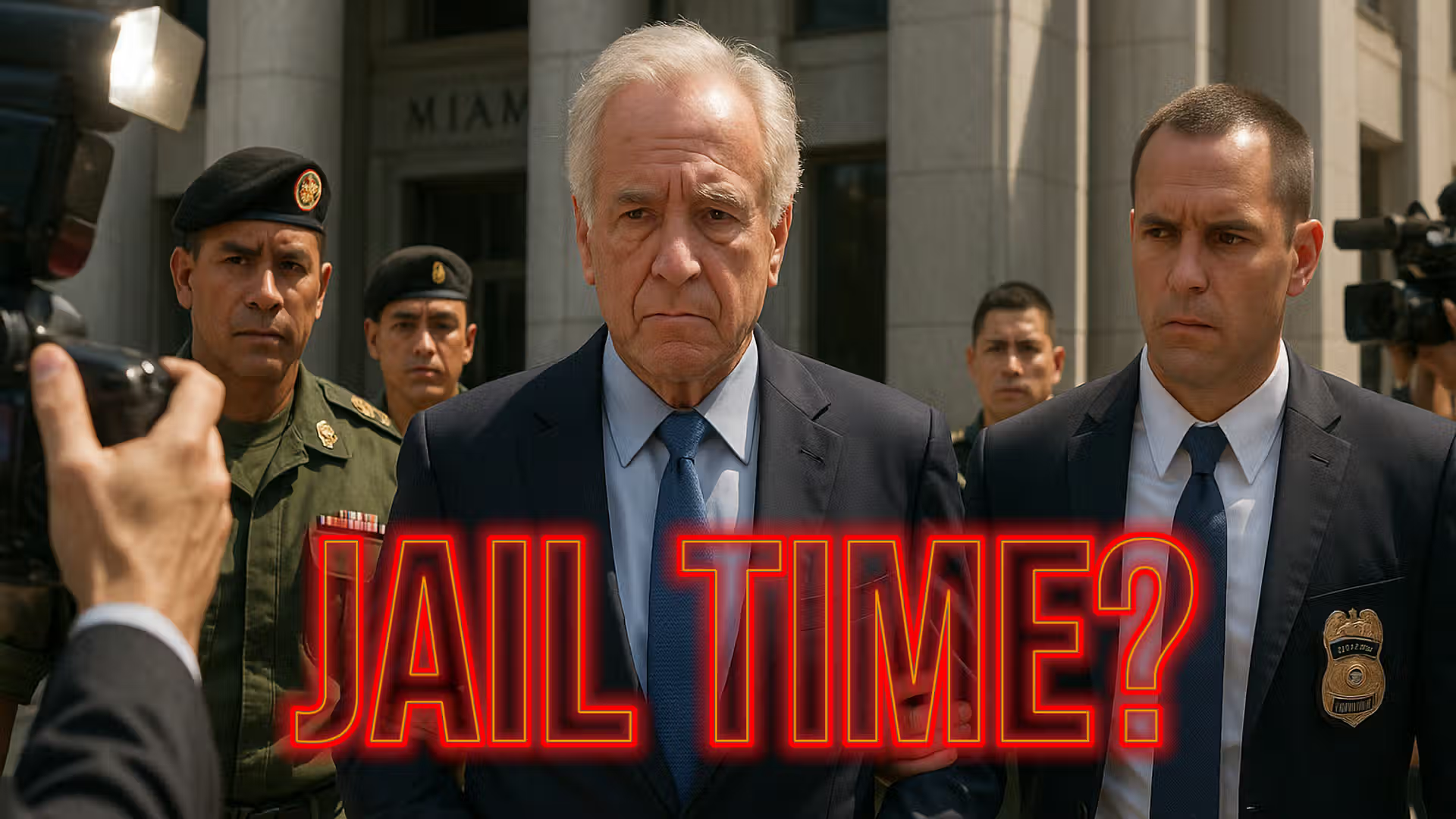
The penalties Zaglin faces are severe. Each FCPA count carries up to five years in prison, while the conspiracy to launder money carries up to twenty years. The sentencing guidelines will determine the exact penalty, but the exposure highlights how corporate executives cannot dismiss compliance obligations as minor regulatory concerns. The personal risk is substantial, extending beyond financial penalties to decades in prison.
The broader impact of corporate money laundering
The consequences of the Atlanco case extend well beyond the individuals convicted. In Honduras, the case underscores the vulnerability of national institutions to corruption. TASA, the procurement body responsible for purchasing goods for the national police, became a channel for bribery. This undermined the legitimacy of security agencies and diverted public resources meant to strengthen law enforcement. Citizens ultimately bear the cost when funds allocated for safety are siphoned into corrupt networks.
For the United States, the case highlights how American companies can be both perpetrators and facilitators of foreign corruption. Atlanco, by laundering bribe payments through U.S. financial institutions, not only violated foreign bribery laws but also compromised the integrity of its own domestic financial system. Honest American businesses that might have competed for the same contracts were unfairly disadvantaged. This distortion of competition harms market fairness and damages international perceptions of American corporate conduct.
Globally, the case adds to the growing evidence that money laundering is not confined to drug trafficking or organized crime. White-collar executives in legitimate industries are just as capable of orchestrating complex laundering schemes. By exploiting intermediaries, falsified contracts, and international banking networks, they create laundering systems that rival those of transnational criminal organizations.
For compliance officers and regulators, the takeaway is that vigilance must extend beyond traditional criminal typologies. Corporate bribery cases often involve subtle laundering tactics that mimic legitimate business practices. Training programs must emphasize detection of red flags such as repetitive payments to vague service providers, reliance on jurisdictions known for weak oversight, and the use of personal email accounts for official correspondence.
Related Links
- U.S. Department of Justice – Criminal Division
- U.S. Department of the Treasury – FinCEN
- Homeland Security Investigations
- Foreign Corrupt Practices Act Resource Guide
- Financial Action Task Force (FATF)
Other FinCrime Central Articles About CEOs in Troubled Waters
- Banca Privada d’Andorra Sees CEO Jailed Seven Years in €70 Million Laundering Case
- Upper Tribunal Affirms FCA’s Ban and £1.1M Fine for Barclays ex-CEO Jes Staley
- Luxury Goods and Sponsorship Deals at the Heart of Former Jumbo CEO AML Case
Source: U.S DOJ
Some of FinCrime Central’s articles may have been enriched or edited with the help of AI tools. It may contain unintentional errors.
Want to promote your brand, or need some help selecting the right solution or the right advisory firm? Email us at info@fincrimecentral.com; we probably have the right contact for you.