Hezbollah has engineered a diversified financial architecture built on cash movement, counterfeit goods, and trade manipulation. Recent sanctions revealed how individuals linked to the organization moved massive sums through Lebanon’s informal economy while also engaging in counterfeiting of CDs, DVDs, and even prescription drugs. These activities generate revenue, obscure the origin of funds, and serve as a parallel financing pipeline to support military and political operations. The case shows how quickly criminal networks adapt when regulatory oversight collapses. This article examines the laundering mechanisms, the counterfeiting operations that feed the system, and the AML vulnerabilities exposed by the U.S. Treasury’s action.
Table of Contents


Terror financing networks expose complex laundering mechanisms
Hezbollah benefits from a financial environment where bank controls can be easily bypassed. Lebanon’s economic crisis pushed individuals and businesses to rely heavily on cash, creating an informal marketplace that moves billions without structured oversight. The sanctioned individuals at the center of this case allegedly supervised the conversion and transfer of foreign revenue, including proceeds from oil and commodities, into Lebanon using unlicensed exchange houses. By routing the funds outside of traditional banking channels, the network avoided the transaction monitoring systems designed to detect suspicious activity.
This model is successful because cash remains untraceable once it leaves a bank. Money changers collect foreign currency, convert it into dollars or euros, and distribute it through couriers or informal brokers. These transfer chains do not generate wires or digital ledgers, making it impossible for financial institutions to detect or report the activity through standard AML processes.
Commodity-linked trade reinforces the illusion of legitimacy. Front companies involved in transporting oil, metals, and chemicals operate with contracts and invoices that make the revenue appear clean. The invoices support the layering phase of laundering by creating documentation that can be presented to banks, auditors, and regulators.
One of the most overlooked revenue channels is mass counterfeiting. Over several years, law enforcement and regulatory bodies across multiple countries have seized counterfeit CDs, DVDs, and prescription medications linked to networks aligned with Hezbollah financing intermediaries. These illegal goods are manufactured or sourced cheaply and sold through informal street markets and e-commerce platforms using cash-only transactions. The profit margins are significant because the products cost almost nothing to produce or acquire. For prescription drugs in particular, counterfeit pills often contain no active ingredient, or worse, harmful substances, creating public health risks in addition to funding illicit activity.
This diversified model relies on the following recurring mechanisms:
- cash placement through informal exchange houses
- currency conversion and physical transport of banknotes
- trade based laundering using commodity shipments
- counterfeit goods sold through cash markets with no traceable record
Each channel supports the others. Cash generated from counterfeit prescription drugs or pirated media enters the exchange system, gets converted into dollars, then moves offshore through couriers or commodity transactions. The laundering structure is designed to blur the origin of money beyond recognition.
Cash economy vulnerabilities exploited to enable laundering and counterfeiting
Lebanon’s reliance on cash intensified after its banking crisis restricted withdrawals and blocked transfers of foreign currency. Individuals and businesses turned to informal money service providers who were willing to convert or move cash without documentation. Exchange houses became essential for daily commerce. Many operate without adequate oversight, and some operate without a license.
This environment allowed the network to run placement, layering, and integration simultaneously. Cash from counterfeit activity enters the exchange system with legitimate business money. Currency is converted multiple times to make tracing impossible. The funds are later funneled into operations including procurement or reinvested into additional counterfeiting or trade-based laundering.
Fake CDs and DVDs are an ideal vehicle because they can be moved across borders in containers of mixed merchandise. Once shipped, counterfeit goods are sold for cash in informal markets. Counterfeit prescription drugs provide an even higher return because they can be sold at a premium price under the guise of expensive imported pharmaceuticals. These counterfeit products are regularly sold through small pharmacies or street markets, especially in countries lacking strong pharmaceutical regulation.
The laundering chain relies on the anonymity of these transactions. Once cash enters the hands of money exchanges, it becomes liquid capital. Multiple currency conversions remove traceability. Physical transfers move money to intermediaries who then reinvest it into additional trade or counterfeit activity. The objective is to ensure that no digital audit trail exists.
Exchange houses are particularly vulnerable because:
- they handle large volumes of cash with minimal documentation
- many lack transaction monitoring systems
- they often operate in high risk areas with weak regulatory oversight
Their legitimate function provides a shield. A business that converts thousands of dollars daily can mix illicit currency with legitimate revenue without raising suspicion. When combined with proceeds from counterfeit products, distinguishing legal from illegal cash becomes nearly impossible.
The U.S. Treasury determined that individuals linked to Hezbollah allegedly collected tens of millions within a short timeframe by using this structure. Investigations also show that the network leveraged money exchanges connected to Hezbollah associates to facilitate the movement, conversion, and layering of funds.
Sanctions pressure and ecosystem accountability
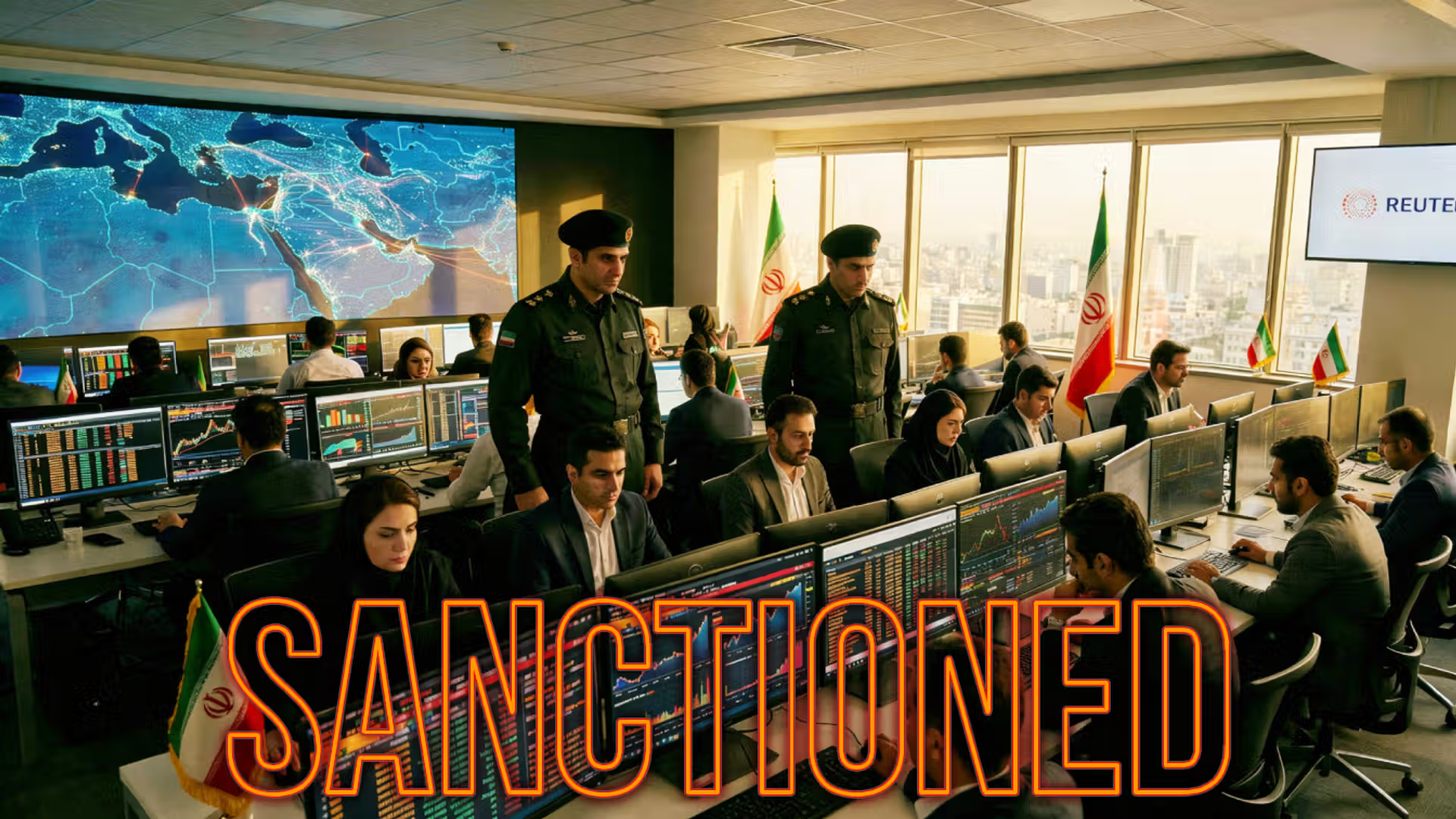
Sanctions freeze assets, prohibit U.S. persons and businesses from engaging with designated individuals, and extend to any company majority owned by those individuals. The Treasury’s action blocks access to funds held in U.S. jurisdiction and prohibits any transaction involving the designated persons. The goal is to disrupt the financial ecosystem that enables the laundering operation.
There are three important consequences for financial institutions. First, exposure carries strict liability. A bank can face civil penalties even if they unintentionally facilitated a transaction involving a sanctioned person. Second, foreign financial institutions that knowingly engage in transactions linked to the designated persons risk losing their ability to maintain correspondent banking relationships in the United States. Losing that access is equivalent to being cut off from the global financial system. Third, sanctions target the broader business infrastructure, not just the individuals. Any entity where a designated individual holds a controlling stake is considered blocked.
Financial institutions must adapt by elevating oversight on cash-intensive businesses, import-export companies, and distributors of generic or bulk pharmaceuticals. These customer types present an elevated risk because they can conceal trade linked to counterfeit goods or unexplained cash inflows.
Modern compliance requires more than sanctions screening. Institutions must apply enhanced due diligence on:
- money service businesses
- businesses operating with high levels of physical cash
- import-export operations involving mixed commodities
- pharmaceutical wholesale companies without transparent sourcing
Trade surveillance is essential. Reviewing documentation alone is insufficient because false invoices can support fabricated economic activity. Monitoring must include abnormal pricing, repetitive trade patterns, and unusual routing across multiple low-regulation jurisdictions.
Sanctions enforcement pushes financial institutions to evolve from reactive to preventive. The expectation is not to detect illicit funds after they enter the system, but to prevent them from entering at all.
Impact, lessons, and strategic AML priorities
This case signals a shift in how terror financing networks operate. Instead of relying on a single method, they diversify to avoid traceability. Cash, counterfeit goods, and commodity trades converge into a durable laundering system. Counterfeit CDs and DVDs generate steady revenue with minimal production cost. Counterfeit prescription drugs generate high profit margins due to market demand and weak oversight. The cash from these activities enters exchange houses where it becomes indistinguishable from legitimate currency.
The lesson is clear: AML programs designed around bank wires and digital transfers are no longer sufficient. Compliance functions must expand to monitor businesses that handle physical cash, trade, logistics, and product distribution. Financial institutions must track beneficial ownership changes, monitor trade flows, and evaluate whether customer behavior aligns with expected business activity.
Global criminal networks have adapted to regulatory pressure. They understand that banks are monitored and instead push funds into unregulated sectors. The future of AML depends on identifying risks outside the banking perimeter.
Organizations that succeed in preventing exposure will:
- assign high risk ratings to money service businesses operating in volatile markets
- review trade activity of customers dealing in mixed or general merchandise
- evaluate cash-based revenue sources for consistency with real economic performance
In the past, money laundering was treated as a banking problem. This case proves it is a commercial ecosystem problem. Cash-intensive businesses, import-export companies, commodity traders, pharmaceutical distributors, and media wholesalers may all serve as channels for illicit funds when AML oversight is weak.
The only effective defense is proactive risk assessment and continuous monitoring.
Related Links
- U.S. Department of Treasury – Specially Designated Nationals and Blocked Persons List
- U.S. Department of Treasury – Sanctions Programs and Country Information
- U.S. Government – Executive Orders Related to National Security
- U.S. Government – Compliance and Enforcement Information
Other FinCrime Central Articles About Hezbollah Money Laundering Operations
- Hezbollah’s Secret Car Trade Networks in Canada Fuel Billions in Dirty Money
- OFAC Hits Hezbollah with Fresh Sanctions Shaking Lebanon’s Banking Sector
- Hezbollah Financier Sentenced for Role in La Shish Conspiracy
Source: US Treasury
Some of FinCrime Central’s articles may have been enriched or edited with the help of AI tools. It may contain unintentional errors.
Want to promote your brand, or need some help selecting the right solution or the right advisory firm? Email us at info@fincrimecentral.com; we probably have the right contact for you.