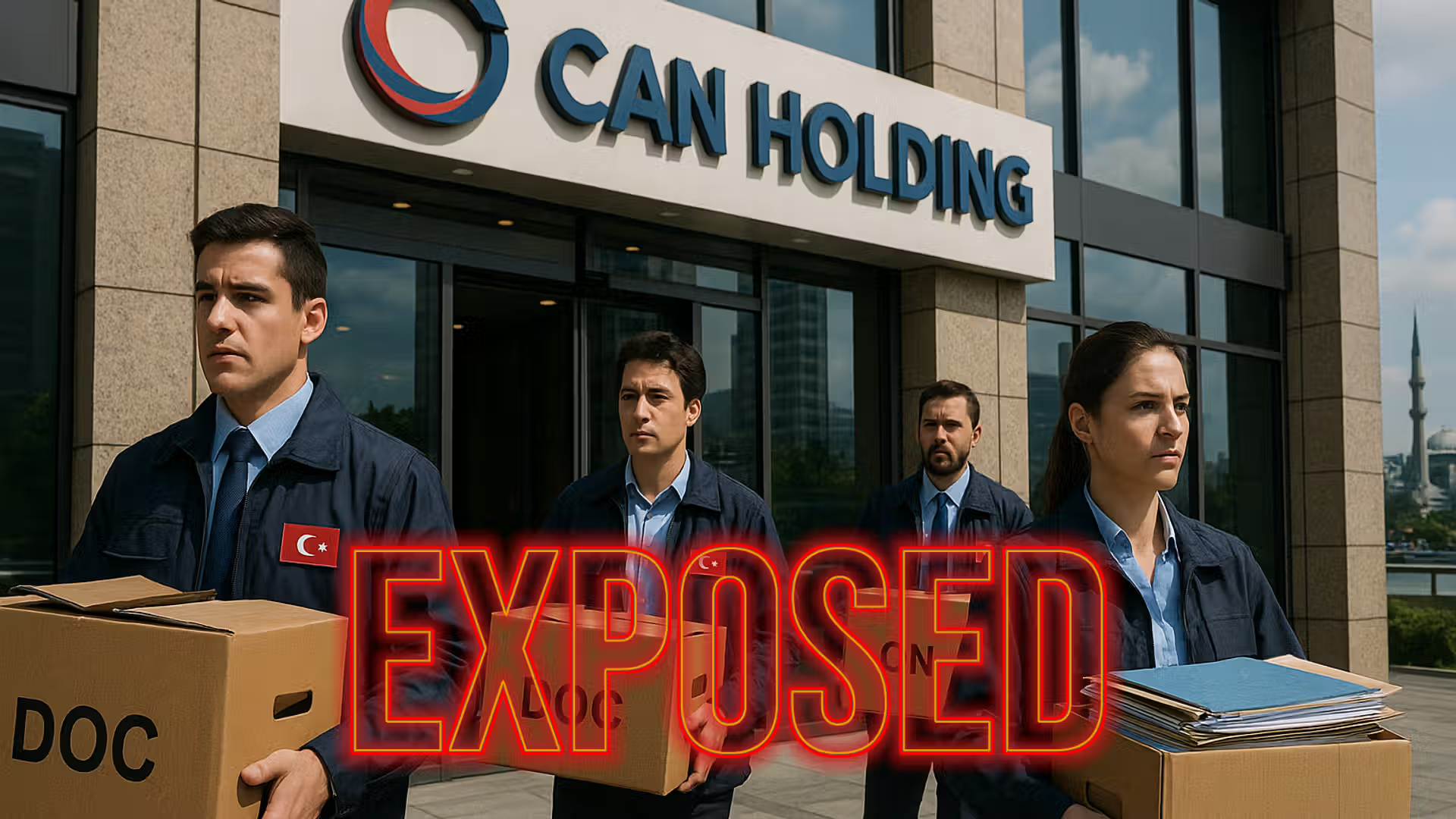
The forced seizure of Can Holding by Turkish authorities has exposed one of the country’s most striking cases of alleged financial crime in recent years. This conglomerate, with assets spanning media, education, finance, and energy, is accused of laundering vast sums of illicit money through a carefully engineered corporate network. The scandal has not only shaken investor confidence but has also highlighted the dangers of weak oversight, politically motivated ownership transfers, and loopholes in financial regulation. For anti-money laundering professionals worldwide, the case provides an opportunity to dissect how illicit finance can infiltrate respected industries, distort market competition, and secure political influence.
Table of Contents


Money laundering through conglomerate structures
At the core of the allegations is the claim that Can Holding functioned as a sophisticated laundering machine. Investigators assert that its owners, Kemal Can and Mehmet Şakir Can, built a labyrinth of companies designed to shuffle illicit capital until it became indistinguishable from legitimate business revenue. More than 121 companies were reportedly involved, an extraordinary number that points to the deliberate use of corporate layering to create complexity and evade detection.
The alleged techniques are textbook examples of advanced laundering. Fake invoices allowed the movement of funds to appear as routine transactions. Dormant firms suddenly received capital increases, financed with offshore cash that had little or no documentation of origin. Once injected, the money was used to buy into high-visibility sectors like television, private schools, and universities, which offered the dual advantage of steady revenue streams and public legitimacy.
Turkey’s “Asset Peace” laws provided the legal pathway to move these funds with minimal scrutiny. This program, which expired in March 2023, was originally intended to bring offshore wealth back into the Turkish economy. It allowed companies and individuals to declare capital held abroad, transfer it to Turkey, and integrate it into the financial system without being required to prove its origin. Prosecutors allege that Can Holding used this channel extensively, disguising illicit funds as repatriated wealth and injecting them into its subsidiaries. For a group seeking legitimacy and influence, the program was an ideal vehicle.
The scale of illicit financial networks
The breadth of the state action reflects the scale of the suspected scheme. Authorities placed Can Holding and all of its 121 linked companies under the control of the Savings Deposit Insurance Fund, a state body often tasked with managing seized firms. This move is unusual for a conglomerate that operated high-profile television networks such as Haberturk and Show TV, as well as prestigious institutions like Istanbul Bilgi University and Doğa Koleji.
Investigators have detailed how illicit cash was cycled through multiple channels before resurfacing as legitimate capital. For example, funds were allegedly moved from shell companies into dormant entities, then presented as new shareholder investments. These investments financed acquisitions in the media sector, enabling the holding to buy networks previously owned by another group. The laundering process not only cleaned illicit funds but also built a bridge into influential sectors where control over public opinion could be leveraged for further protection.
The operation extended beyond simple fund transfers. By acquiring entities in education and finance, the group reportedly diversified the laundering channels and created self-sustaining circuits. Private schools and universities generated steady cash flows that could be mixed with illicit capital, making it even harder to distinguish clean money from dirty money. This type of integration shows how laundering schemes evolve from simple banking transactions into fully embedded economic systems.
Regulatory blind spots and political risks
The Can Holding scandal is not just about money laundering but also about governance. The fact that such a vast network could grow unchecked raises concerns about regulatory blind spots in Turkey’s corporate and financial oversight systems. While asset seizures are a strong enforcement tool, they are reactive by nature. Preventive mechanisms, particularly around beneficial ownership transparency and auditing of capital increases, appear to have been insufficient to prevent the buildup of risks.
The political dimensions cannot be ignored. The timing of Can Holding’s acquisition of key media assets already drew suspicion in 2024, when established networks were sold despite the group’s controversial past. For many observers, this raised red flags, as media ownership in Turkey is deeply entangled with political influence. Today, with more than 85 percent of Turkish media under direct or indirect state control, the state takeover of Can Holding’s outlets further consolidates government dominance in the sector.
The laundering allegations thus have a dual effect: they damage trust in corporate governance and amplify fears about shrinking media independence. While the prosecutor’s office has presented its case as a legitimate fight against organized crime, critics warn that such seizures, even if justified, risk reinforcing political control over information. For AML practitioners, the lesson is clear: laundering schemes often intersect with political and media landscapes, making enforcement a delicate balance between justice and governance.
Lessons for global AML practitioners
The Can Holding scandal offers a number of critical insights for regulators and compliance officers.
- Complex conglomerates require enhanced due diligence. When beneficial ownership ties span multiple unrelated sectors, the risk of illicit layering increases. Regulators should require closer scrutiny of intra-group transactions, particularly capital injections into dormant firms.
- Repatriation programs can create AML loopholes. Turkey’s “Asset Peace” law demonstrates how policies designed to boost domestic liquidity can be exploited. Without strict checks, such programs inadvertently launder the very funds they aim to attract.
- Media and education sectors are high-value laundering targets. Both industries provide steady revenues, social legitimacy, and political influence. Their role in laundering schemes is often overlooked compared to banking or real estate.
- Seizures alone are not enough. While Turkey’s state intervention disrupted Can Holding’s network, systemic reforms are required to prevent similar schemes. Transparency in ownership, tighter monitoring of cross-border flows, and stronger oversight of corporate governance are essential.
- Global implications matter. Laundered funds that enter legitimate industries distort competition, erode public trust, and weaken financial stability. For countries seeking to remain attractive to foreign investors, the reputational damage of such scandals is significant.
The Can Holding case is a reminder that laundering is not confined to criminal syndicates working in the shadows. It can take the form of sprawling business empires that command respect, generate jobs, and even influence public discourse. For AML professionals, this demands vigilance that extends beyond the financial sector into the wider economy.
Related Links
- Turkey Financial Crimes Investigation Board
- Banking Regulation and Supervision Agency of Turkey
- OECD Anti-Corruption and Integrity
- Financial Action Task Force
- European Banking Authority AML Resources
Other FinCrime Central Articles About Turkey
- US Crackdown on Hamas Virtual Currency Reveals Turkey’s Role in Terrorism Financing
- Turkey’s Bold Crypto AML Rules for 2025
- Northern Cyprus Casino Boom Drives Criminal Finance Concerns
Source: OCCRP
Some of FinCrime Central’s articles may have been enriched or edited with the help of AI tools. It may contain unintentional errors.
Want to promote your brand, or need some help selecting the right solution or the right advisory firm? Email us at info@fincrimecentral.com; we probably have the right contact for you.