Leonardo Ayala admitted to participating in a massive illicit financial scheme where he accepted over 6,000 dollars in bribes to facilitate the laundering of 5.5 million dollars to Colombia while working for a major financial institution. The former bank employee exploited his internal access to open fraudulent accounts and issue hundreds of debit cards that circumvented standard security protocols. Federal authorities revealed that these accounts were used to execute more than 12,000 international withdrawals of drug proceeds. Ayala now faces a maximum potential sentence of 50 years in prison for his role in compromising the integrity of the United States banking system. This case underscores the persistent threat of insider collusion within global anti-money laundering frameworks and the vulnerability of retail banking operations to organized crime.
Table of Contents


Financial Institution Insider Fraud
The mechanics of this case demonstrate a sophisticated abuse of internal authority within a retail banking environment to bypass established anti-money laundering controls. Leonardo Ayala used his position at a TD Bank branch in Florida to serve as a critical gatekeeper for a transnational criminal organization moving narcotics proceeds. Between June and November 2023, Ayala engaged in a series of unauthorized administrative actions that allowed millions of dollars to exit the domestic financial system undetected. By creating accounts for shell companies that had no legitimate business purpose, he provided the necessary infrastructure for illicit funds to be layered and integrated into the global economy. The reliance on an insider allowed the criminal syndicate to avoid the scrutiny typically applied to high-volume cash transactions and international transfers. This specific form of corruption represents a significant hurdle for compliance departments because the illicit activity is facilitated by the very individuals tasked with monitoring for red flags. The vulnerability here was not a failure of automated software but a failure of human integrity that allowed criminals to operate from within the vault. The scope of the activity was only possible because Ayala possessed the specific permissions required to validate identity documents and authorize the mass production of payment instruments. This internal compromise effectively neutralized the bank’s first line of defense, creating a silent tunnel through which millions flowed into foreign jurisdictions. Regulators often point to such instances as the ultimate nightmare scenario for a compliance officer, where the threat is not knocking at the door but sitting at the desk. The damage caused by such actions extends beyond the monetary loss, as it erodes the collective trust placed in the banking sector to prevent the movement of criminal capital. Furthermore, the speed at which the 5.5 million dollars was moved highlights the terrifying efficiency of an insider-aided laundering operation. Without the friction of standard regulatory questioning, the criminal organization was able to treat a major US bank as a private ATM service for its narcotics operations.



Exploitation of Debit Card Infrastructure and Shell Companies
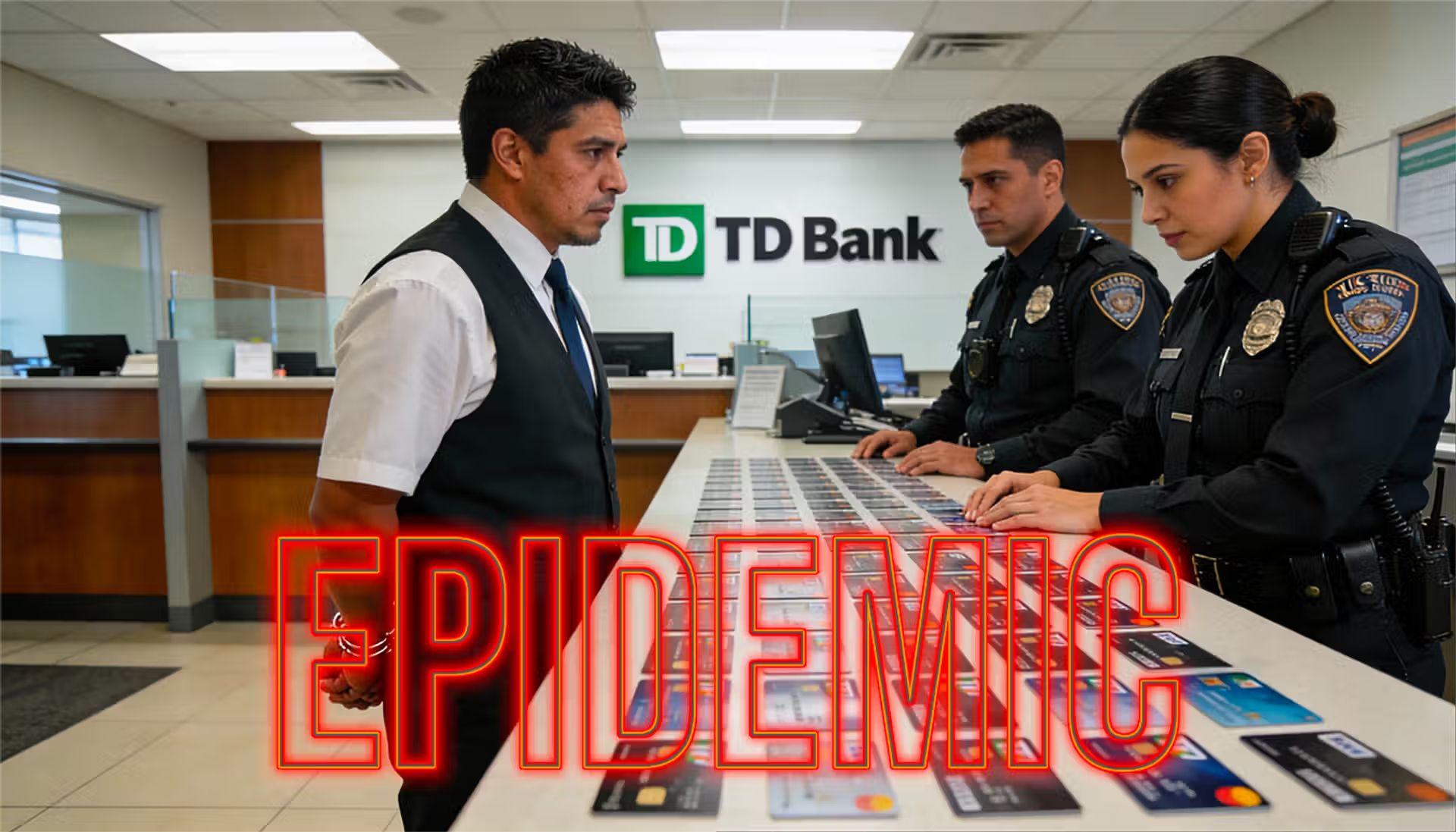
One of the most concerning aspects of the scheme was the massive scale of debit card issuance and the subsequent unblocking of restricted accounts. Ayala issued over 150 debit cards tied to fraudulent corporate entities, which were then transported or details shared for use in Colombia. When the internal monitoring systems of the bank correctly identified suspicious activity and placed restrictions on these cards, Ayala utilized his administrative credentials to override those blocks. This manual intervention by a trusted employee effectively blinded the institution to the rapid outflow of capital. The resulting 12,000 ATM withdrawals in Colombia allowed for the fragmented removal of 5.5 million dollars, a technique designed to keep individual transaction amounts below the thresholds that trigger mandatory reporting in the destination country. This high-frequency, low-value withdrawal strategy is a classic money laundering tactic, yet it was only made possible through the persistent interference of a bank official. The use of peer-to-peer digital payment networks to receive bribe payments further illustrates how modern technology is leveraged both to commit financial crimes and to compensate those who facilitate them. By receiving bribes through these digital platforms, Ayala likely believed he could hide his personal enrichment from his employer’s internal oversight. However, this digital trail eventually became a key component of the federal investigation that led to his downfall. The technical nature of the fraud shows that while the bank’s automated systems were functioning by flagging the cards, the human element was the point of failure that allowed the crime to persist. It also highlights a critical gap in many internal controls where an individual employee has the unilateral power to unfreeze accounts without a secondary approval process. This lack of dual control is a common weakness exploited by those engaging in financial institution corruption. The sheer volume of cards issued should have been an anomaly caught by branch management, but Ayala’s ability to disguise the true nature of these accounts behind shell companies provided enough cover for months of activity. The coordination between the Florida branch and the boots on the ground in Colombia suggests a highly organized network that understands the specific operational limits of modern banking technology.
Criminal Prosecution and Regulatory Investigations
The legal consequences for these actions are severe, reflecting the Department of Justice’s commitment to maintaining the stability of the financial sector. Ayala pleaded guilty to a two-count information, which includes conspiracy to launder monetary instruments and the receipt of bribes by a bank employee. These charges carry maximum penalties of 20 and 30 years, respectively, highlighting that the law treats the betrayal of financial trust with the same gravity as the underlying laundering activity. The investigation was a collaborative effort involving the Drug Enforcement Administration, the Internal Revenue Service Criminal Investigation Division, and the Federal Deposit Insurance Corporation Office of Inspector General. This multi-agency approach is typical in cases where narcotics trafficking and financial crimes intersect. The involvement of the Bank Integrity Unit within the Money Laundering, Narcotics, and Forfeiture Section signals a broader focus on holding individual bank officers accountable for actions that threaten the wider financial system. Prosecutors emphasize that the actions of a single employee can have far-reaching implications for the reputation and regulatory standing of a global bank. The prosecution’s strategy clearly aims to send a deterrent message to other financial industry professionals who might be tempted by the lure of easy cash. By charging Ayala with both the laundering and the bribery, the government is addressing the two distinct harms caused by his conduct: the facilitation of drug crime and the corruption of the banking industry. The 5.5 million dollars involved represents a significant volume of illicit trade, and the recovery of such funds is often difficult once they have been withdrawn in a foreign jurisdiction. Therefore, the focus of the Justice Department has shifted heavily toward the prosecution of the gatekeepers who make these transfers possible in the first place. The sentencing, scheduled for June, will be a major milestone in this case and will likely be watched closely by anti-money laundering professionals worldwide. The cooperation of local law enforcement, such as the Morristown Police Department, also underscores how local investigative leads can blossom into massive federal cases involving international drug cartels.
Future Implications for Banking Compliance and Security
The resolution of this case serves as a stark warning to the financial industry regarding the necessity of robust internal monitoring and the principle of least privilege in digital access. While many institutions focus their anti-money laundering efforts on external threats and customer due diligence, the Ayala case proves that internal actors remain a primary vector for systemic risk. Moving forward, banks may be required to implement more stringent behavioral analytics for employees who have the power to unblock accounts or issue large numbers of credentials. The fact that such a large volume of transactions occurred over a relatively short five-month period suggests that real-time auditing of employee overrides is a critical necessity. Furthermore, the case highlights the ongoing challenge of monitoring shell company activity when the initial onboarding process is compromised by a fraudulent employee. Regulatory bodies are likely to use the findings from this investigation to update guidance on insider threat programs and the supervision of retail branch personnel. As the sentencing date in June approaches, the financial community remains focused on how such a significant volume of cash could be moved through a major institution via simple ATM infrastructure. There is a growing consensus that the traditional three lines of defense model must be enhanced with artificial intelligence that can detect patterns of employee behavior that deviate from standard operational norms. For instance, an employee unblocking over a hundred cards in a short period should trigger an immediate and automatic alert to a central security hub. This case also brings into question the adequacy of training for branch managers in spotting the signs of employee corruption and coercion. As criminal organizations become more adept at identifying vulnerable or greedy employees, the banking industry must respond with a culture of transparency and accountability. The financial cost to the bank in terms of potential fines, legal fees, and reputational damage will far exceed the 5.5 million dollars laundered by Ayala. This serves as a powerful reminder that investing in high-level internal security is not just a regulatory requirement but a fundamental necessity for business continuity. The Ayala case will undoubtedly be cited in future compliance seminars as a textbook example of why the human risk factor is the most difficult element of money laundering to control.
Key Points
- Leonardo Ayala facilitated the transfer of 5.5 million dollars to Colombia through more than 12,000 ATM withdrawals using fraudulent accounts.
- The defendant received over 6,000 dollars in bribes via cash and digital payment platforms in exchange for bypassing bank security measures.
- Federal authorities charged Ayala with money laundering conspiracy and bribery by a bank employee, carrying a combined 50-year maximum sentence.
- The investigation involved the DEA and IRS to dismantle the link between narcotics trafficking and the exploitation of the US banking system.
Related Links
- IRS Criminal Investigation Annual Report on Financial Crimes
- DEA Domestic and International Narcotics Laundering Overview
- FDIC Office of Inspector General Recent Investigations
- Financial Action Task Force Guidance on Insider Threats in Banking
Other FinCrime Central Articles About TD Bank’s Non-Stop AML Failures
- TD Bank Employee Admits Guilt in 26 Million Dollar ATM Laundering Case
- TD Bank Employee Pleads Guilty in Massive 474 Million Dollar Laundering Case
- Unbelievable: Another TD Bank Employee Caught in Money Laundering Scheme
Source: US DOJ
Some of FinCrime Central’s articles may have been enriched or edited with the help of AI tools. It may contain unintentional errors.
Want to promote your brand, or need some help selecting the right solution or the right advisory firm? Email us at info@fincrimecentral.com; we probably have the right contact for you.