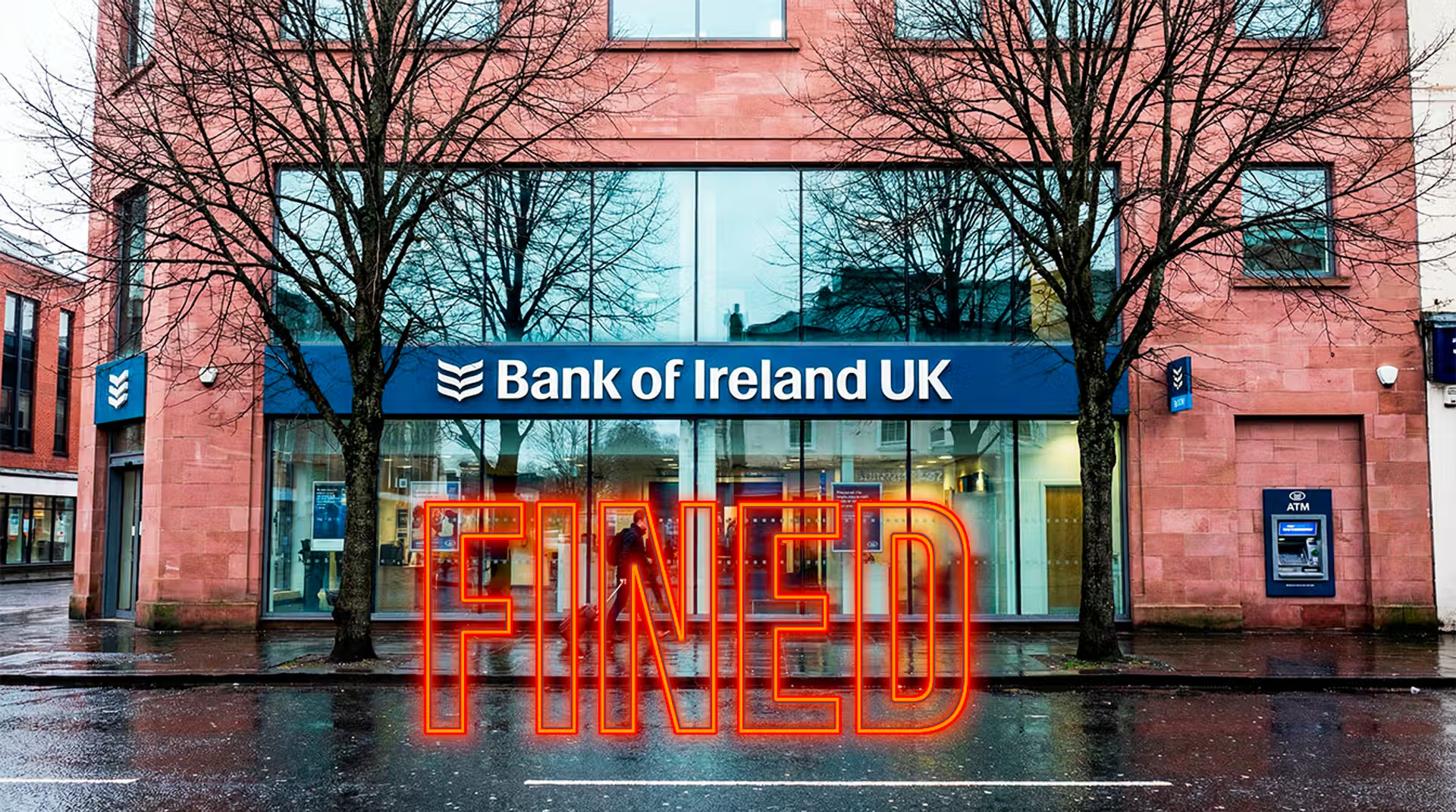
The 3 million Swiss franc fine against JP Morgan Suisse stems from a criminal case that began in November 2022, years after the 1MDB scandal had already exposed a global web of corruption and mismanagement. Swiss prosecutors turned their attention to the bank’s role in processing funds linked to Petrosaudi, a company whose executives were later convicted of siphoning money from 1MDB. Investigators found that, between October 2014 and July 2015, JP Morgan Suisse executed forty-three transfers worth about 174 million francs, thirty-four of which were outbound, raising concerns about whether the bank’s oversight mechanisms were robust enough to flag high-risk activity tied to one of the world’s most notorious financial scandals.
Table of Contents


Swiss 1MDB AML Compliance Failure Highlights Systemic Issues
The proceedings against JP Morgan Suisse culminated in a summary penalty order after prosecutors concluded that the bank failed to put adequate organizational safeguards in place. Between October 2014 and July 2015, the bank processed forty-three transactions connected to Petrosaudi, totaling approximately 174 million Swiss francs. While the bank itself was not accused of orchestrating the fraud, its role in facilitating transactions linked to illicit proceeds made it complicit through organizational shortcomings.
This period was particularly sensitive. By 2014, widespread international coverage of the 1MDB scandal had already raised doubts about the legitimacy of certain business ventures. Public reports questioned Petrosaudi’s links to the Malaysian fund, making due diligence not only a regulatory requirement but also a reputational necessity. Nevertheless, JP Morgan Suisse allowed high-value transactions to pass through its systems without applying enhanced scrutiny.
The organizational failure was not a single point of weakness but a combination of factors. Relationship managers lacked guidance on how to escalate reputational risks. Compliance teams failed to critically assess client activities despite red flags. Monitoring tools were insufficiently calibrated to detect patterns consistent with laundering. These gaps allowed the bank to become a conduit for funds that prosecutors later confirmed were connected to fraud and misappropriation.
The conviction thus signals that Swiss regulators expect banks to act decisively when reputational and compliance risks converge. Ignoring publicly available information or treating it as irrelevant is no longer tolerated.
Organizational AML Controls And What Went Wrong At JP Morgan Suisse
Corporate liability under Swiss law hinges on whether a company put in place adequate safeguards to prevent crimes. Article 102 of the Swiss Criminal Code specifies that institutions can be held criminally liable if a lack of organization enables offenses such as money laundering. JP Morgan Suisse’s conviction rests on this provision, as prosecutors determined the bank did not exercise the judgment or implement the processes required to stop illicit flows.
Several deficiencies stand out. First, risk-based due diligence was not applied with sufficient depth. Petrosaudi and its managers were associated with negative press, yet the bank did not reassess their client profile. Enhanced due diligence, designed for high-risk scenarios, was either bypassed or performed inadequately.
Second, transaction monitoring was not fit for purpose. Large cross-border transfers involving hundreds of millions should have triggered escalation. Instead, they were processed routinely. This points to a disconnect between compliance design and actual practice, suggesting that systems were either under-resourced or not integrated into decision-making.
Third, governance mechanisms fell short. Organizational culture in financial institutions plays a crucial role in AML effectiveness. If compliance is seen as a bureaucratic necessity rather than a central pillar of corporate integrity, red flags are more easily ignored. In the case of JP Morgan Suisse, investigators concluded that compliance staff did not adequately challenge front-office decisions, allowing profitability and client relationships to overshadow risk considerations.
Ultimately, the failure was not about ignorance. It was about willful complacency in the face of reputationally sensitive clients. In a globalized financial environment, banks are expected to act not only on direct evidence but also on indirect signals, including media reports and public controversies. Ignoring such signals is no longer defensible.
Legal Context And Real-World Implications Of Aggravated Money Laundering Penalties
The conviction highlights the strength of Swiss legal provisions against money laundering. Article 305bis criminalizes laundering of assets derived from crime, with aggravated circumstances applying when major amounts are involved or when the acts are linked to organized crime. By combining this with Article 102 on corporate liability, prosecutors held the bank responsible not for deliberate wrongdoing but for enabling money laundering through poor organizational choices.
The three million franc fine may appear modest compared to the billions siphoned from 1MDB, yet its significance is strategic. Swiss enforcement bodies used the penalty to reinforce expectations that banks must proactively defend against money laundering. The amount also reflected mitigating circumstances, such as JP Morgan Suisse’s cooperation and the fact that the victim, 1MDB, had already received compensation through parallel proceedings amounting to 1.4 billion Malaysian ringgit.
Beyond Switzerland, the conviction resonates with global compliance standards. The Financial Action Task Force emphasizes that financial institutions must adopt a risk-based approach and continuously adapt controls to evolving risks. The JP Morgan Suisse case shows what happens when those standards are applied in practice: a failure to act on widely known risks results in corporate conviction.
For other institutions, the message is clear. Regulatory expectations extend beyond formal compliance programs. Banks are judged on their capacity to apply critical judgment in real-world situations. A policy manual is not enough if culture, governance, and execution do not align with the principles enshrined in law.
The broader implications extend to market confidence. When a household-name bank is convicted, clients, investors, and regulators reassess its reliability. The reputational impact often outweighs the financial penalty. For compliance officers, this illustrates that investing in stronger systems is not just about avoiding fines but about preserving long-term trust and credibility.
Final Thoughts On AML Lessons From The 1MDB Swiss Case
The JP Morgan Suisse conviction reinforces that compliance is not an abstract regulatory burden but a core business imperative. For a bank of its size and stature, a three million franc fine may not cause financial strain, yet the reputational costs are substantial. The case also underscores how regulators view organizational liability: failures in governance and culture can be as damaging as direct involvement in criminal activity.
One of the key lessons is the importance of vigilance when clients are linked to scandals, even if no conviction has yet been reached. Risk appetite must be reassessed continuously, and front-office staff must be trained to escalate concerns without hesitation. Compliance teams, meanwhile, must be empowered with resources, independence, and authority to block or scrutinize transactions that raise suspicion.
The case also demonstrates that corporate liability frameworks are powerful tools for regulators. By targeting the institution rather than individuals alone, authorities create systemic accountability. Institutions can no longer claim that wrongdoing was isolated if organizational weaknesses made it possible.
Finally, this ruling fits into a broader global narrative. Enforcement actions against banks tied to 1MDB have occurred in multiple jurisdictions. Each case reinforces the principle that banks are not passive intermediaries but active guardians of the financial system. Failure to recognize this role will inevitably invite sanctions, reputational damage, and heightened scrutiny.
Related Links
- Swiss Criminal Code (Official Text)
- Swiss Criminal Procedure Code (Official Text)
- Office of the Attorney General of Switzerland – Official Site
- Federal Criminal Court of Switzerland – Official Site
- 1MDB Asset Recovery Official Announcements (Government of Malaysia)
More FinCrime Central Articles On the 1MDB Story
- Standard Chartered Under Fire as $3.4 Billion 1MDB Laundering Lawsuit Hits Singapore
- Jail Sentence for Tim Leissner in Goldman Sachs 1MDB Case
- Edmond de Rothschild Europe Settles 1MDB Case for €25 Million: Legal Impact and Details
Source: Ministère de la Confédération Helvétique
Some of FinCrime Central’s articles may have been enriched or edited with the help of AI tools. It may contain unintentional errors.
Want to promote your brand with us or need some help selecting the right solution or the right advisory firm? Email us at info@fincrimecentral.com; we probably have the right contact for you.