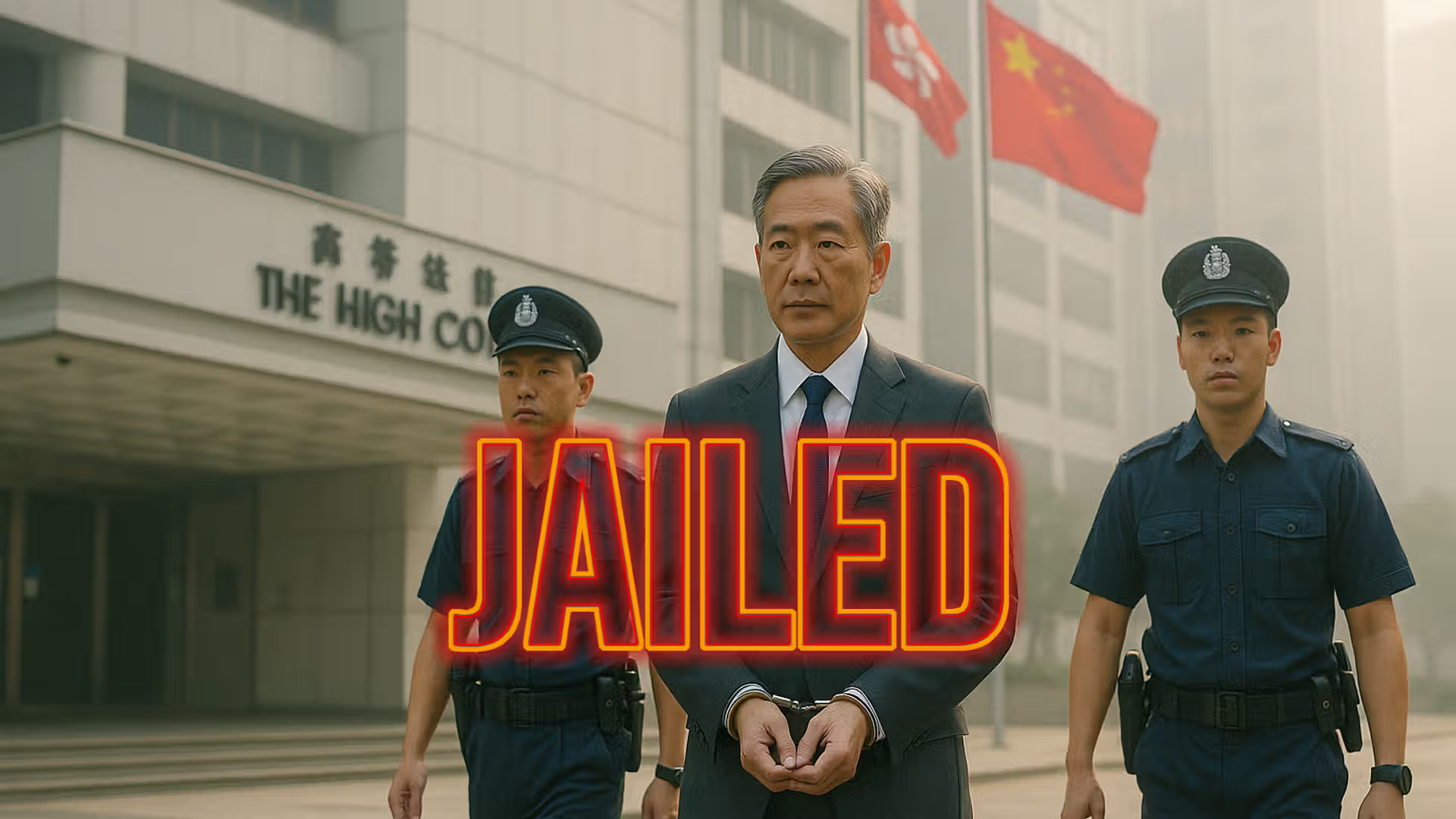
The conviction of former Hua Han Health Industry Holdings executive Wong Ming Chun for laundering corporate funds highlights a rare instance where internal misconduct within a listed company became a full-fledged financial crime case. Hong Kong’s financial system is globally respected for its rigorous regulatory oversight, yet this case showed that strong external supervision cannot compensate for internal betrayal and failed governance.
Hong Kong’s anti-money laundering regime is anchored in the Organized and Serious Crimes Ordinance (OSCO). Section 25(1) of the law makes it an offence to deal with any property known or reasonably suspected to represent the proceeds of an indictable offence. Conviction carries a maximum sentence of 14 years imprisonment and a fine of HK$5 million. The Joint Financial Intelligence Unit (JFIU), which collects and analyses suspicious transaction reports, supports this legal framework alongside the Securities and Futures Commission (SFC) and the Hong Kong Police.
The Hua Han case demonstrates how laundering can evolve from within a company rather than through external syndicates. The financial controller responsible for protecting investor funds instead manipulated corporate transactions to conceal illicit movements of capital, exploiting the very systems designed to maintain transparency.
Table of Contents


The Hua Han scandal and the laundering chain uncovered
Hua Han Health Industry Holdings Limited, once a pharmaceutical firm listed on the Main Board of the Hong Kong Stock Exchange, raised billions of Hong Kong dollars in 2015 through an open offer and convertible bond issuance. Those proceeds were intended for legitimate expansion projects, yet large amounts were instead transferred to related accounts controlled by senior executives.
The SFC’s review of Hua Han’s financial statements from 2013 to 2015 exposed a pattern inconsistent with declared business activities. Investigators traced complex fund transfers across multiple accounts, some located offshore, and detected entities created solely to disguise the origin and ownership of the diverted money. Internal documentation was incomplete, inconsistent, or retroactively altered to support the false narrative that the transfers served operational needs.
When the movements were reconstructed, the financial trail satisfied the statutory definition of laundering under OSCO. Wong Ming Chun, Hua Han’s financial controller and company secretary at the time, admitted to dealing with property derived from criminal conduct. The High Court sentenced him on 22 October 2025 to seven years and eight months’ imprisonment and banned him from serving as a company director for 12 years.
The sums involved approached HK$5 billion, marking one of the largest cases of insider-driven laundering ever prosecuted in Hong Kong. What differentiates it from typical cases is that the crime was concealed behind legitimate capital-market activity. Fund-raising events that normally symbolize business growth became vehicles for moving illicit proceeds through a listed entity’s own financial structure.
Governance collapse and AML implications for capital markets
Corporate governance operates as the first line of defence against laundering, and when that framework collapses, external regulators are left to clean up the aftermath. The Hua Han affair revealed deep weaknesses in board oversight, internal audit independence, and financial control segregation. The very people entrusted with safeguarding shareholder value exploited those weaknesses for personal gain.
A breakdown in internal accountability was evident in several ways:
• Capital raised for specific projects was diverted to unrelated purposes without proper documentation.
• The financial controller had unchecked authority over account transfers.
• External auditors, alarmed by discrepancies, declined to approve the 2015 financial statements.
• The board failed to question inconsistent fund movements or unusual offshore dealings.
For compliance professionals, the case underscores that anti-money-laundering programs must extend beyond financial institutions to include listed issuers. Banks that service such corporations must apply enhanced scrutiny to large inbound and outbound flows from fund-raising events. Corporate customers should be risk-scored not only by sector but also by transactional behavior.
Regulators have repeatedly warned that directors and senior officers remain accountable even when criminal acts are carried out by subordinates. The principle of “willful blindness” applies: turning a blind eye to suspicious activity does not shield management from prosecution. In Hua Han’s situation, the leadership’s passivity amounted to facilitation.
Long-term impact on compliance culture and market integrity
The Hua Han conviction represents a turning point for how Hong Kong views internal misconduct in publicly listed companies. The collaboration between the SFC, the Police, and the Department of Justice signals an evolution toward integrated enforcement across market conduct and AML domains. The message is clear: disclosure manipulation, misappropriation, and laundering are no longer treated as separate issues but as interconnected violations of market integrity.
For the market, the consequences extend beyond the prison sentence. Investor trust, once shaken, is difficult to restore. The case triggered renewed calls for boards to strengthen internal controls and for regulators to impose personal accountability on senior executives overseeing financial operations. Many listed firms have since introduced independent audit committees, more rigorous approval protocols, and internal AML policies that mirror those used by financial institutions.
The scandal also amplifies the need for cultural reform within companies. Employees must feel protected when reporting anomalies, yet whistleblowing remains underutilized across Asian markets. A comprehensive whistleblower framework could have detected the irregularities earlier, reducing both reputational damage and investor loss.
Internationally, the case has drawn attention to a wider trend of laundering through capital markets. Similar patterns have surfaced elsewhere, where bond proceeds or share placements were channeled into shell companies. Regulators globally are reassessing how AML risk assessments cover non-financial corporate issuers, not just financial intermediaries. The intersection between securities law and AML enforcement is becoming one of the defining challenges for modern compliance.
Related Links
- Hong Kong e-Legislation – Organized and Serious Crimes Ordinance Cap. 455
- Joint Financial Intelligence Unit – Suspicious Transaction Reporting Guidelines
- Department of Justice – Proceeds of Crime and Asset Recovery Framework
- Companies Registry – AML/CFT Obligations for Directors and Officers
- Securities and Futures Commission – Enforcement Actions and Announcements
Other FinCrime Central Articles about Hong Kong SFC’s Tough Stance
- HK SFC Fines Freeman Commodities $3.4 Million and Suspends Responsible Officer
- HK SFC Suspension Highlights Money Laundering Risks in Electronic Trading
- SFC reprimands and fines CSC Futures (HK) Limited $4.95 million for regulatory breaches
Source: HK SFC
Some of FinCrime Central’s articles may have been enriched or edited with the help of AI tools. It may contain unintentional errors.
Want to promote your brand, or need some help selecting the right solution or the right advisory firm? Email us at info@fincrimecentral.com; we probably have the right contact for you.