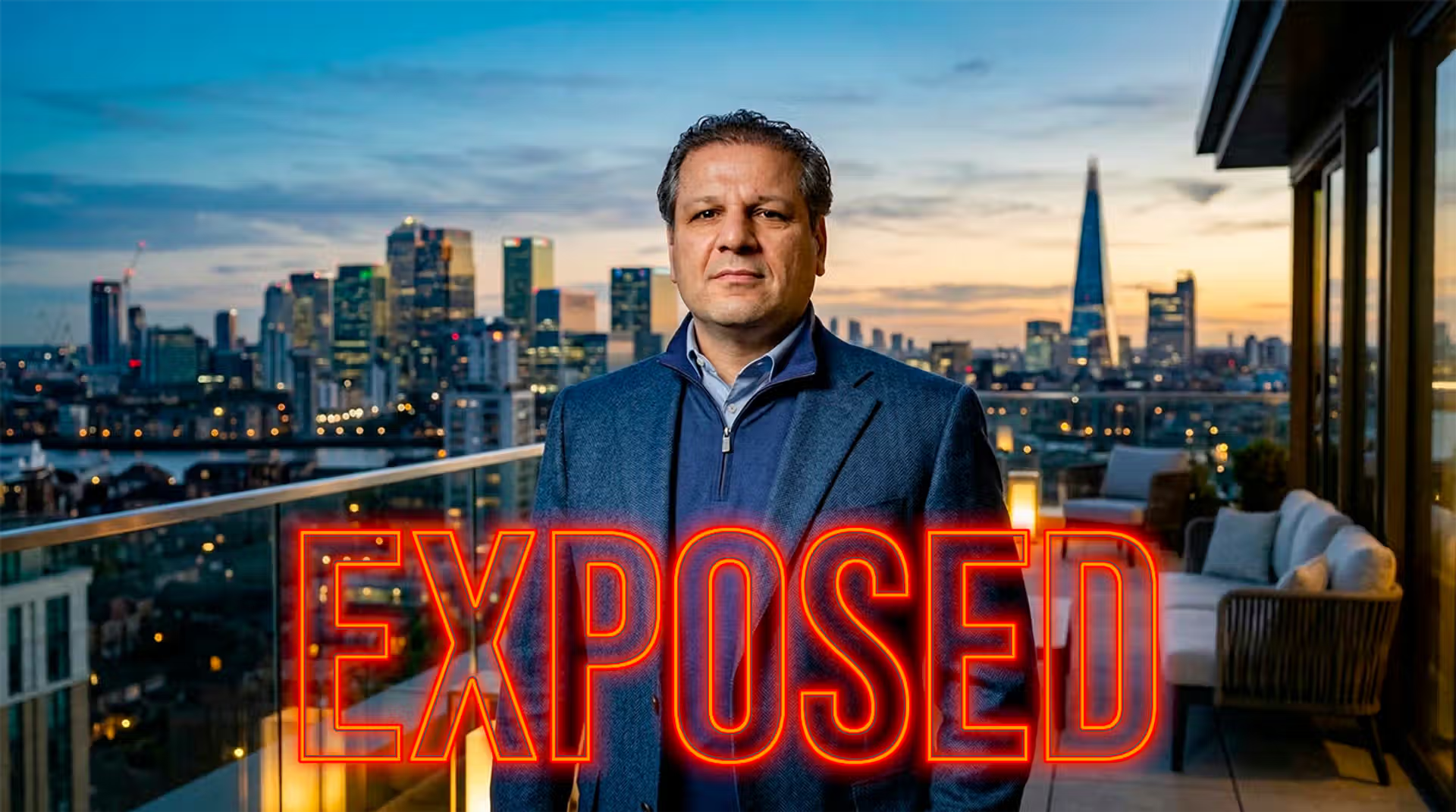
The United Kingdom government recently enacted a massive 100 million pound asset freeze against Ali Ansari, a prominent Iranian banker accused of providing critical financial infrastructure to the Islamic Revolutionary Guard Corps. This enforcement action targets a sprawling international real estate portfolio that spans from high-end London mansions to luxury estates on the Spanish coast. Authorities allege that Ansari utilized a complex network of corporate entities to obscure the origin and destination of funds tied to the Iranian military apparatus. The sanctions represent a significant escalation in Western efforts to disrupt the shadow banking systems that sustain sanctioned regimes.
Table of Contents


Cross-Border Real Estate and Global Money Laundering Risks
The intersection of high-value real estate and corporate opacity provides a fertile ground for the movement of illicit capital across international borders. In the case of Ali Ansari, the use of a United Kingdom-based firm, Veritas Reales Investment Limited, served as a primary vehicle for managing substantial property holdings. This entity, which lists Ansari as the sole person with significant control, illustrates how domestic corporate registries can be exploited to facilitate the acquisition of foreign assets. By establishing a subsidiary in Spain, known as Veritas Reales Marbella SL, the network effectively layered its ownership of a luxury villa in the exclusive Altos Reales community. Such structures are classic examples of how money laundering risks manifest in the real estate sector, where the true beneficial owner remains several steps removed from the physical asset. Regulatory bodies like the Financial Action Task Force have long warned that the real estate industry is a primary target for those seeking to integrate illicit wealth into the legitimate economy. The complexity of these arrangements often requires deep forensic investigation into corporate filings across multiple jurisdictions, including the United Kingdom, Spain, and Cyprus.
When an individual uses a third-country passport, such as a Cypriot document, to register businesses in London that subsequently invest in Spanish property, it creates a jurisdictional puzzle for law enforcement. Each layer of the corporate chain adds a level of protection against immediate seizure or identification. The British authorities have moved to freeze over 100 million pounds in assets, which includes commercial and residential properties valued at staggering amounts. This specific enforcement action highlights the vulnerability of the European property market to capital inflows from jurisdictions under heavy international sanctions. The ability of a sanctioned individual to maintain a lifestyle of extreme luxury while their home country faces economic collapse and civil unrest underscores the importance of robust anti-money laundering checks. Financial institutions and real estate agents are required to perform enhanced due diligence when dealing with politically exposed persons or individuals from high-risk jurisdictions, yet the Ansari case suggests that gaps in the global financial net still persist.



Financial Institutions and the Shadow Economy of Sanctioned States
The role of domestic banks in facilitating the goals of sanctioned organizations is a critical component of modern financial warfare and money laundering investigations. Ali Ansari held significant influence over Ayandeh Bank, an Iranian financial institution that eventually faced dissolution by the Central Bank of Iran due to extreme mismanagement and massive debt. Reports indicate that the bank had accumulated debts exceeding 5 quadrillion Iranian rials, a figure that nearly doubled its total deposits. More importantly for investigators, over 90 percent of the funds within Ayandeh Bank were reportedly allocated to parties closely related to the bank or to projects managed by the bank itself. This type of related party lending is a major red flag for money laundering and systemic corruption, as it allows for the siphoning of public and depositor funds into private or paramilitary hands. The dissolution of the bank in late 2025 followed years of what regulators described as reckless financial behavior, which ultimately contributed to the broader economic instability in the region.
The collapse of such a large financial entity often leaves a trail of digital and paper evidence that links domestic political interests to international investments. In this instance, the United Kingdom government alleges that the wealth generated through these banking activities was used to fund the Islamic Revolutionary Guard Corps. The Guard is not merely a military wing but a massive economic conglomerate with interests in telecommunications, oil, and construction. By controlling the flow of credit and capital through entities like Ayandeh Bank, individuals can theoretically bypass international sanctions by moving money through a series of shell companies and offshore accounts before it reaches the final destination in a European real estate market. The sheer scale of the debt and the concentration of loans to insiders suggest a deliberate effort to use the banking sector as a personal or political treasury. As standard standards of living plummeted and inflation soared, the contrast between the domestic economic ruin and the acquisition of a 15 million euro Spanish villa became a focal point for international observers and domestic protesters alike.
Corporate Transparency and the Mechanics of Asset Recovery
The process of identifying and freezing the assets of a sanctioned individual relies heavily on the transparency of corporate registers like Companies House in the United Kingdom. However, the Ansari investigation reveals that even with public registers, the path to ownership is often obscured by late filings and shifting directorships. Veritas Reales Investment Limited, the firm at the heart of the Spanish villa acquisition, has faced potential forced dissolution due to overdue annual filings. This pattern of non-compliance is frequently observed in entities used for money laundering, as it allows the controllers to operate in a gray area while they move or liquidate assets. The Spanish subsidiary, Veritas Reales Marbella SL, functioned as the direct owner of the Marbella estate, which features historic architectural elements and extensive grounds. Recovering or permanently seizing such assets requires a high level of international cooperation between British and Spanish judicial authorities.
The legal challenges posed by sanctioned individuals further complicate the asset recovery process. Ansari, through his legal representation, has vehemently denied any financial link to the Islamic Revolutionary Guard Corps, framing the sanctions as a byproduct of geopolitical tensions rather than evidence-based law enforcement. This defense strategy often involves challenging the quality of the evidence provided by government agencies, which is frequently classified or based on intelligence reports. Despite these denials, the sheer volume of wealth held in Western jurisdictions by a banker from a sanctioned state remains a primary concern for anti-money laundering regulators. The goal of the 100 million pound freeze is to prevent the further movement of these funds while the legal merits of the case are debated in court. If the freeze is upheld, it serves as a powerful deterrent against the use of Western financial centers as safe havens for the capital of individuals tied to oppressive regimes or sanctioned military groups.
Strategic Implications of Financial Sanctions on Private Wealth
The use of targeted financial sanctions against individuals rather than entire nations is a precise tool designed to hit the economic elite who support sanctioned governments. By freezing luxury assets, governments aim to create a direct personal cost for those facilitating the financial operations of groups like the Revolutionary Guard. The case of the Marbella villa and the 52 million dollar London mansion illustrates the lifestyle that these individuals seek to protect. The fact that the Spanish property was marketed with features like 15th century church chandeliers and temperature-controlled wine cellars highlights the extreme concentration of wealth that is often the target of money laundering probes. The conclusion of such cases often takes years of litigation, as the state must prove that the funds used to purchase the assets were derived from illicit activities or intended for illegal use.
The broader impact of these enforcement actions is felt across the global real estate and banking sectors. It forces a reevaluation of how luxury properties are sold and how corporate entities are allowed to operate across borders. The Ansari case serves as a warning that no matter how many layers of companies are created, the digital footprints of global finance are increasingly visible to investigative journalists and government regulators. As the United Kingdom and its allies tighten their grip on the shadow financial networks used by the Iranian state, the focus will likely remain on the intermediaries—the lawyers, real estate agents, and company formation specialists—who enable these transactions. The ultimate success of the 100 million pound freeze will be measured not just by the value of the seized property, but by its ability to disrupt the long term financial viability of sanctioned organizations that rely on private bankers to move their money through the global economy.
Key Points
- The United Kingdom has frozen over 100 million pounds in assets belonging to Ali Ansari due to alleged ties with the Islamic Revolutionary Guard Corps.
- Ansari utilized a chain of corporate entities in the United Kingdom and Spain to acquire luxury real estate, including a 15 million euro villa in Marbella.
- The dissolution of Ayandeh Bank in Iran exposed massive debts and high levels of related-party lending used to funnel funds into private projects.
- Corporate opacity through the use of foreign passports and multiple layers of subsidiaries remains a primary challenge for anti-money laundering enforcement.
Related Links
- Financial Action Task Force Guidance on Real Estate Sector Risks
- United Kingdom Office of Financial Sanctions Implementation Consolidated List
- European Union Anti-Money Laundering Directive Framework
- Central Bank of Iran Official Press Releases on Banking Dissolution
- United Kingdom Companies House Corporate Registry Records
Other FinCrime Central Articles About London Being a Safe Heaven for Laundered Money
- London Real Estate Market Faces Continuous Questions Over $17M Deal By Sanctioned Criminal
- Dinosaur Bones and London Penthouses Exposed in a $2.3B Laundering Case
- UK Jails ‘Crypto Queen’ Qian Zhimin for Bitcoin Laundering Scheme Worth Billions
Source: OCCRP
Some of FinCrime Central’s articles may have been enriched or edited with the help of AI tools. It may contain unintentional errors.
Want to promote your brand, or need some help selecting the right solution or the right advisory firm? Email us at info@fincrimecentral.com; we probably have the right contact for you.