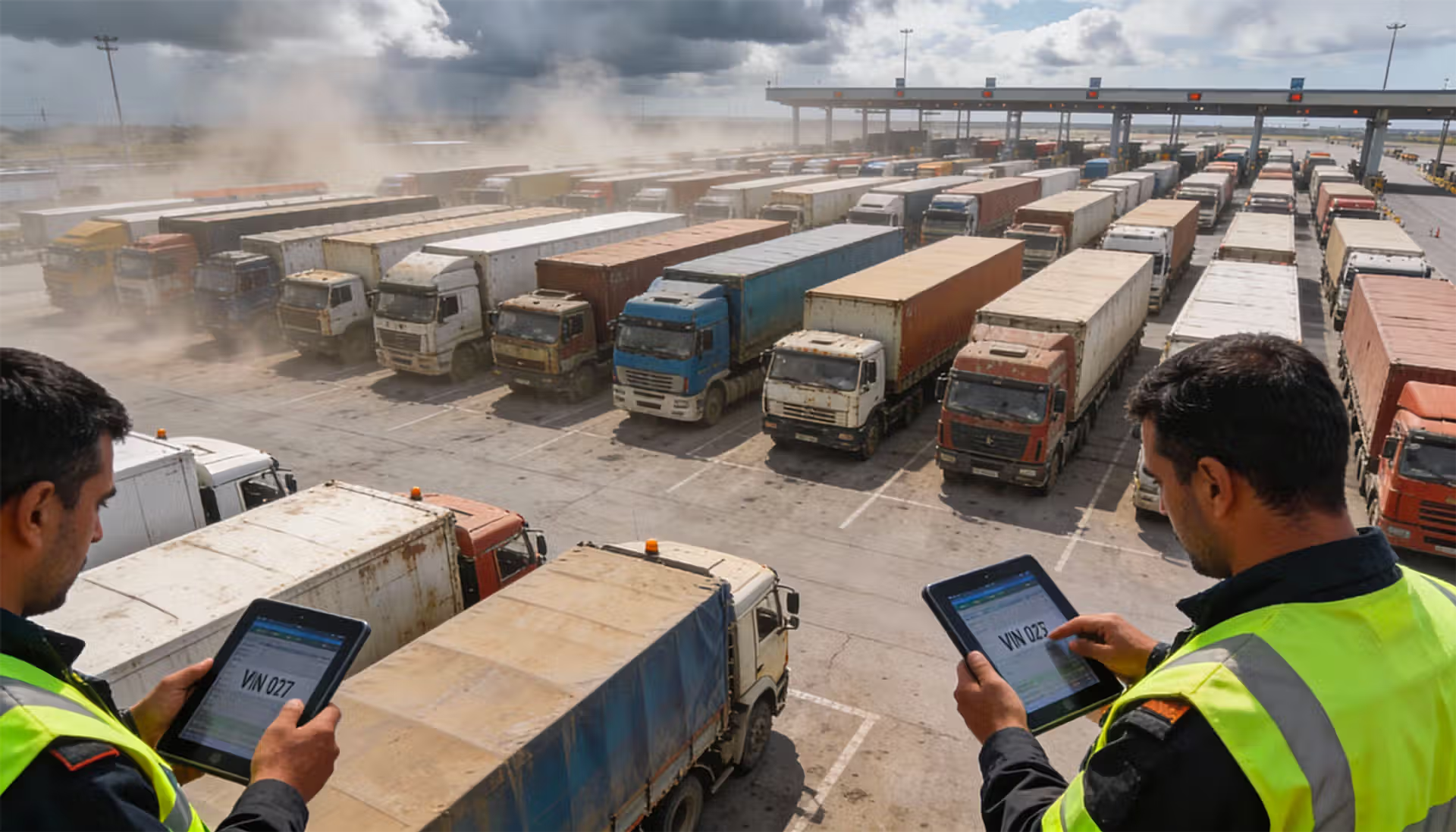
The European Anti-Fraud Office coordinated a massive cross-border investigation that recently uncovered the illegal export of 766 transport vehicles to Russia in violation of standing trade restrictions. Launched after Polish authorities flagged suspicious used vehicle exports, the probe revealed a sophisticated logistics chain that utilized false destination declarations to bypass international sanctions. European officials confirmed that these vehicles were rerouted through third countries despite being officially destined for nations like Türkiye. The operation has triggered criminal investigations in three different member states as authorities move to address the integration of illicit goods into restricted markets.
Table of Contents


Transshipment Tactics for Sanctions Evasion
The complexity of the scheme relied on a multi-layered network of exporters and importers designed to obscure the final destination of high-value assets. During the investigation, officials identified that the vehicles were ostensibly sold to entities in countries including Armenia, Georgia, Kazakhstan, Kyrgyzstan, and Moldova. By performing detailed data analysis and cross-checking customs records, the European Anti-Fraud Office established that none of the 766 vehicles ever reached their declared regional importers. Instead, the logistics trail was reconstructed to show that the assets were moved directly into Russia, utilizing these neighboring jurisdictions as mere transit points to hide the true nature of the transaction. This method of transshipment is a hallmark of modern money laundering and sanctions circumvention, where legitimate trade routes are exploited to facilitate the movement of restricted items. The investigation highlighted that exporters within the European Union worked in tandem with straw importers to generate a paper trail that appeared compliant on the surface. Only through individual vehicle tracking and international cooperation with local authorities in the transit countries was the fraud revealed. The removal of these vehicles from the regulated market represents a significant breach of the restrictive measures intended to safeguard regional security interests.
Furthermore, the data analysis revealed that the perpetrators utilized a series of shell companies to manage the financial aspects of these transactions. These companies were often registered in jurisdictions with opaque beneficial ownership registries, making it difficult for financial institutions to perform adequate due diligence. The exporters would receive payments from these third-party entities, effectively decoupling the source of funds from the physical movement of the goods. This financial obfuscation is a critical component of professional money laundering, as it allows illicit actors to access the global banking system without triggering immediate alerts. The investigation showed that the volume of transactions was scaled specifically to avoid the thresholds that typically trigger enhanced reporting requirements. By splitting the shipments and the corresponding payments, the network managed to sustain its operations for a significant period before the Polish authorities intervened. The collaboration between customs agencies and anti-fraud investigators was essential in bridging the gap between physical cargo movements and the digital footprints left by the financial transfers.



Money Laundering Risks in Global Vehicle Logistics
The illicit trade of transport vehicles often serves as a primary vehicle for moving value across borders while bypassing financial transparency requirements. In this case, the use of fictitious trade documentation and the intentional misdeclaration of goods to customs authorities represent the placement and layering phases of a broader criminal enterprise. By generating false invoices and transit papers, the participants were able to process payments through the international banking system under the guise of legal commerce. This integration of illicitly diverted goods into the Russian economy provides the financial fuel necessary for sanctioned entities to continue operations despite global restrictions. Financial institutions and customs agencies are now facing increased pressure to enhance their risk profiling to detect similar schemes before the assets leave the jurisdiction. The European Anti-Fraud Office noted that the findings from this case have already prompted regulators to strengthen monitoring systems and update the criteria used to identify high-risk shipments. The scale of the operation, involving hundreds of heavy transport units, suggests that organized criminal networks are increasingly leveraging the used vehicle market due to its high liquidity and the ease with which individual units can be moved through complex land routes.
Beyond the immediate movement of vehicles, this case exposes the vulnerability of the secondhand market to criminal exploitation. Unlike new vehicle exports, which are often subject to direct manufacturer oversight and more stringent supply chain controls, the used vehicle market involves a diverse array of independent dealers and intermediaries. This fragmentation provides ample opportunities for bad actors to insert themselves into the supply chain. The investigation found that the 766 vehicles were sourced from various member states, indicating that the network had a broad reach across the continent. This geographic diversity was likely a deliberate tactic to prevent any single national authority from detecting the full scope of the operation. Each local transaction appeared relatively small and unremarkable, but when aggregated at the regional level, the total value and strategic impact of the diversion became clear. The role of OLAF as a central coordinating body was therefore indispensable, as it provided the bird’s-eye view necessary to connect these disparate data points into a coherent picture of criminal activity. This systemic approach to investigation is becoming the standard for addressing complex financial crimes that span multiple jurisdictions.
Structural Vulnerabilities in Trade Finance
The reliance on trade-based money laundering techniques in this instance demonstrates a deep understanding of the weaknesses within international trade finance. Many of the transactions were supported by standard trade documents that, while fraudulent in content, were technically perfect in form. This allowed them to pass through automated compliance filters that focus on document consistency rather than the underlying reality of the goods’ movement. The criminals exploited the fact that banks often have limited visibility into the actual logistics of a trade transaction once the documents are presented and the payment is authorized. The investigation revealed that the use of third countries as declared destinations was not just a logistics choice, but a financial one. By involving entities in countries like Kazakhstan or Kyrgyzstan, the network could justify large transfers of funds to regions that are known for significant trade volumes with the European Union. This provided a plausible cover for the movement of millions of euros, which were then used to facilitate the final delivery of the vehicles into Russia.
This case also sheds light on the role of specialized logistics firms that may knowingly or unknowingly assist in these schemes. While the investigation focused on the exporters and the importers, the role of transport intermediaries is a critical area for future regulatory attention. These entities often hold the most detailed information regarding the actual route taken by a shipment. In the case of the 766 diverted vehicles, the logistics chain was carefully managed to ensure that the vehicles were diverted after passing the initial European exit points. This required a level of coordination that suggests the involvement of professional logistics facilitators who specialize in navigating the complexities of border crossings and customs inspections. Strengthening the reporting requirements for these intermediaries could serve as a powerful deterrent against future circumvention attempts. The use of advanced tracking technologies, such as GPS monitoring for high-value exports to sensitive regions, is one potential solution being discussed by regulators to close these gaps.
Strategic Implications for European Financial Security
The conclusion of this investigation marks a pivotal moment for European enforcement agencies as they transition from detection to criminal prosecution. With criminal proceedings now initiated in three separate member states, the focus shifts to holding the individuals and corporate entities responsible for the diversion of 766 vehicles accountable under national and international law. The success of the probe was largely attributed to the initial intelligence provided by Polish customs, illustrating the critical role of frontline border agencies in identifying the early warning signs of large-scale sanctions evasion. Moving forward, the European Union is expected to utilize these findings to refine the legal frameworks governing the export of sensitive transport equipment. The ability of OLAF to reconstruct the entire logistics chain from the point of origin to the Russian destination serves as a warning to those attempting to exploit regulatory gaps. By demonstrating the effectiveness of cross-border data sharing and collaborative investigative techniques, authorities are signaling a more aggressive stance against the circumvention of restrictive measures. This case underscores the reality that effective sanctions enforcement requires constant vigilance and a robust response to the evolving tactics of international money laundering syndicates.
As the legal process unfolds, the evidence gathered will likely be used to designate more entities on restricted lists, further narrowing the field of play for illicit actors. The investigation has shown that the fight against sanctions evasion is not just about blocking individual shipments, but about dismantling the financial and logistical infrastructure that makes such evasion possible. This includes targeting the shell companies, the complicit intermediaries, and the financial networks that provide the necessary capital for these operations. The strategic goal is to increase the cost and risk of non-compliance to such a degree that it becomes unviable for criminal organizations. The cooperation seen between OLAF and the authorities in transit countries like Armenia and Georgia is a positive sign that international standards are being adopted more broadly. However, the persistent nature of these schemes suggests that as one route is closed, others will be sought. Continued investment in data analytics and artificial intelligence to monitor trade patterns in real-time will be essential for staying ahead of these sophisticated networks. The integrity of the European financial system depends on the ability of regulators to ensure that trade remains a tool for economic growth rather than a cover for illegal activities that undermine global security.
Key Points
- OLAF coordinated a probe into the illegal export of 766 vehicles to Russia through transshipment hubs.
- The scheme used false customs declarations for countries like Armenia and Türkiye to mask the final destination.
- Criminal investigations are currently active in three member states following the discovery of the logistics fraud.
- National authorities have implemented stricter risk profiling for vehicle exports to prevent future circumvention.
Related Links
- European Anti-Fraud Office and Europol Join Forces
- Council Regulation EU 833/2014 Restrictive Measures Overview
- FATF Guidance on Counter Proliferation Financing and Sanctions
- European Commission Trade Enforcement and Market Access Policy
Other FinCrime Central Articles About OLAF and EPPO
- How OLAF and EPPO Uncovered a EUR 9.5 Million Fraud and Money Laundering Scheme
- Massive €188 Million Hawala and Money Laundering Ring Exposed by EPPO Across EU
- Money Laundering Network Exposed in €520 Million Moby Dick VAT Fraud Scheme
Source: OLAF
Some of FinCrime Central’s articles may have been enriched or edited with the help of AI tools. It may contain unintentional errors.
Want to promote your brand, or need some help selecting the right solution or the right advisory firm? Email us at info@fincrimecentral.com; we probably have the right contact for you.