An exclusive article by Fred Kahn
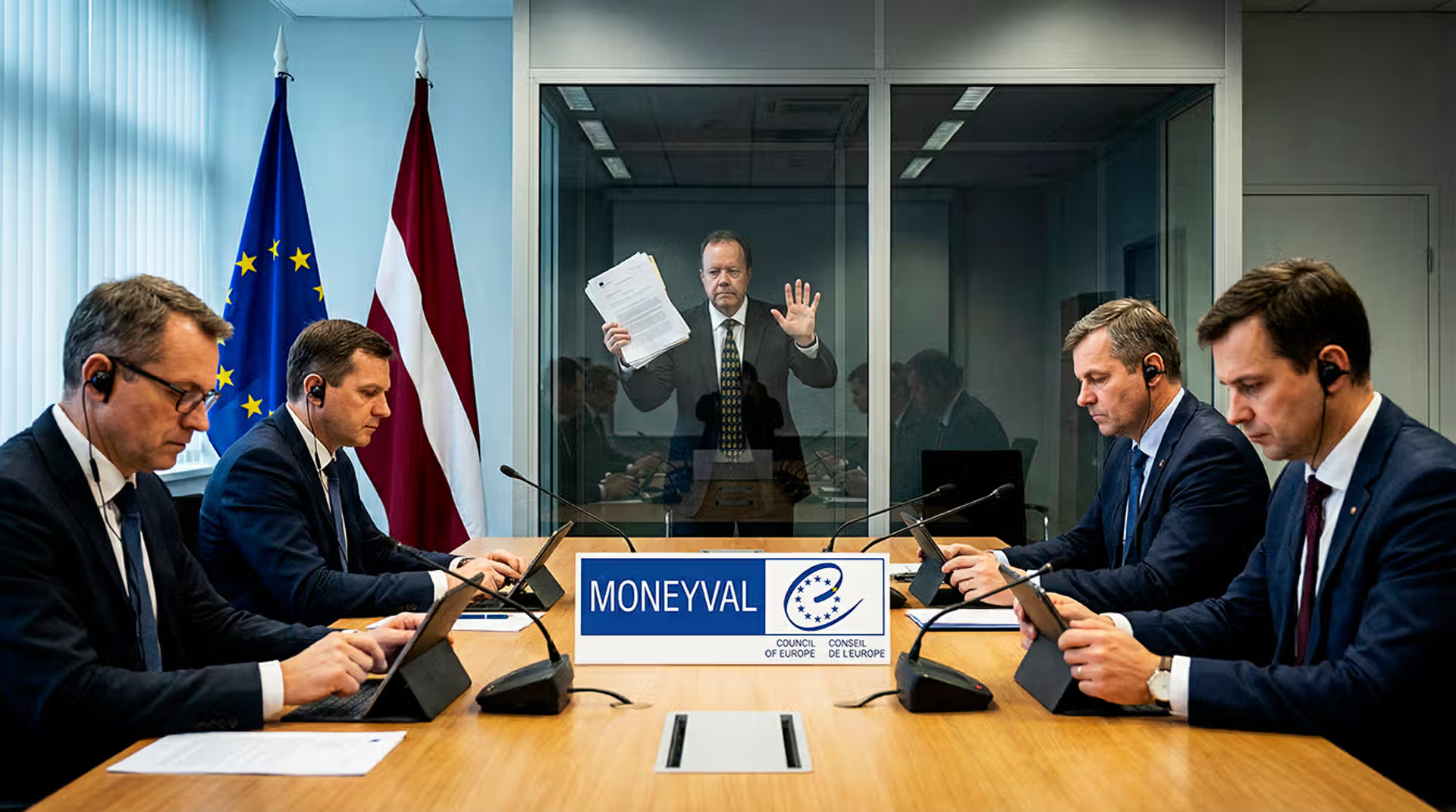
MONEYVAL ignoring a whistleblower is becoming the central controversy surrounding Latvia’s recent anti-money laundering assessment. The Council of Europe body praised Latvia for significant reforms, yet Latvian banking whistleblower John Christmas states that his attempts to communicate during the evaluation process were refused. That claim places procedural transparency at the center of the debate. Latvia’s reform narrative now faces scrutiny not only for what was measured, but for who was heard.
Table of Contents


MONEYVAL Ignoring Whistleblower In Latvia Review
MONEYVAL concluded that Latvia has strengthened its legal and institutional framework to combat money laundering and terrorist financing. The evaluation, carried out under the Council of Europe mechanism aligned with Financial Action Task Force standards, highlighted legislative amendments, enhanced supervision, and improved risk mitigation following earlier banking crises. Latvian authorities have emphasized reduced exposure to high-risk non-resident deposits and closer compliance with European Union directives.
John Christmas, a former banking executive who publicly disclosed alleged irregularities linked to Parex before its collapse, maintains that he sought engagement with the assessors. According to his public statements, he did not receive a response. His position does not dispute the existence of legislative reforms. Instead, it questions whether an evaluation can be considered complete if a whistleblower associated with Latvia’s largest banking scandal was not consulted.
MONEYVAL’s methodology, as published by the Council of Europe, relies on documentation provided by national authorities, statistical analysis, and on-site interviews with state bodies and private sector representatives. It assesses technical compliance and effectiveness indicators such as investigations, prosecutions, and asset confiscation. The framework does not explicitly detail how unsolicited whistleblower submissions are handled. In Latvia’s case, that omission has become part of the controversy.
The debate therefore shifts from the content of the reforms to the breadth of consultation. If a whistleblower asserts exclusion, observers may reasonably ask whether independent testimony was invited or considered. That procedural dimension now intersects with Latvia’s broader effort to demonstrate a clean break from its financial past.



Parex, ABLV, and The Accountability Question
Latvia’s banking sector underwent dramatic restructuring after the 2008 collapse of Parex Bank. The state intervened, separated assets, and later established Citadele Bank as part of the resolution process. Official records confirm the involvement of international investors in the privatization phase. Subsequent reforms aimed to strengthen governance and supervision across the sector.
A decade later, ABLV Bank entered voluntary liquidation after a finding by the United States Financial Crimes Enforcement Network under Section 311 of the USA PATRIOT Act, citing money laundering concerns. That development triggered further reforms, including tighter scrutiny of non-resident clients and enhanced due diligence obligations.
Government statistics indicate that non-resident deposits as a percentage of total banking assets declined significantly after 2018. The Financial Intelligence Unit expanded its analytical capacity, and supervisory authorities issued updated guidance in line with European Union AML directives. These changes formed part of the evidence considered during the evaluation.
However, John Christmas argues that institutional reform does not automatically equate to individual accountability. He has publicly stated that prominent figures connected to historic banking collapses were not criminally punished. Official court records and prosecutorial announcements provide details of investigations and proceedings, yet the perception of limited high-level convictions remains a point of contention among critics.
MONEYVAL’s mandate focuses on systemic compliance rather than adjudicating specific criminal responsibility. Nonetheless, effectiveness indicators include the pursuit of complex cases and the confiscation of illicit proceeds. Whether those indicators fully capture legacy accountability concerns is at the heart of the present debate.
EBRD, Citadele And Transparency Concerns
The restructuring of Parex led to the creation of Citadele Bank, with participation by the European Bank for Reconstruction and Development as a shareholder during the stabilization and privatization phase. Public information from the EBRD confirms its investment role in the Latvian banking sector as part of broader economic support measures.
The EBRD made announcements when it became a shareholder in Parex and again when it became a shareholder in Citadele. However, the EBRD and the Latvian government withheld an important detail. Both investments were reversible. The Latvian government guaranteed to reverse the investments at pre-negotiated prices. Under IFRS accounting standards, a reversible equity investment must be accounted for as a loan.
Christmas has been publishing articles for years that the reason why the Latvian government made these transactions, which on the surface seem irrational since it lost money paying the EBRD to act as temporary shareholder, was to cover up his whistleblowing that certain bank assets were fake. The importance of this is heightened by connections between Parex and the Putin Regime.
Official documents outline the general framework of state intervention and investor participation, yet critics argue that public understanding remains incomplete. The involvement of the EBRD is documented in its investment summaries and annual reporting. The institution’s mandate focuses on supporting market economies and financial stability. No official source has alleged misconduct by the EBRD in Latvia. The controversy instead centers on whether greater transparency would strengthen public confidence in the clean-up narrative.
For Latvia, the association with an international development bank during restructuring was presented as evidence of credibility and oversight. For critics such as Christmas, unanswered questions about historic transactions contribute to skepticism regarding the depth of reform. The tension illustrates how financial stabilization measures can be interpreted differently depending on perspective.
Reform Success Or Procedural Blind Spot
Latvia has taken measurable steps to align its AML regime with international standards. Amendments to national legislation, reinforcement of supervisory bodies, and reductions in high-risk exposure are reflected in official reports. MONEYVAL’s positive findings underscore those structural changes.
Yet the assertion that a central whistleblower was not engaged during the review introduces a procedural blind spot. The credibility of peer evaluations depends not only on data but also on perceived openness to dissenting voices. If an identified whistleblower claims exclusion, the evaluation body may face questions about outreach mechanisms.
For Latvia, the stakes are reputational. International recognition supports investor confidence and integration within European financial structures. Ongoing allegations of incomplete accountability, even if unproven, can influence public discourse.
The broader lesson extends beyond one jurisdiction. AML oversight relies on transparency, accountability, and trust in institutions. Legislative reform can be documented and measured. Engagement with independent actors is harder to quantify, yet equally significant for perception.
Latvia’s progress since the Parex and ABLV episodes is visible in official statistics and supervisory actions. At the same time, the debate surrounding MONEYVAL ignoring the whistleblower demonstrates that reform narratives remain contested. Whether future evaluation cycles incorporate clearer channels for independent submissions may shape how Latvia’s AML transformation is viewed in Europe and beyond.
Key Points
- MONEYVAL praised Latvia for strengthening its AML framework
- John Christmas states he was not engaged during the evaluation
- Latvia restructured its banking sector after the Parex and ABLV events
- EBRD participated in the stabilization and privatization of Citadele
- The controversy centers on procedural transparency and accountability
Related Links
- MONEYVAL Mutual Evaluation Report on Latvia
- Financial Intelligence Unit of Latvia Annual Report
- FinCEN Finding Regarding ABLV Bank Under Section 311
- European Bank for Reconstruction and Development Investment in Citadele
- Financial Action Task Force Methodology 2013 Updated
Other FinCrime Central Articles Written by John Christmas About Latvia and the EBRD
- Cover-Up #1: Parex Bank, Latvia, and the EBRD
- Cover-up #3: ABLV Bank, the Latvian government, FinCEN and the EBRD
- Cover-Up #4: Citadele Bank Latvia, Parex Bank’s successor, and the EBRD’s involvement
Some of FinCrime Central’s articles may have been enriched or edited with the help of AI tools. It may contain unintentional errors.
Want to promote your brand, or need some help selecting the right solution or the right advisory firm? Email us at info@fincrimecentral.com; we probably have the right contact for you.