The Singapore Police Force recently apprehended two Malaysian nationals involved in a sophisticated money laundering scheme that resulted in the seizure of significant illicit assets. These individuals allegedly acted as physical couriers for international syndicates to bypass modern digital banking safeguards and move stolen funds across the border. Authorities have noted a sharp rise in government official impersonation scams where victims are coerced into surrendering physical assets to avoid detection by automated fraud monitoring systems. This shift toward manual cash and jewelry handovers represents a tactical evolution in how criminal organizations attempt to launder proceeds while insulating their high-level leadership from direct enforcement.
Table of Contents


Cross-Border Money Laundering Tactics and Financial Courier
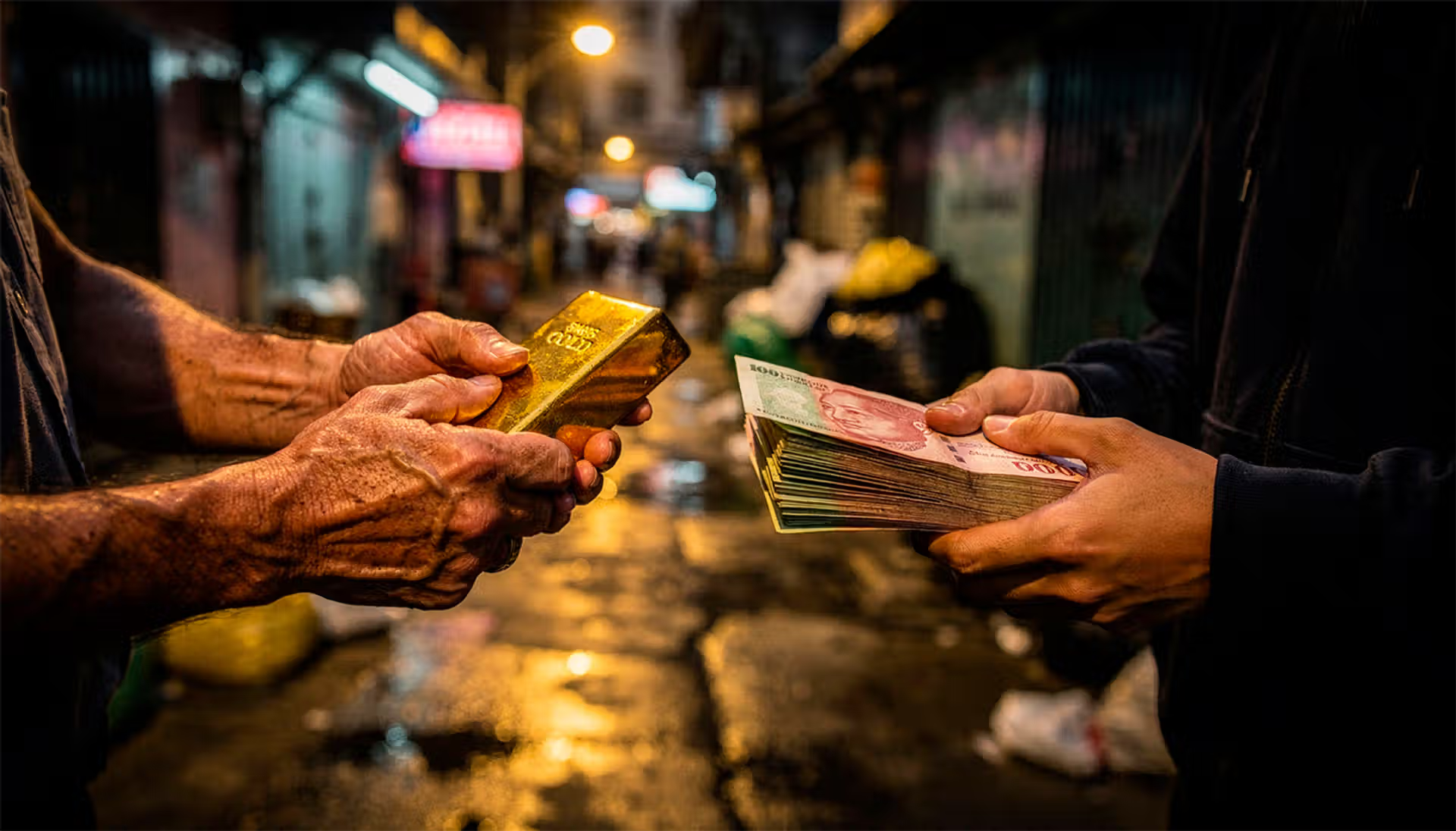
The mechanics of modern financial crime often involve a blend of high-tech deception and low-tech physical movement to evade the stringent anti-money laundering protocols implemented by major financial hubs. In recent months, the Singapore Police Force has observed a significant pivot in the operational strategies of Malaysian scam syndicates targeting residents within the city-state. As banking institutions enhance their real-time monitoring and introduce delays for suspicious digital transfers, criminal organizations have reverted to the use of human mules to facilitate the movement of criminal proceeds. These mules are often tasked with traveling across the border to collect physical cash, gold, or luxury items directly from victims who have been manipulated through elaborate social engineering schemes. By utilizing physical handovers, the syndicates effectively bypass the digital paper trail that typically triggers red flags in automated banking systems.
This method of laundering relies heavily on the speed of movement and the exploitation of jurisdictional boundaries. Once the physical assets are collected in Singapore, they are rapidly moved or converted into liquid funds that can be withdrawn from automated teller machines in Malaysia within a matter of hours. This rapid cycling of funds through various payment channels and physical couriers makes it exceptionally difficult for law enforcement to freeze the assets before they are successfully integrated into the legitimate financial system. The use of Malaysian nationals as couriers provides an additional layer of complexity, as these individuals can move between countries with relative ease, carrying illicit wealth that has not yet entered a traceable digital ledger. The Singaporean authorities have responded by increasing surveillance and cooperation with regional partners to identify these couriers before they can exit the jurisdiction with the stolen property.
The surge in these activities is evidenced by the arrest of over fifty Malaysian nationals since May 2025, all of whom were allegedly involved in the collection of cash and valuables on behalf of larger criminal entities. The legal framework surrounding these arrests focuses on participation in money laundering activities and the assistance provided to criminal syndicates. In the eyes of the law, the act of collecting and transporting these funds is a critical component of the laundering process, as it serves to obscure the origin of the wealth and facilitates its eventual placement into the offshore economy. While the couriers themselves may only receive a small fraction of the total proceeds, they bear the highest legal risk, acting as the visible front for a hidden network of organizers who remain safely tucked away in foreign jurisdictions.



The Role of Impersonation Scams in Generating Illicit Capital
At the heart of these laundering operations is the government official impersonation scam, a highly effective form of social engineering that generates vast amounts of illicit capital. Scammers often pose as members of the police force, bank employees, or regulatory officials to instill fear in their targets. Victims are frequently told that they are under investigation for serious financial crimes, such as money laundering or drug trafficking, and that they must cooperate to prove their innocence. The demand for cooperation usually involves the “safekeeping” of their funds or the appraisal of their valuables by a designated official. This psychological pressure is designed to bypass the victim’s natural skepticism, leading them to withdraw large sums of money or purchase gold bars to hand over to a waiting courier.
The scale of this problem is reflected in the dramatic increase in impersonation cases, which more than doubled within a single year. Despite a general decline in other types of fraudulent activity, the financial losses associated with these specific scams surged by over sixty percent, reaching hundreds of millions of dollars. This disparity highlights the high-value nature of impersonation scams and their central role in the regional money laundering ecosystem. Each successful scam provides the syndicate with a fresh injection of untraceable capital that must then be laundered through various channels. The preference for physical gold and jewelry is particularly notable, as these assets hold intrinsic value, are easily portable, and can be resold in secondary markets with fewer questions asked than a large wire transfer.
Criminologists suggest that this trend is a classic example of crime displacement. When the digital “front door” of the banking system is locked through better encryption and fraud detection, criminals do not simply stop their activities; they look for a “side door” or a “window” that remains vulnerable. In this case, the vulnerability is the human element. By convincing a victim to physically remove their wealth from the protection of the bank, the scammers successfully move the battleground from a monitored digital environment to an unmonitored physical one. This allows the syndicate to maintain its cash flow even in the face of aggressive technological countermeasures. The legal challenges in prosecuting these cases often involve tracing the communication back to the source, which is frequently hidden behind encrypted messaging apps and spoofed phone numbers.
Regulatory Challenges and International Law Enforcement Cooperation
Combating the rise of physical money laundering requires a multifaceted approach that goes beyond traditional banking regulations. Because the crimes involve suspects and victims across different national borders, international cooperation is essential. The collaboration between the Singapore Police Force and the Royal Malaysian Police Commercial Crime Department has been instrumental in identifying the organizers behind these courier networks. Through shared intelligence and synchronized operations, authorities have been able to map out the payment channels used by the syndicates, including the use of digital wallets and cross-border payment platforms like PayNow and YouTrip. These platforms, while providing convenience for legitimate users, are also exploited by criminals to move smaller increments of money quickly before consolidating them into larger sums for laundering.
The legal repercussions for those caught participating in these schemes are severe. In Singapore, individuals involved in the movement of criminal proceeds can be charged under the Corruption, Drug Trafficking, and Other Serious Crimes Act. This legislation is designed to strip criminals of their ill-gotten gains and provide a strong deterrent against assisting in money laundering. The challenge for regulators is to stay ahead of the evolving tactics of these syndicates, which are increasingly using cryptocurrency to further obscure the audit trail once the physical cash has been deposited into the system. Financial experts warn that we may only be seeing the tip of the iceberg, as the infrastructure supporting these criminal networks is robust and highly adaptable to new enforcement pressures.
Furthermore, the impact of these crimes extends beyond the immediate financial loss to the victims. It undermines public trust in government institutions and the security of the financial system. When citizens are afraid to answer calls from the police or their bank, the efficiency of legitimate state functions is compromised. Regulators are therefore focusing on public education campaigns alongside technical measures. By informing the public that government officials will never demand cash handovers or the purchase of gold for investigations, authorities hope to dry up the source of the syndicates’ capital. Ultimately, the fight against money laundering in the region depends on a combination of vigilant citizens, proactive banking safeguards, and seamless international police work.
Strategic Analysis of Evolving Financial Crime Trends
The persistent evolution of money laundering techniques in Southeast Asia demonstrates the resilience of organized crime in the face of modern technology. The shift back to physical currency movements suggests that while digital safeguards are effective, they are not a panacea. Criminals will always seek the path of least resistance, and currently, that path involves the physical exploitation of cross-border travel and human psychology. The data from 2025 and early 2026 shows that the volume of assets being moved through these manual networks is staggering, necessitating a reevaluation of how border security and local law enforcement interact with financial intelligence units. The integration of stolen funds into the Malaysian economy via ATM withdrawals suggests a sophisticated understanding of regional banking windows and the time required for international alerts to be processed.
In conclusion, the case of the Malaysian couriers in Singapore serves as a critical warning for the global anti-money laundering community. It proves that as digital defenses grow stronger, the threat of physical laundering becomes more acute. The recent seizures and the subsequent arrests are significant victories, but they represent a small fraction of a much larger, ongoing conflict. To effectively dismantle these syndicates, law enforcement must continue to bridge the gap between digital forensic analysis and traditional boots-on-the-ground investigative work. Only through a sustained, coordinated effort can the flow of illicit capital be stemmed, and the perpetrators at the top of these criminal hierarchies be brought to justice. The battle against money laundering is moving back to the streets, and the legal systems of the region must be prepared to meet this old threat in its new, more aggressive form.
Key Points
- Malaysian syndicates are increasingly using physical couriers to collect cash and jewelry from scam victims in Singapore to bypass digital banking safeguards.
- Government official impersonation scams have surged significantly, leading to hundreds of millions in losses and providing a primary source of illicit capital for laundering.
- Stolen funds are frequently moved across the border and withdrawn from ATMs in Malaysia within hours to obscure the financial trail and evade detection.
- Over fifty Malaysian nationals have been arrested for acting as money mules since May 2025, highlighting the scale of the regional criminal network.
- Effective enforcement requires close cooperation between Singaporean and Malaysian authorities to target both the physical couriers and the digital payment channels used.
Related Links
- Singapore Police Force Official News and Crime Advisories
- Bank Negara Malaysia Anti Money Laundering and Counter Financing of Terrorism Guidelines
- Financial Action Task Force Recommendations on Physical Currency Cross-Border Movements
- Royal Malaysian Police Commercial Crime Investigation Department Public Alerts
- Association of Banks in Singapore Scam Awareness and Security Measures
Other FinCrime Central Articles About Singapore
- Singapore Police Seize $150M in Assets from Prince TCO Laundering Network
- Singapore Law Firms Hit with Nearly $200 K in AML Enforcement
- Singapore Fines 9 Leading Financial Institutions S$27.45 Million for AML Failures
Source: South China Morning Post
Some of FinCrime Central’s articles may have been enriched or edited with the help of AI tools. It may contain unintentional errors.
Want to promote your brand, or need some help selecting the right solution or the right advisory firm? Email us at info@fincrimecentral.com; we probably have the right contact for you.