Authorities in the United Kingdom are facing renewed pressure to investigate the flow of illicit funds into the capital following reports that a sanctioned individual linked to a global criminal syndicate acquired residential assets worth 12.7 million pounds. This specific case involves Yang Jian, an associate of the Prince Group, who reportedly utilized a Cypriot passport to establish a local entity for the bulk purchase of twelve adjoining houses and seventeen parking spaces in South London. The acquisition highlights ongoing vulnerabilities in the British financial system despite the introduction of stricter transparency measures for overseas entities. Legal experts suggest that the failure to freeze these assets sooner raises significant questions about the coordination between international regulators and domestic enforcement agencies.
Table of Contents


London Real Estate Money Laundering Risks
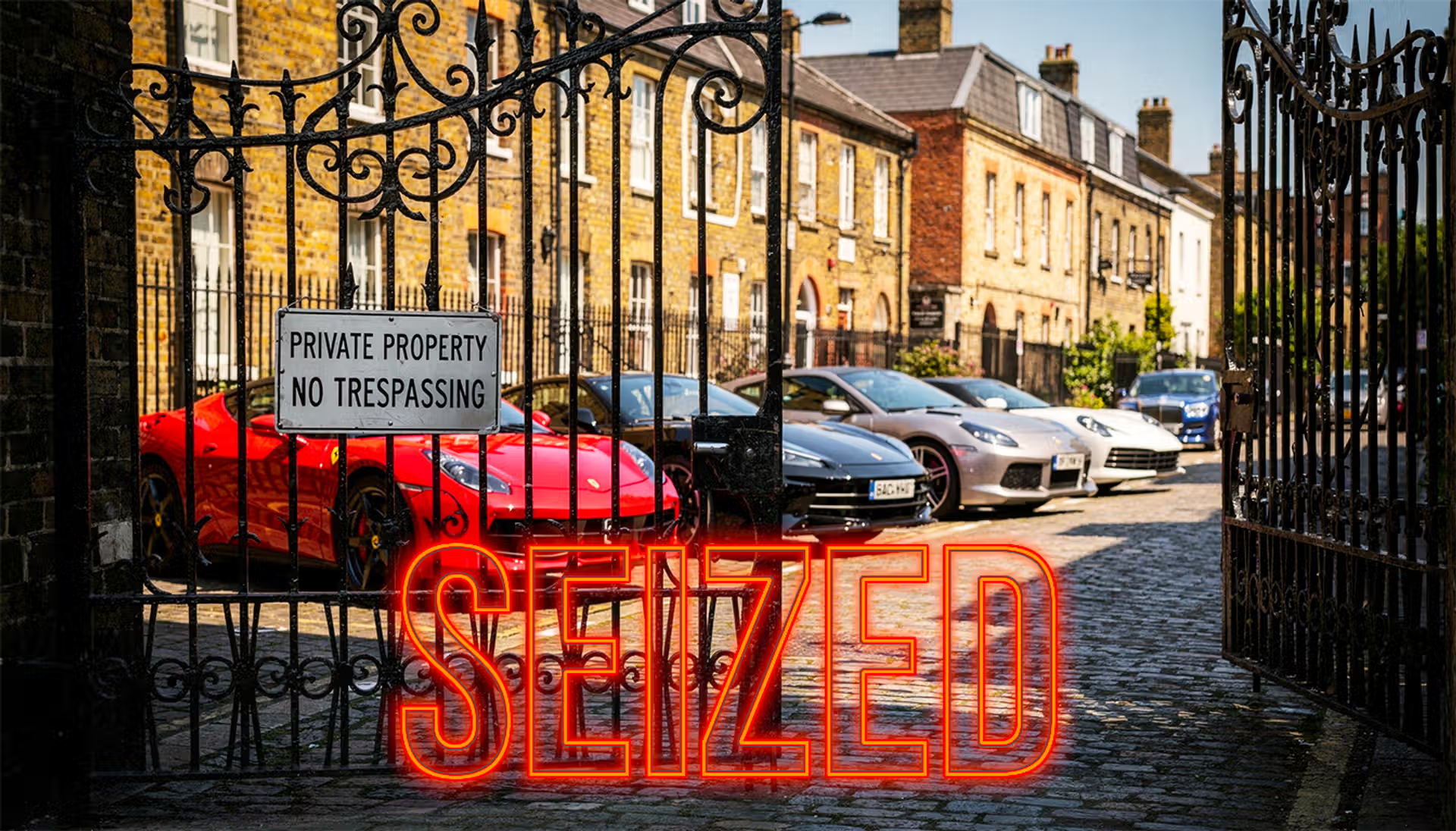
The details of the Yang Jian case provide a startling look at how easily high value property can be consolidated by those under international scrutiny. Records indicate that Jian purchased the twelve adjoining house units and seventeen parking spaces in a single transaction in November 2022 through his United Kingdom-registered company, DSRR Limited. This 12.7 million pound acquisition, roughly equivalent to 17 million dollars, was completed using a Cypriot passport obtained through an investment scheme, effectively masking his primary affiliations during the initial stages of the deal. Despite his role as a director in Grand Legend International Asset Management Co Ltd, a firm sanctioned by the United States Treasury for its ties to the Prince Group and its involvement in online fraud and human trafficking, the London transaction proceeded without immediate hindrance. Reporters visiting the site in Rotherhithe found the properties fenced off in a private gated road, standing as a quiet but powerful testament to the massive scale of undetected financial integration within the city.
The scale of the London real estate money laundering problem is often difficult to quantify, yet the ease with which high-value assets are acquired by individuals with documented ties to transnational organized crime remains a primary concern for the Treasury. In this instance, the buyer was able to consolidate a significant portion of a private road through a company that executed the multi-million pound transaction in a single day. While the United Kingdom has implemented the Register of Overseas Entities to curb the use of anonymous shell companies, the use of golden passports from jurisdictions like Cyprus continues to provide a layer of legitimacy that can bypass initial red flags during the conveyancing process. The Prince Group, which the United States has categorized as a transnational criminal organization, has allegedly been involved in diverse illicit activities ranging from human trafficking to sophisticated online fraud operations. The fact that a core member of such an entity could successfully navigate the British banking and legal systems to park seventeen million dollars in the heart of the capital suggests that the current gatekeeper model, which relies on solicitors and estate agents to report suspicious activity, may be insufficient. Regulators are now questioning whether the volume of suspicious wealth in the London market is far higher than previous estimates suggested, particularly as more associates of this specific conglomerate are discovered to hold prestige properties in major global financial hubs.



Regulatory Gaps and the Role of Overseas Entities
The integration of criminal proceeds into the legitimate economy through property remains a preferred method for syndicates due to the relative stability of the London market and the ability to hold assets through complex corporate layers. Yang Jian, who also holds Chinese citizenship, appears to have leveraged his dual nationality to facilitate international business interests that span from Palau to Hong Kong. Financial investigators note that the acquisition of twelve separate residential units under one corporate umbrella should have triggered enhanced due diligence protocols, yet the transaction proceeded without immediate intervention from the National Crime Agency. This lack of immediate friction is a common theme in high-end property deals where the source of wealth is obscured by legitimate-looking investment firms or asset management companies. The interconnected nature of the Prince Group’s leadership, including its chairman Chen Zhi and other sanctioned figures like Hu Xiaowei, demonstrates a systematic approach to diversifying criminal assets across multiple continents. By the time international sanctions were applied by the United States Treasury, the capital was already deeply embedded in the local infrastructure, making the process of recovery or forfeiture a lengthy legal challenge for the Crown Prosecution Service.
The complexity of these corporate structures often allows for a separation of legal and beneficial ownership that can take years for investigators to untangle. In the case of DSRR Limited, the entity served as a bridge between the offshore wealth of the Prince Group and the physical bricks and mortar of the London suburbs. This method of layering is designed to satisfy basic anti-money laundering checks while avoiding the deeper scrutiny that usually accompanies direct personal investments by high-risk individuals. Furthermore, the reliance on professional enablers such as formation agents and specialized law firms creates a buffer that shields the ultimate beneficiary from direct contact with regulatory bodies. Until there is a more rigorous and mandatory requirement for banks to report not just the identity but the specific origin of funds used in bulk residential purchases, the London market will likely continue to attract those seeking to insulate their wealth from the volatile environments of their home jurisdictions.
International Coordination and Asset Seizure Challenges
The global effort to dismantle the Prince Group has seen varying levels of success across different jurisdictions, with China and Singapore recently taking aggressive steps to arrest key figures and seize billions in assets. However, the lag in enforcement action within the British Isles provides a window for individuals to potentially liquidate or further obscure their holdings before formal freezes are enacted. This case mirrors other investigations into sanctioned associates who have purchased luxury apartments in London and Dubai, creating a network of high-value retreats that serve as both a store of value and a means of establishing residency. The disparity in sanction lists between the United States and the United Kingdom often complicates the ability of local financial institutions to block transactions, as seen with Yang Jian not being explicitly named on the local consolidated list at the time of the purchase. To address these inconsistencies, there is a growing call for more automated sharing of intelligence between the Five Eyes nations regarding the beneficial owners of residential portfolios. Without a more proactive approach to auditing the historical acquisitions of individuals linked to known scam operations, the integrity of the British property market remains at risk of being undermined by those seeking to wash the proceeds of human exploitation and digital theft.
Recent arrests in Cambodia and subsequent extraditions to China highlight the closing net around the Prince Group, yet the physical assets located in the West remain a separate and difficult legal hurdle. Asset forfeiture requires a high burden of proof, often needing a direct link between a specific crime and the funds used for a specific purchase. When funds are comingled in large corporate accounts or moved through various asset management firms, this link becomes increasingly opaque. The United Kingdom government has introduced Unexplained Wealth Orders to combat this, but their application remains relatively rare and legally intensive. For every successful seizure, there are likely dozens of properties that remain in the hands of foreign nationals whose wealth originates from industries under heavy suspicion. The task for the National Crime Agency is not just to identify these individuals after they have been sanctioned elsewhere, but to develop the internal intelligence capabilities to spot these patterns as they are occurring in real time.
Future Implications for Property Transparency Laws
Ensuring that the capital does not remain a safe haven for the proceeds of crime requires a fundamental shift in how the government treats the ownership of land by foreign nationals and their associated companies. The recent extradition of the Prince Group chairman to China and the indictment of dozens of associates in Taiwan signal a turning point in the global tolerance for this specific criminal enterprise, but the physical assets in South London remain a testament to the work that still needs to be done. Future legislative updates may include more stringent requirements for the verification of the source of funds at the point of sale, moving beyond simple identity checks to deep forensic audits for bulk residential purchases. The visibility of these twelve houses, fenced off yet overlooking the prosperous Canary Wharf district, serves as a stark visual reminder of the proximity between the legitimate financial world and the shadows of global money laundering. As the investigation into the broader Prince Group network continues, it is likely that more properties will be identified, further inflating the estimated value of illicit wealth currently circulating within the city.
The ultimate goal for enforcement agencies is to move from a reactive posture to one where the detection of criminal wealth occurs in real time, preventing the finalization of deeds before the illicit nature of the funds can be confirmed by international partners. This involves not only technological upgrades to the Land Registry but also a culture of skepticism among the professionals who facilitate these deals. If a company with no prior history of activity in the United Kingdom suddenly makes a multi-million-pound investment in residential housing, it should be a matter of routine for the authorities to demand a full accounting of that capital’s journey. Only by closing these gaps can the London market hope to shed its reputation as a global laundromat for transnational criminal organizations. The case of the Prince Group and its seventeen million dollar footprint is a warning that, without immediate action, the scale of the problem will only continue to grow.
Key Points
- A sanctioned member of the Prince Group acquired twelve London houses and seventeen parking spots for seventeen million dollars.
- The transaction was facilitated through a United Kingdom company using a Cypriot passport to bypass certain geographical restrictions.
- International enforcement actions in Singapore and China have led to the arrest of the group chairman and the seizure of billions.
- The case highlights a significant gap in the domestic response to individuals already flagged by the United States for criminal activity.
- Financial regulators are now questioning the total volume of laundered money within the London residential real estate sector.
Related Links
- Financial Action Task Force Annual Report on Money Laundering Trends
- United Kingdom Office of Financial Sanctions Implementation Consolidated List
- United States Treasury Department Press Release on Prince Group Sanctions
- National Crime Agency Strategic Assessment of Serious and Organised Crime
- United Kingdom Land Registry Guidance on the Register of Overseas Entities
Other FinCrime Central Articles About Real Estate Money Laundering
- OFAC $4.7M Penalty Highlights Serious Risks in Real Estate Dealings with Blocked Assets
- Dubai Extradites Belgian Crime Boss After Uncovering €8.5 Million Luxury Real Estate Money Laundering Network
- Luxury Real Estate Money Laundering Scandal Exposes Russian Links in Spain
Source: OCCRP
Some of FinCrime Central’s articles may have been enriched or edited with the help of AI tools. It may contain unintentional errors.
Want to promote your brand, or need some help selecting the right solution or the right advisory firm? Email us at info@fincrimecentral.com; we probably have the right contact for you.