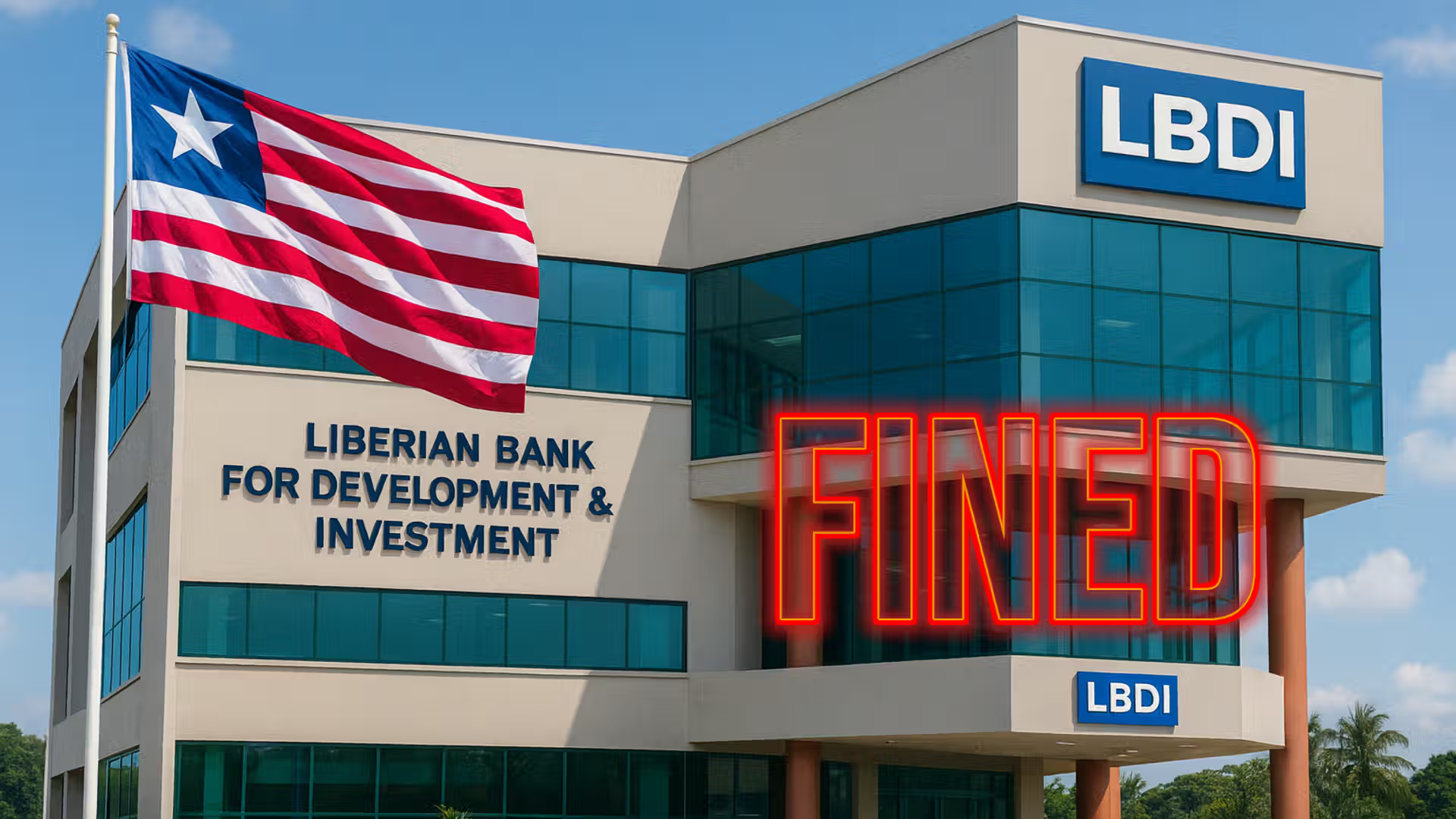
Liberia’s Financial Intelligence Agency (FIA) has fined the Liberian Bank for Development and Investment (LBDI) L$18.5 million after discovering systemic breakdowns in its anti-money-laundering and counter-terrorism-financing controls. The penalty, based on a compliance inspection conducted in December 2024, highlights how weak governance and poor risk management can turn a leading domestic bank into a high-risk gateway for illicit finance.
Table of Contents


LBDI AML Failure and Its Compliance Deficiencies
The inspection revealed that LBDI had failed to meet multiple obligations under the Liberia Anti-Money Laundering and Countering the Financing of Terrorism (AML/CFT) Act 2021. The FIA documented shortcomings that included missing board oversight, ineffective monitoring, and lack of policy approval by senior management.
The bank did not maintain a comprehensive money-laundering risk assessment program. No structured identification of customer, product, or geographic risk existed, making the institution vulnerable to criminal misuse. Moreover, internal controls did not differentiate between low- and high-risk clients, allowing politically exposed persons and offshore-linked customers to transact without enhanced scrutiny.
Customer due diligence and beneficial ownership verification were fundamentally flawed. LBDI accepted declarations without corroborating data from independent or reliable sources. This opened the door to shell companies and proxy ownership schemes designed to disguise the source of funds.
Even more concerning was the absence of suspicious transaction reporting. Despite having automated monitoring software, LBDI did not file reports with the FIA as required by Section 15.3.20 of the Act. Staff assigned to AML functions lacked training to interpret alerts, creating a gap between technology and execution.
The FIA concluded that these weaknesses were not isolated technical errors but a structural compliance collapse.
Liberia AML Enforcement and Regulatory Implications
The AML/CFT Act 2021 and Central Bank Regulations No. CBL/RSD/002/2017 impose strict obligations on financial institutions to identify and mitigate laundering risks. Section 15.3 requires institutions to establish a risk-based approach, verify beneficial ownership, monitor ongoing transactions, and report suspicious activities.
Under the Corporate Governance Regulations No. CBL/RSD/001/2012, boards and senior management bear responsibility for AML oversight. LBDI’s failure to comply represented a breach of that fiduciary duty.
The FIA ordered LBDI to pay the L$18.5 million fine into the Government of Liberia’s account at the Central Bank within ten working days and to submit proof of payment. The agency further instructed the bank to create a remediation plan by October 20 2025 and to implement full corrective measures by December 1 2025.
These directives represent Liberia’s most assertive AML enforcement action since the 2021 Act came into force. They signal to the wider sector that governance failures will no longer be tolerated as administrative oversights but treated as systemic risk events requiring public sanctions.
For global correspondent banks and investors, such action also demonstrates Liberia’s effort to align with Financial Action Task Force (FATF) and GIABA expectations, reinforcing international confidence in the country’s financial integrity.
How Weak Controls Enable Money Laundering
The deficiencies identified at LBDI are typical of the vulnerabilities exploited by money launderers worldwide. When institutions lack governance discipline and reporting rigor, illicit funds can flow unimpeded through legitimate channels.
- Placement stage – Unverified customer accounts can receive large cash deposits, remittances, or transfers from corruption or smuggling.
- Layering stage – Funds are moved through multiple accounts and cross-border transfers. Without transaction monitoring, these movements appear legitimate.
- Integration stage – Proceeds are reintroduced into the economy through real-estate purchases, loans, or investments. Absent beneficial-ownership verification, identifying the true origin becomes impossible.
In Liberia’s context, the combination of under-trained compliance staff, weak data validation, and lack of board accountability creates an ecosystem ripe for abuse. Beyond money laundering, such vulnerabilities expose institutions to terrorist financing and sanctions breaches.
The LBDI AML failure case underscores how technology alone cannot ensure compliance. Real effectiveness lies in governance culture, analytical capability, and regulatory pressure.
Strengthening Compliance After the LBDI Fine
To rebuild trust, LBDI must turn the FIA’s sanction into a reform blueprint. Several steps are essential for both the bank and the broader Liberian sector.
- Reinforce governance accountability – Boards must treat AML oversight as a standing agenda item with regular metrics and escalation procedures. Senior executives should personally approve risk assessments and policy frameworks.
- Adopt data-driven risk scoring – Each customer should be assigned a quantitative risk score, updated dynamically as transactions evolve.
- Upgrade beneficial-ownership validation – Banks must verify corporate structures through registries and independent documentation rather than self-declarations.
- Establish a continuous training program – Compliance staff must be certified, refreshed annually, and evaluated on performance metrics tied to STR quality and timeliness.
- Automate escalation and audit trails – Every alert review should generate an auditable trail showing who reviewed it, what action was taken, and why.
- Embed whistleblower protections – Internal mechanisms must empower employees to report non-compliance anonymously, ensuring early detection of internal collusion.
By implementing these reforms, LBDI could transform a regulatory setback into a model of institutional resilience. For the Liberian regulator, enforcing deadlines and public follow-ups will be crucial to maintaining momentum.
Related Links
- AML/CFT Act 2021 – Government of Liberia
- Central Bank of Liberia AML/CFT Regulations No. CBL/RSD/002/2017
- Corporate Governance Regulations No. CBL/RSD/001/2012
- GIABA Mutual Evaluation of Liberia – Regional AML Assessment
Other FinCrime Central News About Liberia
- Liberia’s Staggering L$15M AML Fines Spark Urgent Compliance Action
- Liberia Slaps Lonestar Cell MTN Mobile Money with L$25M Fine
Source: FIU Liberia
Some of FinCrime Central’s articles may have been enriched or edited with the help of AI tools. It may contain unintentional errors.
Want to promote your brand, or need some help selecting the right solution or the right advisory firm? Email us at info@fincrimecentral.com; we probably have the right contact for you.