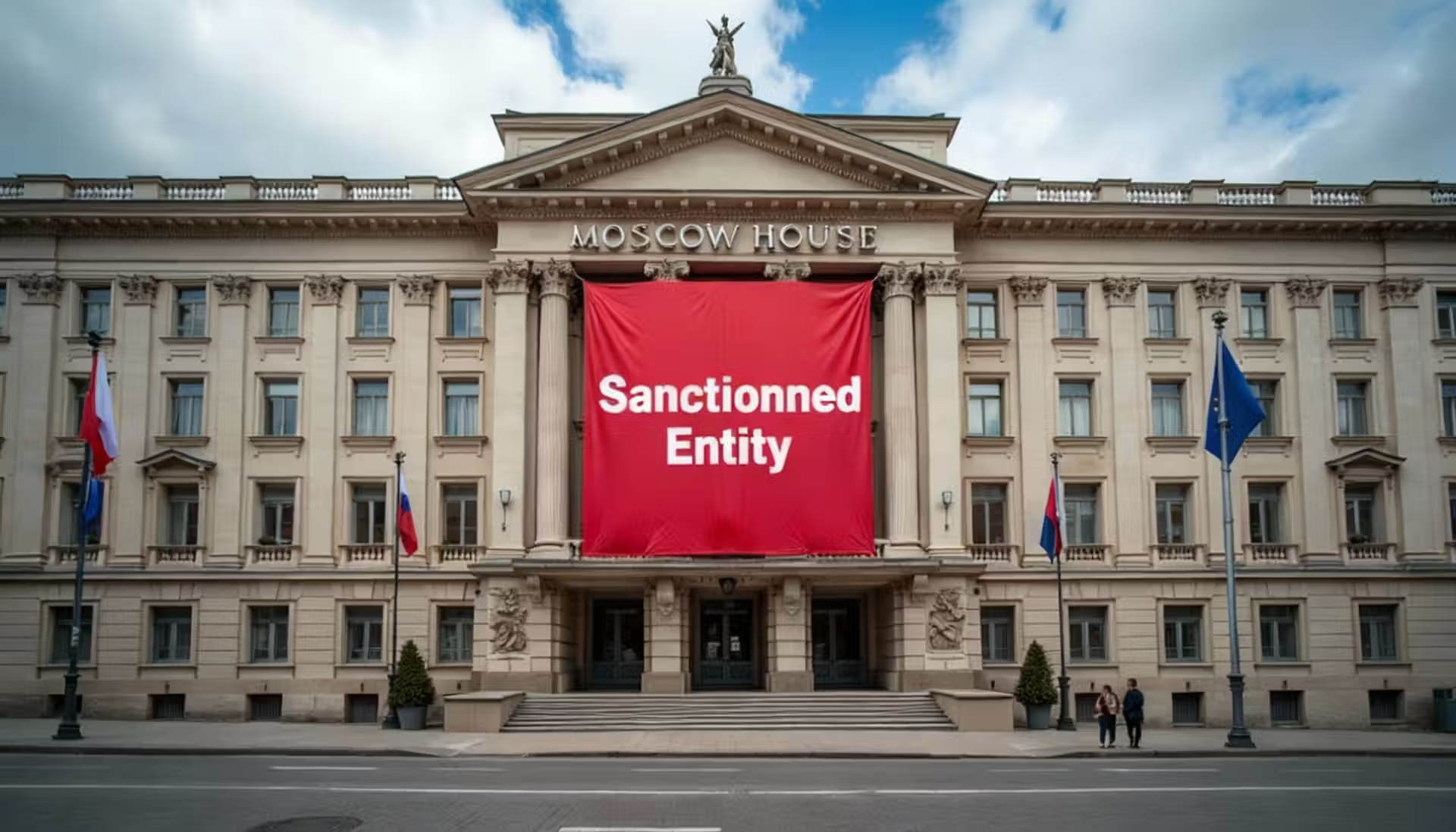
Latvia’s security authorities have escalated one of the country’s most politically charged financial crime cases — the prosecution request against two former managers of the former “Moscow House,” accused of using a sanctioned Russian property to generate income and sustain operations despite European Union restrictions. The case, now moving toward criminal proceedings, captures the complexity of sanctions enforcement in Europe and the ease with which frozen assets can be re-energised through local economic activity.
The investigation by the State Security Service (VDD) shows how the managers of the Moscow House building allegedly rented out premises and accepted services from tenants, violating asset-freeze measures imposed under the EU’s Russia sanctions regime. The episode highlights that sanctions evasion can manifest not only through shell companies or foreign transfers but also through the continued commercial use of physical property. For Latvia, which has become a key jurisdiction for the enforcement of EU sanctions against Russia, this case represents a litmus test of its ability to criminally pursue violations under Section 84(1) of its Criminal Law.


Sanctions Enforcement and the Frozen Asset Framework
The foundation of this case lies in the European Union’s restrictive measures adopted in response to Russia’s full-scale invasion of Ukraine in 2022. These measures, designed to limit the financial reach of individuals and entities supporting the Russian government, require the freezing of all funds and economic resources owned or controlled by designated persons. The prohibition covers not only direct cash holdings but also any form of economic resource — including real estate, rental income, or property-derived services.
The Moscow House, officially the representative office of the Moscow Centre for International Cooperation, fell under these measures because its parent organisation was owned by the Moscow City Property Department, which in turn operates under the authority of Moscow Mayor Sergey Sobyanin and President Vladimir Putin. Both were placed under EU sanctions in 2022, meaning any assets under their control within EU jurisdictions had to be frozen immediately.
Under this regime, a building such as Moscow House cannot lawfully be rented, leased, or used for generating financial benefit. All funds and economic resources associated with it must remain immobilised. Latvia’s VDD found, however, that the building continued to operate commercially. Tenants occupied offices, events were hosted, and income was generated through rent and maintenance fees. These activities directly violated the prohibition on using frozen assets and represented, in essence, a functioning business under the control of a sanctioned entity.
This form of breach — sometimes described as “economic activation of frozen resources” — demonstrates the challenges of practical sanctions enforcement. While financial institutions can screen payments digitally, property-based assets require constant physical oversight. In this case, the VDD determined that not only were the premises rented out, but tenants also paid bills and service costs on behalf of the property, effectively ensuring its continued operation. Each such transaction amounted to the unauthorised use of a frozen asset.
The regulatory foundation underpinning this prosecution is Latvia’s Criminal Law Section 84(1), which makes the violation of international or EU-imposed sanctions a criminal offence. The provision covers both active participation — such as arranging rentals — and passive allowance of activity that contravenes sanctions. Latvia’s adoption of this measure aligns with the EU’s broader effort to harmonise enforcement across Member States, recognising that inconsistent national enforcement undermines the effectiveness of the sanctions regime.
The Mechanism of Sanctions Evasion and Its Hidden Financial Layer
The Moscow House case illustrates how sanctions violations can blend into seemingly ordinary commercial activities. The alleged conduct followed a pattern that transformed a frozen property into an active revenue-generating asset, masking the prohibited nature of the activity beneath layers of routine transactions.
First, the building’s managers entered into lease agreements with several tenants — foundations, companies, and individuals. These agreements, while appearing legitimate, directly contravened the asset-freeze obligations. Each rent payment received was, by definition, the proceeds of an unlawful use of sanctioned property.
Second, the tenants reportedly assumed responsibility for certain building expenses, including utilities and maintenance. These service flows maintained the property’s functionality and represented a secondary channel through which value was transferred to a sanctioned entity. Such indirect support is expressly prohibited under EU rules because it allows sanctioned resources to continue providing economic benefit.
Third, once these payments entered the domestic financial system, they assumed the appearance of lawful commercial income. This stage creates the bridge between sanctions violation and potential money-laundering risk. The funds, though originating from an illegal source, were processed through normal payment channels — rental contracts, service invoices, and utility accounts. If later integrated into other transactions, they could qualify as criminal proceeds under EU anti-money-laundering definitions.
The broader danger illustrated here is that sanctions evasion schemes often evolve into laundering typologies. The proceeds of sanctions breaches can be reinvested or transferred under innocuous headings, eventually entering legitimate economic circulation. This is why AML and sanctions compliance are interdependent disciplines: a sanctions breach creates the predicate offence from which laundering risk arises.
In Latvia’s case, the VDD’s investigation sought to sever this connection early, treating the original violation — the unlawful use of the Moscow House — as a standalone criminal act before any proceeds could be further integrated. The agency’s decision to hand the case to prosecutors signals a shift from administrative enforcement toward full criminal accountability, reflecting the EU’s call for Member States to criminalise sanctions evasion in line with the proposed directive on harmonised sanctions offences.
Latvia’s Enforcement Context and the Broader EU Dimension
Latvia’s proactive stance in this case aligns with its position as one of the European Union’s most vigilant sanctions enforcers since 2022. The country has frozen hundreds of millions of euros in Russian-linked assets, strengthened cooperation between its financial intelligence and security agencies, and amended national law to close gaps in sanctions oversight. The Moscow House case therefore serves both as a national enforcement milestone and a test case for EU-wide policy evolution.
Across the EU, the enforcement of sanctions remains uneven. Some Member States treat violations as administrative matters, while others pursue full criminal prosecution. Latvia’s choice of criminal route reinforces the view that sanctions evasion should be punished as a serious economic crime rather than a regulatory infraction. It also demonstrates how non-financial assets — such as real estate, yachts, or art — can become the centre of sanctions-evasion networks.
For the EU, the effective enforcement of its restrictive measures depends on Member State implementation. The upcoming directive on harmonising the definition and penalties for sanctions violations aims to eliminate disparities by making such conduct uniformly punishable. Latvia’s approach anticipates this harmonisation, integrating sanctions enforcement with broader AML/CFT frameworks.
The case also exposes the enforcement challenge of so-called “representative offices” or “cultural centres” established by sanctioned governments or municipal bodies. These entities, often registered as non-profits, may continue operations despite sanctions because their formal ownership structures obscure state control. The Moscow House episode reveals how these setups can serve as local extensions of sanctioned authorities, maintaining activity under the cover of cultural or civic engagement.
From a financial compliance perspective, this case reinforces the need for vigilance among property managers, notaries, and banks handling rental or service payments. Every entity participating in or facilitating payments related to sanctioned property risks regulatory exposure. Financial institutions must therefore integrate property-based sanctions checks into their screening systems, ensuring that any income derived from listed entities or their controlled assets is blocked immediately.
Strategic Lessons for Sanctions and AML Professionals
The prosecution of the Moscow House managers offers several practical lessons for compliance officers, regulators, and investigative authorities. These insights extend beyond Latvia’s borders and into the broader European sanctions enforcement landscape.
1. Physical assets demand continuous monitoring.
Sanctions enforcement cannot rely solely on digital screening of financial transactions. Real-estate and property assets must be actively monitored to ensure they are not generating income. Asset freezes should include physical verification, tenant audits, and cross-checks of service contracts.
2. Economic resources extend beyond money.
The EU’s definition of “economic resources” includes property capable of generating revenue or conferring value. Renting out a building, leasing vehicles, or using sanctioned assets for events constitutes prohibited use. Compliance teams should map all resource categories, not just financial accounts.
3. Service provision can equal sanctions circumvention.
When tenants or service providers pay bills or maintain property functionality, they indirectly sustain a sanctioned entity. These indirect value transfers must be treated as potential sanctions violations, requiring immediate escalation.
4. Coordination between sanctions and AML functions.
Sanctions breaches can create laundering risks once proceeds enter the financial system. Compliance frameworks should ensure information flow between sanctions screening units and AML transaction-monitoring teams.
5. Reporting obligations and legal exposure.
Under EU and Latvian law, entities that knowingly assist in the use of frozen assets can face prosecution. Financial intermediaries should report any suspected use of sanctioned resources to national authorities.
6. National enforcement credibility matters.
Latvia’s willingness to criminally prosecute demonstrates a model of strong enforcement credibility. For the EU, consistent national application reinforces the integrity of the collective sanctions regime.
7. Predicate offences for laundering.
Although the primary crime is sanctions evasion, once illicit income is generated it becomes subject to AML reporting and potential prosecution under money-laundering statutes. Financial institutions must treat sanctions-derived proceeds as high-risk transactions.
8. Communication and awareness across sectors.
Many sanctions breaches stem from ignorance rather than malice. Outreach to landlords, property managers, and service companies is crucial to ensure understanding of asset-freeze obligations.
By integrating these lessons, regulators and institutions can strengthen their capacity to detect and prevent sanctions evasion before it develops into cross-border laundering.
Broader Implications for Sanctions Policy and Compliance
The Moscow House case illustrates that the effectiveness of sanctions depends not only on legal frameworks but also on enforcement culture. A frozen asset is not automatically an inactive asset; without supervision, it can quietly generate revenue and undermine the intent of restrictive measures. Latvia’s decision to pursue criminal prosecution underscores its commitment to closing these enforcement gaps.
For compliance professionals, the message is unambiguous: sanctions are no longer a matter for foreign-policy departments alone. They sit squarely within the realm of financial crime compliance, demanding the same analytical rigour as money-laundering prevention. The intersection of sanctions and AML obligations will only grow more significant as the EU expands its restrictive measures and strengthens penalties for breaches.
The Moscow House affair therefore becomes more than a local controversy — it marks a shift toward treating sanctions evasion as a serious criminal enterprise, one that undermines both economic integrity and geopolitical accountability. As enforcement spreads from financial institutions to real-estate management, service provision, and local business relationships, the boundaries of compliance responsibility continue to expand. For Latvia and its European partners, this case may set the precedent that sanctioned assets cannot quietly remain productive — even under the guise of cultural diplomacy or municipal representation.
Related Links
- European Union restrictive measures and sanctions enforcement framework
- Latvian Criminal Law – Section 84 on violation of international sanctions
- EU directive proposal on harmonised sanctions offences and penalties
- EU AML/CFT framework on proceeds of crime and predicate offences
Other FinCrime Central Articles About Lavia (All Written by WhistleBlower John Christmas)
- Cover-Up #1: Parex Bank, Latvia, and the EBRD
- Cover-up #3: ABLV Bank, the Latvian government, FinCEN and the EBRD
- Cover-Up #4: Citadele Bank Latvia, Parex Bank’s successor, and the EBRD’s involvement
Source: Latvian State Security Service (VDD)
Some of FinCrime Central’s articles may have been enriched or edited with the help of AI tools. It may contain unintentional errors.
Want to promote your brand, or need some help selecting the right solution or the right advisory firm? Email us at info@fincrimecentral.com; we probably have the right contact for you.