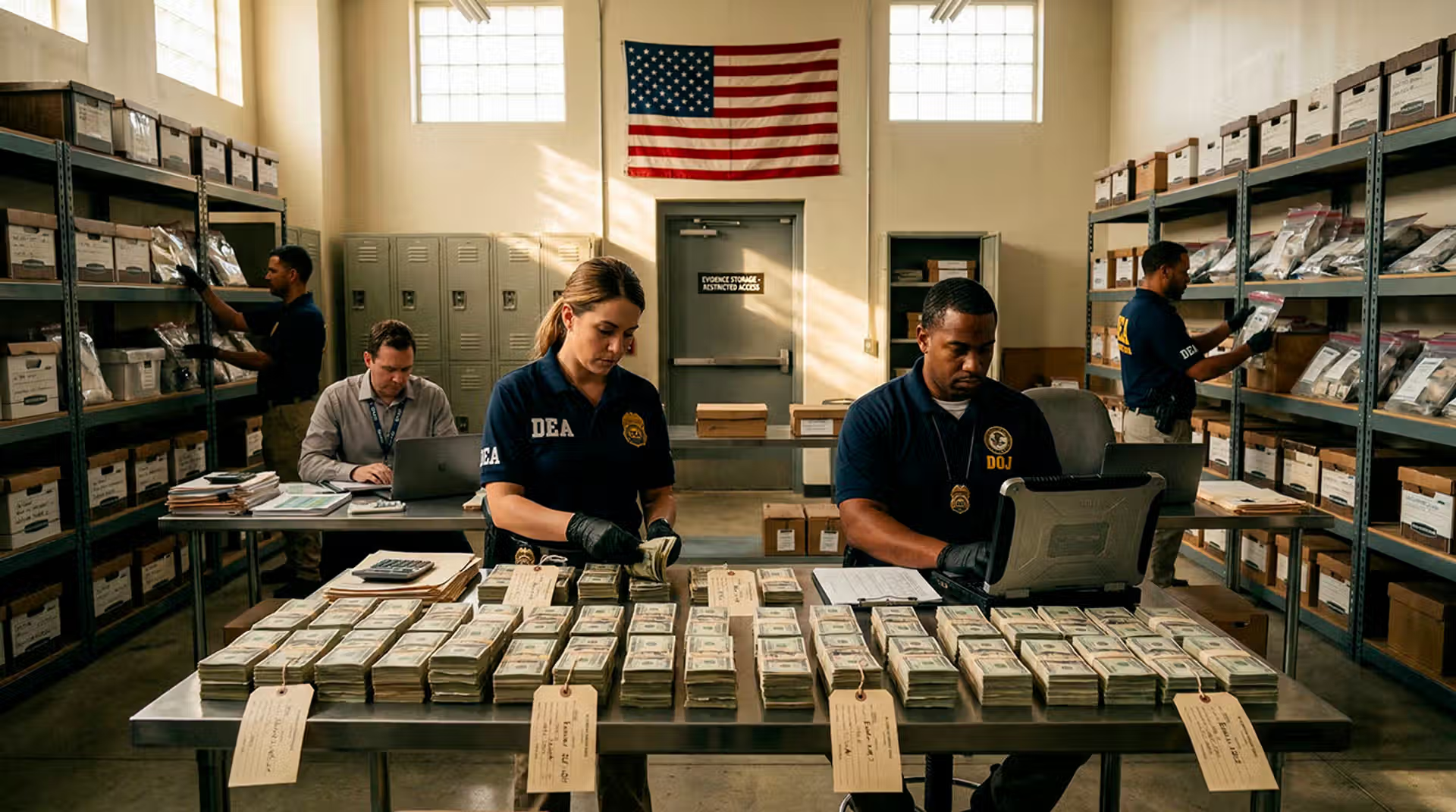
The United States Department of Justice successfully seized 14.9 million dollars linked to an international cartel money laundering operation following a long-term civil forfeiture investigation. Federal prosecutors in the Eastern District of Michigan unsealed the case recently to highlight the massive scale of trade-based financial crimes occurring within American borders. This legal action targets funds that officials claim originated from the illicit sale of narcotics and were subsequently funneled through various corporate accounts. Authorities emphasize that the forfeiture is a primary component of a broader initiative designed to dismantle the financial infrastructure of transnational criminal organizations. By removing these significant assets, the government aims to disrupt the cycle of violence and drug trafficking that plagues local communities.
Table of Contents


International Trade-Based Money Laundering
The unsealed civil lawsuit provides an intricate look at the mechanics of international trade-based money laundering and how criminal syndicates exploit legitimate commercial channels to move wealth across borders. This specific method involves the placement of bulk currency into the domestic banking system through a series of structured deposits into accounts belonging to both real businesses and shell companies. Once the cash is integrated into these accounts, the wealth is often transferred to foreign jurisdictions like Colombia by purchasing goods or services that are later sold for local currency. This process effectively converts illegal drug proceeds into clean capital while masking the true origin of the funds through the guise of international commerce. Investigators noted that the 14.9 million dollars seized in this action represent a significant victory in the ongoing effort to identify and close these systemic loopholes. The complexity of these transactions requires a high level of coordination between financial institutions and federal law enforcement agencies to track the movement of money that often appears as standard business activity. In this instance, the tracking of deposits led authorities to several import-export firms that were allegedly serving as conduits for the cartel. The use of commercial trade as a veil for laundering makes it difficult to distinguish between legal and illegal enterprise without deep forensic accounting and international cooperation. Federal officials have indicated that the investigation into these specific networks is still active as they seek to identify additional participants in the scheme.
The involvement of high-profile individuals and diverse business sectors further illustrates the pervasive nature of these laundering networks. One notable aspect of the case involves a successful Latin American musician whose accounts were flagged for receiving large cash deposits. When questioned about the source of these funds, the individual’s accountant claimed the money was generated through concert performances held in Colombia. However, federal investigators allege these deposits were actually part of the broader cartel-linked laundering operation rather than legitimate entertainment revenue. This highlight shows that even sectors as seemingly unrelated as the music industry can be leveraged by criminal organizations to move illicit wealth. Import export businesses also played a central role in this specific conspiracy by providing the necessary documentation to justify large cross-border transfers of value. By utilizing the global trade system, the cartel was able to hide the trail of its narcotics profits behind a wall of invoices and shipping manifests. The Department of Justice remains focused on these intermediaries who facilitate the movement of money, as they are essential to the survival of the cartel’s business model. This seizure serves as a warning to those in the commercial sector who might be tempted to look the other way when presented with suspicious financial activity. The government’s ability to trace these funds back to their criminal source demonstrates a growing sophistication in anti-money laundering tactics and a commitment to holding all enablers accountable.



Operation Take Back America and Cartel Suppression
This forfeiture action is a cornerstone of Operation Take Back America, which is a comprehensive nationwide strategy designed to utilize the full weight of federal resources against transnational crime. The initiative focuses on the total elimination of cartels by attacking their most vulnerable point, which is their access to liquid capital. Without the ability to move and use their profits, these organizations lose the power to fund their violent operations and expand their reach into new territories. U.S. Attorney Jerome F. Gorgon Jr. stated that drug trafficking and money laundering are inseparable elements of a single destructive machine that poisons American communities. By seizing 14.9 million dollars, the government is not just taking money, but is also actively preventing the future purchase of narcotics and the recruitment of new members into criminal networks. The Drug Enforcement Administration has been instrumental in this operation, providing the boots on the ground intelligence needed to connect the dots between street-level sales and high-level financial transactions. Special Agent in Charge Joseph O. Dixon emphasized that the pursuit of these bad actors will be relentless, regardless of the distance or the complexity of the methods they use. The goal of Operation Take Back America extends beyond simple law enforcement to include the protection of the country from human trafficking and violent crime associated with cartel activity. This case in Michigan is just one example of how federal agencies are collaborating to tighten the net around those who profit from human misery.
The legal framework used in this seizure, known as civil asset forfeiture, allows the government to take control of property or money that is suspected of being involved in a crime. This tool is particularly effective against money laundering because it targets the assets themselves rather than relying solely on the successful prosecution of individuals who may be located in foreign jurisdictions. In the 2024 filing that was recently unsealed, prosecutors detailed a pattern of suspicious activity that met the legal threshold for seizure. This includes the identification of shell companies that existed only on paper for the purpose of moving cash through the U.S. financial system. These companies often lack a physical presence or a legitimate customer base, making them obvious red flags for financial investigators. The 14.9 million dollars represents a culmination of years of work spent analyzing bank records, surveillance data, and intercepted communications. It is a testament to the persistence of the Department of Justice and its partners in the face of increasingly clever financial crimes. As the investigation continues, authorities expect to uncover more connections to the international cartel network, potentially leading to further seizures and arrests. The message from the Eastern District of Michigan is clear: the United States will not serve as a safe harbor for the proceeds of international crime. Every dollar taken from a cartel is a dollar that cannot be used to harm citizens or undermine the rule of law.
Strengthening Financial Oversight and Compliance
The success of this investigation highlights the critical importance of robust compliance programs within the banking and commercial sectors. Financial institutions serve as the first line of defense against the integration of illicit funds into the global economy. When banks fail to properly vet their clients or ignore suspicious patterns of deposits, they inadvertently become participants in the laundering process. In this case, the movement of 14.9 million dollars was eventually detected because of the specific tracking of cash deposits into the accounts of import export firms and high-net-worth individuals. This underscores the necessity for businesses to conduct thorough due diligence on their partners and to report any activity that seems inconsistent with normal operations. The Department of Justice relies heavily on the reports generated by financial institutions to launch investigations, such as the one unsealed in Detroit. As cartels become more adept at using trade based methods, the need for specialized knowledge in forensic accounting and international trade laws becomes even more vital. The government is actively working with the private sector to improve the detection of shell companies and other vehicles used for laundering. This collaborative approach is essential for staying ahead of criminal organizations that are constantly evolving their tactics to avoid detection.
Furthermore, the involvement of a Latin American musician’s accounts suggests that non-traditional sectors must also be vigilant. The entertainment industry, luxury goods market, and real estate are all areas where large sums of money can be moved with relatively little scrutiny compared to traditional banking. This case demonstrates that federal investigators are looking beyond the obvious targets and are willing to follow the money wherever it leads. The seizure of 14.9 million dollars acts as a deterrent not only to the cartels themselves but also to the professionals who might assist them, such as accountants, lawyers, and business managers. Those who facilitate the layering and integration of drug money face severe legal consequences, including the loss of their professional licenses and potential imprisonment. The Department of Justice has made it clear that being an ostrich by ignoring the obvious signs of criminal funding is not a valid legal defense. The ongoing nature of this investigation suggests that the 14.9 million dollars may only be the tip of the iceberg in terms of the total volume of money being moved through these specific channels. By publicizing this seizure, the government hopes to encourage more whistleblowers and financial professionals to come forward with information about suspicious activity.
Future Implications for Transnational Crime Prevention
Looking forward, the unsealing of this 14.9 million dollar forfeiture case marks a pivotal moment in the fight against transnational criminal organizations. It proves that the government has the capability to dismantle complex trade-based laundering schemes that were once thought to be too difficult to untangle. The success of Operation Take Back America in the Eastern District of Michigan provides a blueprint for other jurisdictions to follow in their own efforts to combat cartel influence. As law enforcement agencies continue to share intelligence and resources, the environment for money laundering in the United States will become increasingly hostile. The total elimination of these criminal networks is an ambitious goal, but one that federal authorities believe is achievable through sustained pressure on their financial lifelines. The 14.9 million dollars will eventually be processed through the forfeiture system, where it can be used to fund further law enforcement efforts and community programs designed to prevent drug abuse. This creates a virtuous cycle where the profits of crime are repurposed to fight the very problems they created.
The international community also watches these cases closely, as the methods used by the cartels in this Michigan case are often mirrored in other parts of the world. Global cooperation is essential because the money moved through U.S. accounts often ends up in other countries, fueling corruption and violence on a global scale. The Department of Justice works with international partners to ensure that there are no safe havens for stolen or laundered wealth. This case serves as a powerful reminder of the global nature of the narcotics trade and the corresponding need for a global response. The dedication shown by the U.S. Attorney’s Office and the DEA in Detroit reflects a broader commitment to upholding the integrity of the financial system. By targeting the 14.9 million dollars, authorities have struck a significant blow against the cartel’s ability to operate with impunity. As the investigation moves into its next phase, the focus will remain on identifying the high-level leaders who authorize these laundering operations. The ultimate success of these efforts will be measured not just in the millions of dollars seized, but in the lives saved and the communities restored.
Key Points
- Federal authorities unsealed a civil forfeiture case involving 14.9 million dollars linked to international cartel drug money laundering.
- The scheme utilized trade based money laundering techniques involving shell companies and import export firms to move funds to Colombia.
- A Latin American musician and various business entities were identified as participants in the structured deposit and transfer network.
- This seizure is a key component of Operation Take Back America which targets the financial infrastructure of transnational criminal organizations.
- The Department of Justice aims to disrupt cartel operations by removing the liquid capital necessary to fund narcotics trafficking and violence.
Related Links
- U.S. Department of Justice Office of Public Affairs Case Announcements
- Drug Enforcement Administration Asset Forfeiture and Money Laundering Reports
- Financial Crimes Enforcement Network Advisory on Trade-Based Money Laundering
- Financial Action Task Force Guidance on Transnational Organized Crime Financial Flows
- United States Attorney’s Office Eastern District of Michigan Press Releases
Other FinCrime Central Articles About Cartel Laundering
- From Chips to Cash: Casino-Based Money Laundering in the Sinaloa Cartel Case
- From Campaign Funds to Cartel Cash Colombia’s AML Crisis
- Billions In Cartel Proceeds Moved Through Chinese Networks Says FinCEN
Source: US DOJ
Some of FinCrime Central’s articles may have been enriched or edited with the help of AI tools. It may contain unintentional errors.
Want to promote your brand, or need some help selecting the right solution or the right advisory firm? Email us at info@fincrimecentral.com; we probably have the right contact for you.