
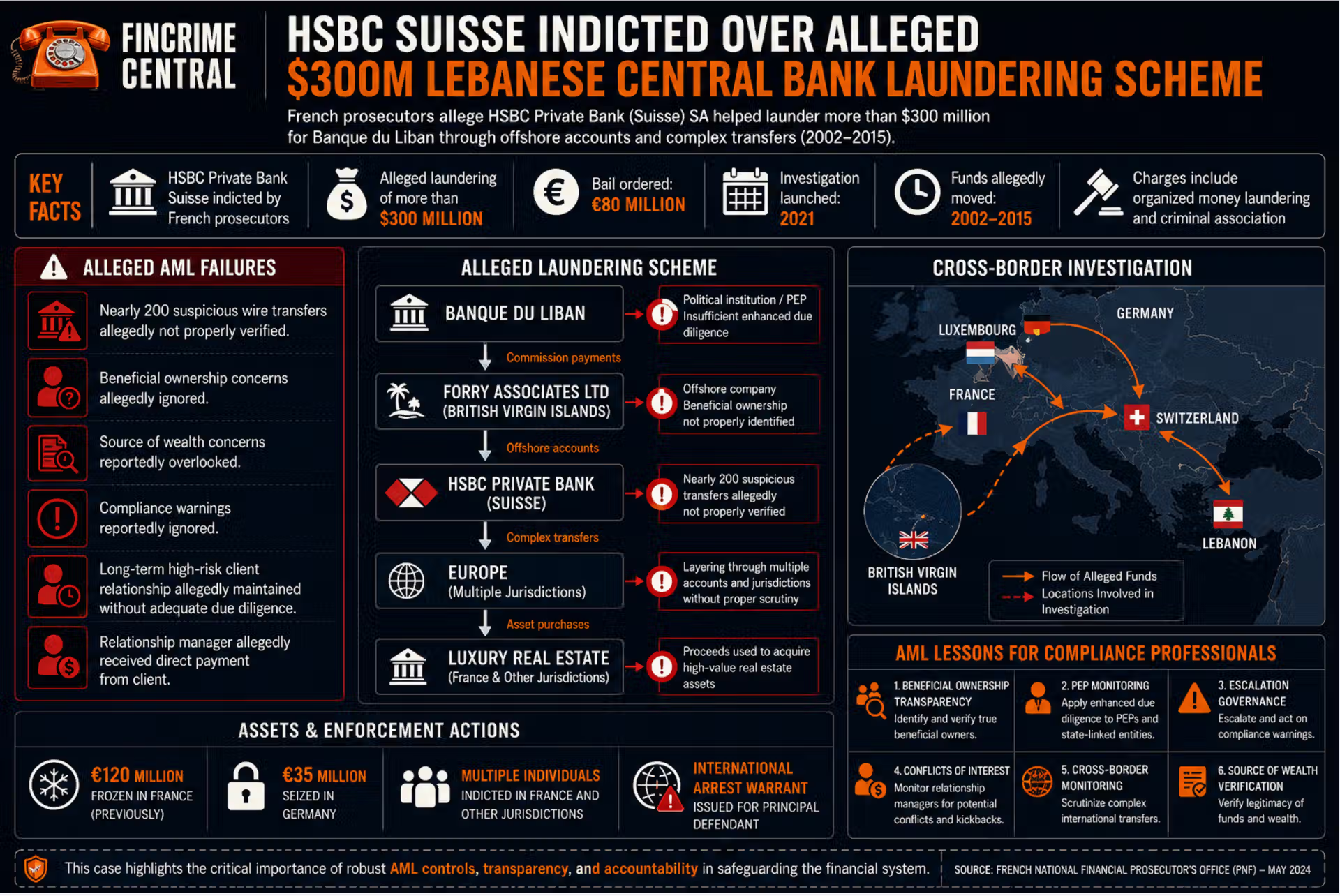
The French National Financial Prosecutor’s Office formally indicted HSBC Private Bank Suisse for organized money laundering and criminal association following an extensive two-day interrogation by financial judges. This significant development arises from a judicial investigation launched in July 2021 after legal complaints from anti-corruption organizations targeting systemic financial crimes. The Swiss subsidiary of the British banking giant faces accusations of facilitating the concealment and movement of over 300 million dollars allegedly diverted from the Lebanese central bank between 2002 and 2015. To secure potential future damages and penalties while the investigation proceeds, the judicial authorities ordered the financial institution to post an immediate bail amount of 80 million euros. The criminal investigation highlights serious alleged regulatory failures within the compliance departments of major global banking institutions handling high-risk funds.
Table of Contents



The Alleged Mechanism of Wealth Diversion and Bank Inaction
The core of the suspected illicit scheme involved commissions paid by commercial banks in Lebanon for purchasing financial products from the Banque du Liban. These financial institutions routed the commission payments through the central bank to an offshore brokerage structure known as Forry Associates Ltd. The offshore entity, registered in the British Virgin Islands in 2001, appeared to operate as an independent intermediary in the financial markets. Investigation records indicate that the governor of the central bank signed a contract with this firm in 2002 without disclosing that his brother maintained full beneficial ownership. The Swiss dollar account of the offshore corporation received these funds, which prosecutors allege then moved through highly complex corporate structures spanning multiple European jurisdictions. The financial architecture enabled the relocation of state resources back and forth between the Middle East and Europe to purchase luxury real estate properties. These real estate assets belonged to high-ranking public officials, family members, and close associates involved in the financial network.
A comprehensive fifteen-page synthesis report completed by the Central Office for the Suppression of Major Financial Delinquency details systematic compliance omissions. The investigative documentation relies heavily on judicial evidence provided by Swiss prosecutors who investigated the tracking of the underlying international transactions. According to financial investigators, the Swiss private banking entity possessed all necessary legal, regulatory, and operational mechanisms to detect and disrupt the concealment process. The banking institution had access to transactional records that clearly demonstrated anomalous patterns regarding the source and destination of the funds. The regulatory findings allege that the bank effectively validated an opaque system of financial flows by failing to implement basic due diligence. The organizational structure permitted high-profile clients to accumulate massive personal wealth using funds derived entirely from the offshore broker entity.
The criminal indictment challenges multiple operational layers of the financial institution, extending from back office personnel to executive management structures. Back office departments repeatedly failed to execute required regulatory verifications by contacting the beneficial owner directly to validate nearly two hundred suspicious wire transfers. These questionable transactions moved significant capital from European accounts back to commercial bank accounts located within the Lebanese financial sector. Senior executive management cannot legally cite communication failures or silence from internal compliance teams to justify their prolonged institutional inaction. The judicial record demonstrates that the bank maintained a passive posture despite visible indicators of large-scale capital diversion from a sovereign central bank. This passivity allegedly allowed the integration of illicit funds into legitimate European asset markets over a period exceeding a decade.




Compliance Failure Allegations and Cross-Border Investigations
Internal investigations conducted by non-governmental organizations revealed specific instances where warnings raised by internal compliance departments were completely ignored by management. A relationship manager handling the accounts of the offshore broker and its beneficial owner received extraordinary salary increases between 2000 and 2020. Financial investigators suggest these substantial compensation increases indicate institutional pressure to retain high net worth clients regardless of anti-money laundering standards. Transaction audits uncovered a personal wire transfer of nearly seventeen thousand dollars sent directly to the relationship manager from the client in 2009. This direct financial link between the bank employee and the client further compromised the independence required for effective transaction monitoring. The institutional framework prioritized profitability and asset under management metrics over international regulatory obligations regarding politically exposed persons.
The enforcement actions against the banking group extend well beyond the borders of the French judicial system into multiple European financial centers. The Swiss Financial Market Supervisory Authority imposed a severe regulatory sanction against the bank for profound compliance failures related to these specific accounts. Swiss prosecutors also initiated a distinct criminal investigation targeting the private bank for severe organizational deficiencies that permitted money laundering. This specific criminal case names a senior banking supervisor who directly managed the commercial relationship with the offshore firm and its operators. The supervisor faces charges of aggravated money laundering for active participation in concealing the origin of the allegedly stolen funds. The multi-jurisdictional nature of the prosecution reflects the international strategy used by the perpetrators to scatter financial records across diverse regulatory environments.
The Grand Duchy of Luxembourg represents another critical theater in the European legal effort to address the financial ramifications of this case. Judicial authorities in Luxembourg indicted a former relationship manager who administered accounts for the central bank governor between 2007 and 2008. Evidence shows the manager received a personal payment of four hundred thirty thousand dollars from the governor into a private Lebanese account. This substantial sum remained entirely undisclosed to subsequent banking employers, where the manager continued to oversee the financial portfolio of the official. Investigating magistrates noted that this personal income represented approximately one-third of the total earnings of the manager during that period. The judicial interrogation questioned the true loyalty of the employee, suggesting the manager worked effectively for the client rather than the financial institution.


Judicial Accountability and Institutional Impact
The international judicial network has coordinated efforts to trace, freeze, and seize assets related to the individuals indicted in the main case. German judicial authorities announced the seizure of thirty-five million euros in real estate and financial assets linked directly to the main suspects. This enforcement action follows a prior coordinated asset freeze totaling one hundred twenty million euros enacted by France, Germany, and Luxembourg. In France, the prosecution involves at least ten individuals, including family members, close associates, and prominent figures from the Middle East finance sector. The Lebanese central bank recently obtained civil party status in the French proceedings, appearing before investigating magistrates to provide institutional testimony. The current leadership of the central bank characterized the offshore broker company as an artificial entity designed solely to drain resources.
The present leadership of the central bank emphasized the critical importance of the European judicial procedures for the integrity of the domestic financial system. The primary victims of the complex diversion scheme include the central bank institution itself and the broader population of domestic bank depositors. The sovereign institution pledged total cooperation with European magistrates to ensure the transmission of relevant financial data and accounting books. Representatives from anti-corruption groups state that the indictment of the intermediary bank represents a critical victory against systemic financial impunity. The legal strategy aims to hold global financial facilitators accountable for providing the infrastructure necessary to hide stolen public assets. The prosecution underscores that international banks cannot profit from corrupt funds while shielding themselves behind corporate structures or compliance oversights.
Legal experts tracking international financial crime emphasize that the specific charge of criminal association carries profound implications for the banking sector. This specific designation indicates a level of cooperation between the financial institution and the primary defendants that goes beyond mere negligence. The substantial bail amount imposed by the French courts reflects the extreme gravity of the criminal charges and the scale of funds involved. The main defendant has been subject to an international arrest warrant issued by French judicial authorities since May 2023. Although domestic extradition laws may prevent physical transfer to Paris for trial, the indictment of the bank ensures a trial will occur. The presence of a major global bank as a defendant provides a central focus for judicial accountability regarding transnational corruption.
Financial Crime Typologies for Compliance Professionals
- Misuse of Offshore Brokerage Arrangements; Setting up intermediary firms in jurisdictions with high corporate secrecy to receive unjustified commissions from state entities.
- Undisclosed Beneficial Ownership by Politically Exposed Persons; Structuring contracts where public officials hide their familial or personal relationships with commercial service providers.
- Reciprocal Personal Payments to Bank Staff; Direct transfers of capital from client accounts to personal accounts of relationship managers under the guise of gifts.
- Circular Capital Movements Between Jurisdictions: Routing funds from a central origin through European private banks and back to domestic accounts to obfuscate paths.
- Failure to Review Repeated Automated Transactions; Approving hundreds of high-value wire transfers based solely on verbal confirmations from the account holder without documentation.
Key Points
- The French judiciary indicted HSBC Private Bank Suisse for organized money laundering and criminal association involving a suspected 300 million dollars.
- The banking institution must pay a security bail bond of 80 million euros during the active judicial investigation phase.
- Investigating magistrates found that the bank possessed the operational tools to detect the fraud but allegedly permitted the concealment.
- The underlying fraud utilized an offshore broker company in the British Virgin Islands to siphon commissions from the Lebanese central bank.
- Multi-jurisdictional enforcement actions have resulted in asset seizures and individual indictments across France, Switzerland, Germany, and Luxembourg.
Related Links
- Autorité de Contrôle Prudentiel et de Résolution (ACPR) Enforcement Decisions
- Financial Action Task Force Guidance on Politically Exposed Persons
- Swiss Financial Market Supervisory Authority Press Releases
- French National Financial Prosecutor’s Office Judicial Announcements
- Egmont Group of Financial Intelligence Units Public Summaries
- Organized money laundering
Other FinCrime Central Articles About HSBC
- US Judge Orders HSBC, Standard Chartered To Release Bank Records in Iran Sanctions Case
- Journalists Denied Transparency Into HSBC Anti-Money Laundering Report
- Swiss and French Authorities Target HSBC Over $300 Million Lebanese Funds Scandal
Source: Le Monde
Some of FinCrime Central’s articles may have been enriched or edited with the help of AI tools. It may contain unintentional errors.
Want to promote your brand, or need some help selecting the right solution or the right advisory firm? Email us at info@fincrimecentral.com; we probably have the right contact for you.