British American Tobacco recently encountered a significant legal challenge as more than 100 shareholders filed a lawsuit in the London High Court following a 635 million dollar settlement with United States authorities. This litigation centers on allegations that the company failed to provide timely and accurate market disclosures regarding its historical business operations in North Korea, which involved systemic breaches of international sanctions. The claimants suggest that the organization withheld critical information for over a decade, leading to inflated share prices that eventually collapsed when the true scale of the regulatory misconduct was revealed in 2023. By addressing these claims in the first sentence of this analysis, it becomes clear that the financial penalty and the subsequent private litigation are distinct yet related legal hurdles. This case serves as a landmark example of how anti-money laundering failures and sanctions evasions can trigger a cascade of legal liabilities that threaten both the capital and the reputation of a multinational entity.
Table of Contents


BAT Sanctions Compliance Failures
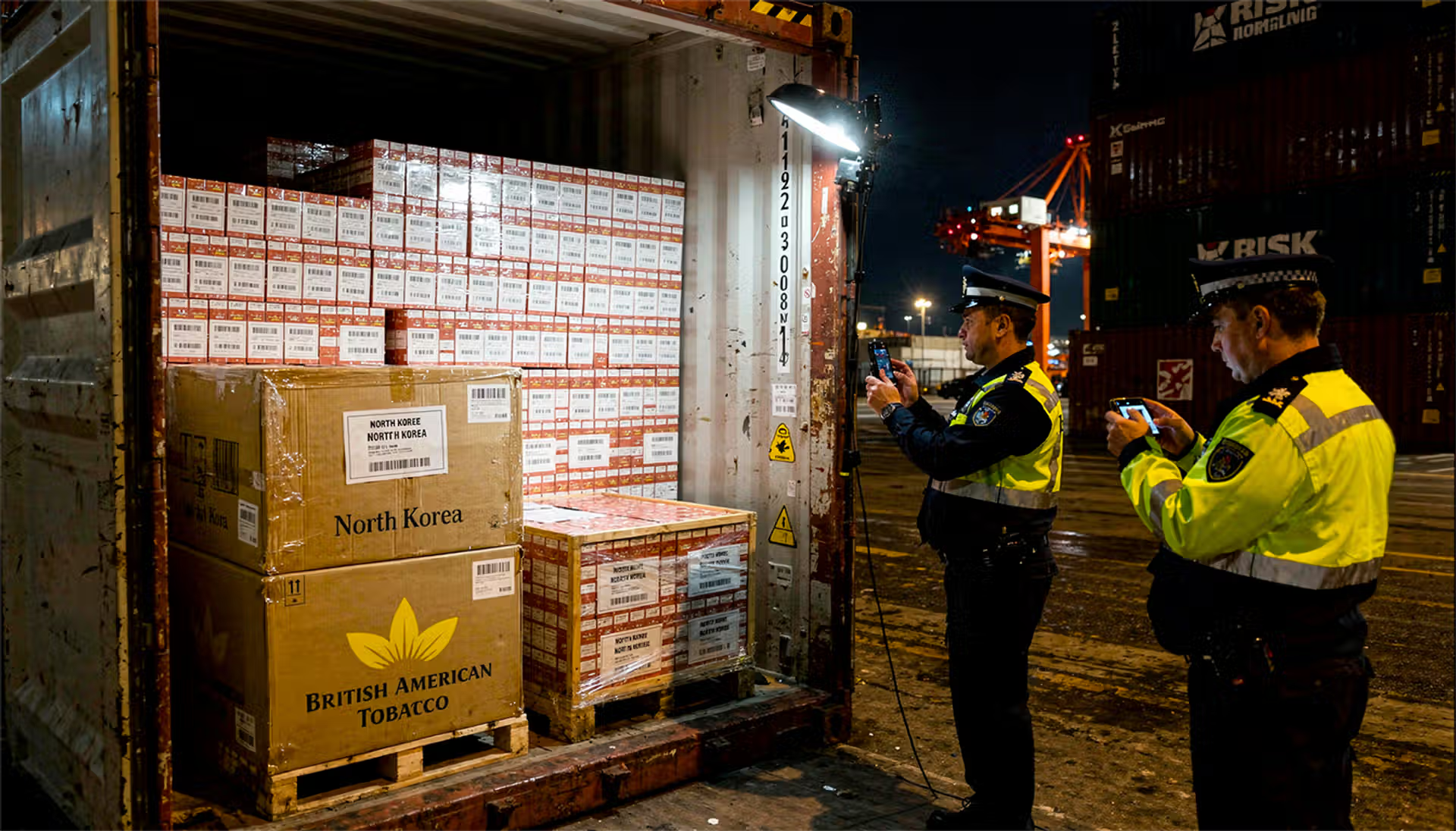
The genesis of the record-breaking 635 million dollar penalty lies in an intricate scheme to bypass United States sanctions through a Singaporean subsidiary. For a period spanning from 2007 to 2017, the organization facilitated the sale of tobacco products to North Korea by utilizing a sophisticated network of front companies and opaque banking channels. These actions were designed to mask the involvement of a sanctioned regime and ensure the continued flow of profits into the corporate accounts. According to official documents from the Department of Justice, the conspiracy involved the use of third-party intermediaries who processed payments through the United States financial system, effectively tricking banks into handling prohibited transactions. This level of deception highlights a profound failure in the internal controls and ethical oversight of the firm during the decade in question. The subsequent admission of bank fraud and the record-breaking fine reflect the severity with which regulators view the intentional circumvention of global security protocols. Furthermore, the fact that the company publicly claimed to have exited the North Korean market in 2007 while continuing operations through proxies has become a central point of contention in the current shareholder lawsuit. Investors argue that this lack of transparency constituted a material omission that misled the market and caused substantial financial harm to those who held positions in the company.



Mechanisms of Illicit Financial Structuring
To understand the money laundering implications of this case, one must examine the specific mechanisms used to move hundreds of millions of dollars across borders without detection. The scheme relied on the layering of transactions through various jurisdictions, including Singapore and China, to create distance between the parent company and the North Korean state-owned entities. By employing shell companies that appeared to have no direct link to the tobacco industry or the sanctioned state, the participants were able to utilize correspondent banking services in the United States. This allowed for the conversion of local currency into dollars, which is a critical component of international trade but is strictly regulated when it involves prohibited nations. The forensic investigation revealed that over 400 million dollars was processed through these illicit channels, demonstrating the massive scale of the operation. This process mirrors the classic stages of money laundering, where illegal proceeds are integrated into the legitimate financial stream to hide their true origin. The failure of the internal compliance departments to flag these high-risk activities suggests that either the monitoring systems were bypassed or that there was a systemic lack of due diligence regarding third-party partnerships. In the current regulatory environment, such failures are no longer viewed as mere administrative oversights but as criminal conspiracies that warrant the highest level of enforcement action.
Transparency and Market Disclosure Obligations
The ongoing litigation in London brings to the forefront the legal obligations of publicly traded companies to inform their shareholders about material risks. The claimants, represented by law firm Fox Williams, argue that the failure to disclose the ongoing North Korean operations between 2007 and 2023 deprived investors of the ability to accurately assess the value of their holdings. Under the Financial Services and Markets Act 2000, companies are required to publish information that could reasonably be expected to affect their share price. The revelation of a 635 million dollar fine and the admission of criminal conduct certainly qualify as such information. When the settlement was finally made public in April 2023, the stock experienced significant volatility, leading to quantifiable losses for many long-term investors. This case highlights a growing trend of shareholder activism where investors use the court system to hold management accountable for compliance failures. The argument is that the company prioritized short-term profits from a sanctioned market over the long term stability and legal integrity of the firm. By not being transparent about the risks associated with the North Korean business, the organization created a bubble of misinformation that eventually burst with devastating consequences. This legal battle will likely set a precedent for how future sanctions breaches are handled in the United Kingdom, specifically regarding the timeline and depth of required disclosures.
Corporate Accountability in a Sanctioned World
The broader implications of this case extend to every multinational corporation operating in a complex geopolitical landscape. The 635 million dollar settlement is not just a one-time payment but a signal that the cost of non-compliance is rising exponentially. Regulators are increasingly using data analytics and international cooperation to uncover hidden financial networks, making it nearly impossible for illicit schemes to remain buried forever. For the tobacco industry, which has historically faced intense scrutiny, this case adds a new layer of risk related to international security and the funding of prohibited regimes. The Department of Justice specifically noted that the profits from these tobacco sales were often used to support the development of weapons programs in North Korea, creating a direct link between corporate misconduct and global instability. This realization has led to further civil lawsuits from victims of terrorism who claim that the company’s financial support of the regime enabled deadly attacks. While the 635 million dollar fine was a government enforcement action, these private lawsuits represent a different kind of threat that can last for decades. Corporate governance must now evolve to include proactive risk assessments that go beyond simple check-the-box exercises. Organizations must foster a culture of integrity where employees feel empowered to report suspicious activities without fear of retaliation. Only through total transparency and rigorous adherence to international law can companies hope to avoid the catastrophic legal and financial fallout seen in this instance.
The Future of Regulatory Compliance
As the High Court in London prepares to hear the arguments from the frustrated shareholders, the importance of robust anti-money laundering frameworks has never been clearer. The case demonstrates that even a seemingly small subsidiary can expose a massive parent company to global liability if its operations are not properly monitored. Moving forward, the industry will likely see a push for more granular reporting on the ultimate beneficial owners of all third-party partners, especially those located in high risk jurisdictions. The use of advanced technology to screen transactions in real time is becoming a necessity rather than an option. Furthermore, the 635 million dollar fine will serve as a permanent black mark on the company’s record, affecting its future credit ratings and investment attractiveness. The lessons learned from this disaster are being studied by compliance officers worldwide as a cautionary tale of what happens when profit is placed above the rule of law. The final resolution of the shareholder lawsuit will determine the extent to which investors can recover their losses, but the damage to the company’s reputation is already well documented. In an era where ESG factors are increasingly important to the market, a failure of this magnitude in governance and social responsibility is particularly damaging. The global financial system depends on the honesty and transparency of its participants, and cases like this remind us why strict enforcement is necessary to maintain that trust.
Key Points
- British American Tobacco agreed to a 635 million dollar settlement in 2023 following a subsidiary’s admission of sanctions violations and bank fraud.
- A group of more than 100 shareholders filed a lawsuit in London in 2026 alleging the company had misled the market about its North Korean business for sixteen years.
- The illicit scheme involved a complex network of front companies and intermediaries used to process over 400 million dollars through the United States banking system.
- This case underscores the high financial and reputational stakes involved in corporate compliance and the increasing trend of investor-led litigation following regulatory penalties.
Related Links
- US Department of Justice Press Release BAT Settlement
- Office of Foreign Assets Control North Korea Sanctions Information
- UK Financial Conduct Authority Market Disclosure Rules
- Financial Action Task Force Guidance on Sanctions Evasion
- London High Court Database of Civil Claims
Other FinCrime Central Related Articles About Tobacco-Related Cases
- AUSTRAC Strikes at $83 Million Laundering from Illicit Tobacco
- UK’s Crackdown Seizes £10.7M In Dirty Cash From High Street Crime
Source: Reuters
Some of FinCrime Central’s articles may have been enriched or edited with the help of AI tools. It may contain unintentional errors.
Want to promote your brand, or need some help selecting the right solution or the right advisory firm? Email us at info@fincrimecentral.com; we probably have the right contact for you.